Not all bright stars are created equal — their apparent brightness depends on both their true luminosity and their distance from Earth. Some stars only dazzle because they’re nearby, while others shine with the power of millions of Suns across vast interstellar distances.
Many of the stars that dominate our skies are actually multiple-star systems, where two or more suns orbit each other and appear as one brilliant point of light. Famous examples include Alpha Centauri, Capella, Acrux, and Castor.
Take on the Brightest Stars Challenge — observe or photograph the 50 brightest stars in our night sky. From brilliant Sirius to fiery Betelgeuse, each one offers a unique opportunity for backyard observing and astrophotography.
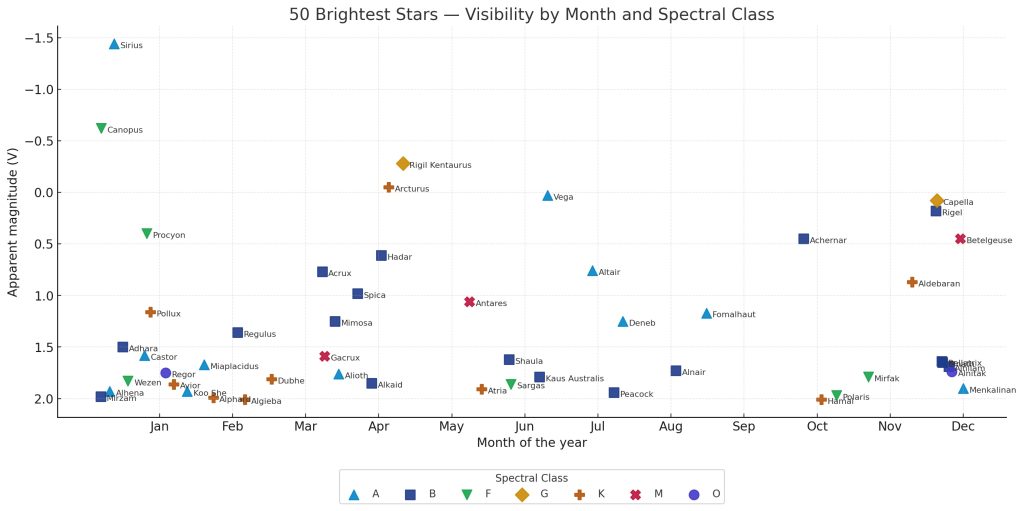
🌈 Spectral Classes & Chart Explained
⭐ Spectral Class
Stars are grouped by temperature and color using the sequence O, B, A, F, G, K, M — from hottest to coolest:
- O – Blue, extremely hot and massive stars
- B – Blue-white, very luminous stars
- A – White, like Vega
- F – Yellow-white, slightly hotter than the Sun
- G – Yellow, like our Sun
- K – Orange, cooler than the Sun
- M – Red, cool stars like Betelgeuse
💡 Tip: Use the interactive tool to see which stars are actually highest above your horizon at your latitude; some never rise from certain locations.
Bright Star Sky Planner
The interactive tool below reveals which of the 50 brightest stars are visible from your location throughout the year — perfect for planning visual observations or astrophotography sessions. It shows which stars are highest above your horizon each month, based on your latitude. Because of Earth’s curvature and your position on the globe, visibility varies: some stars never rise above your horizon, while others can be seen year-round.
Brightest Stars — What’s Up Around Midnight
Pick your latitude and month to see the 50 brightest stars that actually rise within ±6 h of local midnight. Sorted by altitude at midnight, plus a compact night chart for the Top 12.
Night chart
(Top 12 by altitude at midnight) — X: hours from midnight · Y: altitude (°)Stars rising sometime tonight — sorted by altitude at midnight ()
| # | Name | Bayer/Flam. | Vmag | Dist (ly) | Spec | RA (h) | Dec (°) | Alt @ Mid (°) | Max Alt (°) |
|---|
And finally, here’s the list of the 50 brightest stars, ordered from brightest to faintest:
| # | Star | Bayer | Spectral | Vmag | Dist (ly) | RA | Dec | Const |
|---|
🔠 Bayer Designations Explained
The Bayer designation names stars using a Greek letter followed by the Latin abbreviation of their constellation. The letter typically indicates brightness order within that constellation — though not always perfectly.
- α (Alpha) Centauri – brightest star in Centaurus
- β (Beta) Orionis – second brightest star in Orion (Rigel)
- γ (Gamma) Velorum – third brightest star in Vela
💡 Example: “α (Alpha)” usually marks the brightest star, while “β (Beta)” is the next brightest.