Comet 3I/ATLAS is only the third confirmed interstellar comet we’ve ever seen, after 1I/Oumuamua and 2I/Borisov. It moves through our solar system at incredible speeds of around 250.000 km/h. Even though it was faint (about magnitude 10) and far away, I managed to photograph 3I/ATLAS on 21 November 2025 between 05:00 and sunrise from Utrecht, the Netherlands, using my amateur telescope. In this blog, I share how I imaged it, and why this rare interstellar visitor is scientifically so interesting.
Over the past few months, both mainstream media and NASA have been generating a surprising amount of excitement around Comet 3I/ATLAS. And to be fair, this enthusiasm is not completely misplaced. This object is only the third interstellar comet ever detected passing through our solar system, following:
- 1I/ʻOumuamua (2017)
- 2I/Borisov (2019)
We see countless comets from within our own solar system — from the Kuiper Belt or the Oort Cloud — but a comet that originated around another star? That remains a very rare treat. 3I/ATLAS recently passed perihelion (its closest point to the sun) at an incredible speed of 69 km/s, or 250,000 km/h. It will make its closest approach to Earth on 19 December 2025, but even then it will still be 270 million kilometers, or 1.8 AU away. That’s nearly twice the Earth–Sun distance, so there is absolutely no impact risk.
3I/ATLAS – Clearing up some confusion
A number of news outlets reported that “Comet ATLAS” had broken apart — which did happen — but that was not the interstellar comet. The breakup involved C/2025 K1 ATLAS, a completely unrelated comet discovered by the same survey. ATLAS stands for the Asteroid Terrestrial-impact Last Alert System, funded by NASA and run by the University of Hawai‘i. It uses four automated telescopes that scan the sky every night.
There was also confusion surrounding C/2025 V1 Borisov, which some headlines mixed up with 2I/Borisov, the interstellar comet discovered in 2019. The new comet is not interstellar.
If you ever want a clear overview of the brightest comets currently visible, you can use my real-time planets and comets finder on my website. It pulls live data from the COBS database and NASA’s JPL/Horizons system, so you always know which comets are currently in the night sky to observe with a telescope and/or the naked eye.
My Capture of 3I/ATLAS
With 3I/Atlas close to Earth, I decided to capture the comet myself in late November using my 80mm refractor with a 600mm focal length. After entering the RA/Dec coordinates into my polar-aligned equatorial mount and hitting “GoTo,” the telescope slewed directly to the correct patch of sky. 3I/ATLAS appeared right in the center of my camera’s field of view.
With the mount tracking in EQ mode, I took 60-second exposures and tracked the comet for about 90 minutes in the early morning sky from Utrecht, the Netherlands. The final image is a stack of sixty 1-minute exposures — so that’s a total of one hour exposure time. I processed it twice, once aligned on the stars and once on the comet, and merged the results in PixInsight.
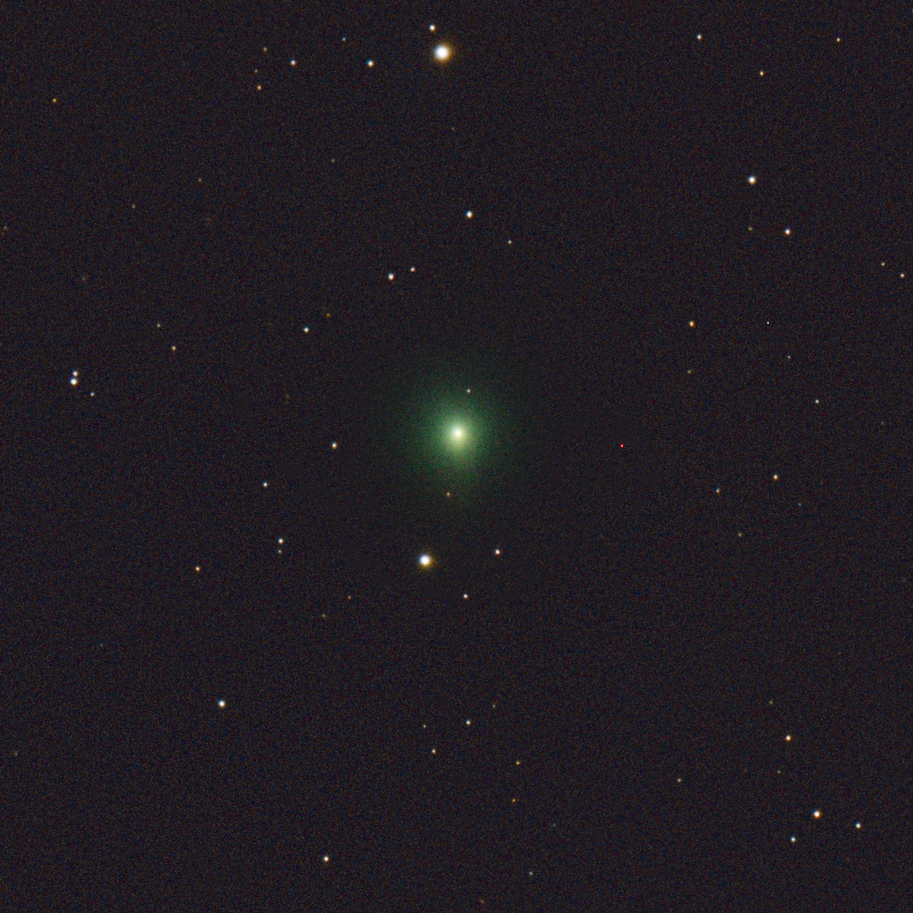
A few things stood out. Despite its reputation as a fast interstellar visitor, 3I/ATLAS moved quite gently across my 3×2-degree field of view. Over the full 90 minutes, it traveled only about half a degree. If you plan to observe or photograph it, I recommend using a larger aperture and a longer focal length telescope than I did. You only need about a one-degree field of view, and more magnification will help to resolve more details of the comet.
UPDATE: 2nd Capture of 3I/ATLAS
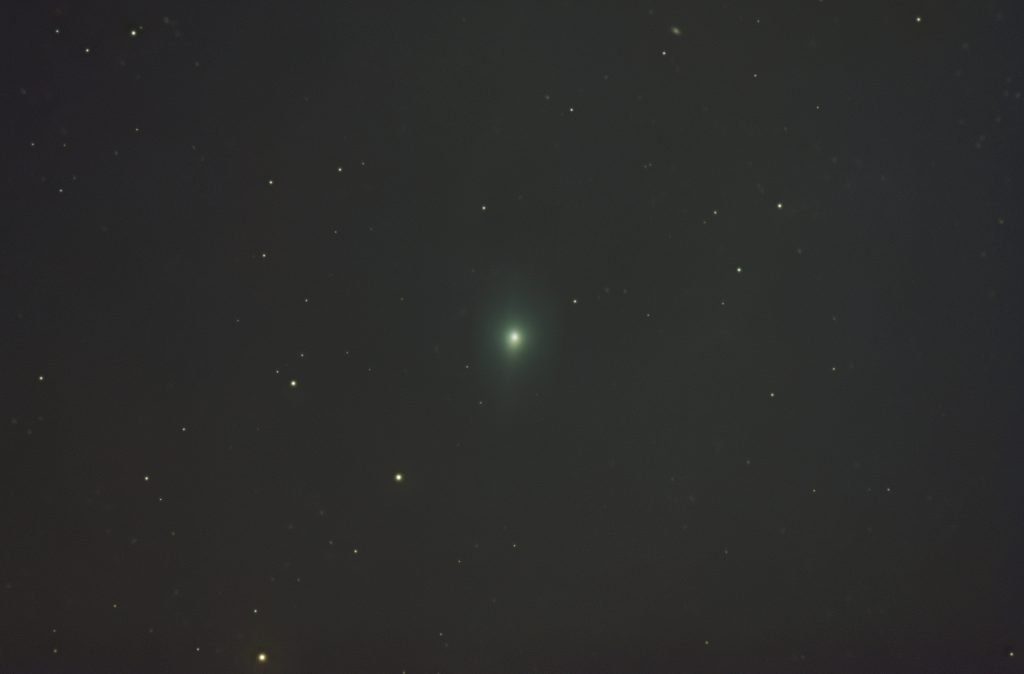
Here’s my second capture. I created a RAW timelapse consisting of two hours of 60-second exposures while tracking comet 3I/ATLAS, along with an integrated image of the comet from 1 December 2025 (120 × 60s). Conditions were hazy in the early morning. Equipment: Celestron EdgeHD 8″ (203/2032 mm) and ASI2600MC Pro. Observed magnitude: 10.4. Distance from Earth 285 million kilometers / 177 million miles.
2-hour timelapse video of 3I/ATLAS
What Makes 3I/ATLAS Scientifically Cool
🌠 Quick Facts About Comet 3I/ATLAS
Comet 3I/ATLAS is an interstellar comet — only the third ever observed, after ʻOumuamua (2017) and Borisov (2019). It formed around another star system and is passing through ours on a one-time hyperbolic trajectory.
Everything in our Solar System shares a common origin. Interstellar comets are true outsiders, carrying foreign material that can reveal how planets and comets form around other stars.
Discovered on 1 July 2025 by the ATLAS telescope in Chile. Its unusual orbit quickly revealed its interstellar origin, confirmed by astronomers worldwide.
“3I” means it’s the third interstellar object ever found. “ATLAS” refers to the survey telescope that discovered it.
- Size: a few hundred metres to a few kilometres
- Speed: ~250,000 km/h at perihelion (record-breaking)
- Age: likely billions of years
- Closest to Mars: ~29 million km (3 Oct 2025)
- Closest to the Sun: 203 million km (29 Oct 2025)
- Closest to Earth: ~270 million km (19 Dec 2025)
- Closest to Jupiter: ~784 million km (16 Mar 2026)
No. Even at closest approach it remains 1.8× the Earth–Sun distance, on the opposite side of the Sun. Zero risk.
ESA’s Planetary Defence Office is tracking the comet using telescopes in Hawaii, Chile, and Australia. Hubble, JWST, SOHO, Mars Express, ExoMars TGO, and even ESA’s Jupiter-bound JUICE spacecraft are contributing observations.
3I/ATLAS is an active comet. As it warms, it releases water, CO₂, CO, carbonyl sulphide, and dust — forming a coma and tail similar to regular Solar System comets.
As with ʻOumuamua and Borisov, speculation about “alien spacecraft” appeared almost instantly. After imaging 3I/ATLAS myself, I’m comfortable saying:
Visually, the comet looked completely normal to me— a fuzzy green coma, a modest tail, nothing unusual as observed through an amateur telescope. Certainly not the alien spacecraft some headlines suggested. This being said, 3I/ATLAS has shown some extraordinary behavior, so let’s talk about what the latest astronomy sources actually tells us.
1. The Comet Is Not “Pristine”
New observations of 3I/ATLAS, including fresh data from the James Webb Space Telescope, reveal a surprising truth: the comet’s surface has been heavily altered by billions of years of exposure to galactic cosmic rays.
Radiation models calculated that this crust probably reaches 15 to 20 meters below the surface. That means the material we’re seeing today — the gas and dust in the coma — does not represent the original material that formed the comet around another star.
This is important because astronomers had hoped interstellar comets would carry pristine material that could reveal the chemistry of other planetary systems. Instead, 3I/ATLAS shows that long interstellar travel can erase or transform those original chemical fingerprints, making it much harder to trace objects back to their home stars.
2. Extreme and Unusual Chemistry
Astronomers looking at 3I/ATLAS with the James Webb Space Telescope (JWST) found gas ratios that are extreme compared to anything in our Solar System. The comet releases 7.6 times more CO₂ than water, and its CO-to-water ratio is about 1.6. These numbers are much higher than normal comets and suggest that the surface has been heavily changed by cosmic rays during its long trip through interstellar space.
Its color confirms this. In detailed measurements of its light, 3I/ATLAS appears as one of the reddest small objects ever observed. That strong redness comes from carbon-rich material — similar to tholins — created when radiation slowly transforms the surface over millions or billions of years. Scientists estimate that this “processed crust” is roughly 15–20 meters thick, while its recent pass around the Sun removed less than a meter. That means we’re still seeing the outer, radiation-altered layer rather than the fresh interior of the comet.
As 3I/ATLAS approached perihelion on October 29, 2025, space-based solar observatories including SOHO, STEREO-A, and GOES-19 recorded a dramatic surge in brightness. The comet brightened at an unusually steep rate—roughly r⁻⁷⋅⁵—far beyond what typical comets show—and its light shifted slightly blue, indicating that fast-moving gas was powering the outburst. The leading explanation is a sudden burst of CO₂-driven activity as the comet warmed, though other possibilities, such as cracks opening in its processed crust or sunlight scattering off fine dust at just the right angle, remain on the table.
Before this outburst, a detailed VLT/X-shooter and UVES spectroscopic study revealed something even stranger: 3I/ATLAS was releasing nickel gas but no detectable iron. This “nickel-without-iron” signature is almost unheard of in comets and suggests a low-temperature release mechanism involving organic or carbon-rich materials rather than the usual metal-bearing dust heated by the Sun. Just as astronomers hoped to monitor how this unusual chemistry behaved near perihelion, the comet slipped into solar glare, cutting off observations. And since re-emerging, no major observatory has yet released new, peer-reviewed spectra showing whether the nickel persisted or whether iron finally appeared.
3. Radio Signal from 3i/Atlas
There was some confusion online when the first “radio signal” from 3I/ATLAS was announced, with people speculating online if the comet might be transmitting a non-natural radio signal. The detection came directly from MeerKAT, a powerful radio telescope in South Africa made up of 64 dishes working together as one instrument. MeerKAT is one of the most sensitive radio arrays on Earth, designed to pick up faint natural signals from galaxies, pulsars, gas clouds — and, in this case, an interstellar comet.
MeerKAT made the first confirmed radio detection of 3I/ATLAS on October 24, 2025. What MeerKAT found was not a transmission or a message, but two very specific absorption lines at 1665 and 1667 MHz. These match the exact frequencies of hydroxyl (OH), a molecule that forms when sunlight breaks apart water vapor released by a comet. In other words, MeerKAT wasn’t detecting an alien broadcast — it was detecting water, or more precisely, the fragments left behind when the comet’s water molecules were broken apart by the Sun.
This is normal, textbook comet behavior. Many comets in our Solar System show the very same OH signals, and radio astronomers have been observing them for decades. MeerKAT simply caught 3I/ATLAS in the act of outgassing water as it warmed up near the Sun. The detection strongly supports the view that 3I/ATLAS is behaving like a natural interstellar comet and not an engineered object emitting any kind of deliberate transmission.
4. Breakthrough in Trajectory Tracking
Another impressive achievement came from ESA’s ExoMars Trace Gas Orbiter. Although it wasn’t designed for comet tracking, scientists managed to repurpose it for high-precision measurements.
Using its instruments, the spacecraft helped triangulate 3I/ATLAS’s position with nearly ten times the previous accuracy.
This is more than just a scientific win. It’s a major step for planetary defense. It proves that when a new or unexpected object enters the inner solar system — even one from another star — we have the tools ready to track it quickly and accurately.
Academic Debate
Prof. Avi Loeb has proposed a more speculative interpretation of 3I/ATLAS. He continues to highlight what he considers highly improbable statistical coincidences in the comet’s trajectory—most notably its predicted passage extremely close to Jupiter’s Hill radius—as well as the unusual, very steep brightening behavior observed near perihelion. Prof. Loeb interprets the combination of these factors as potentially exceeding what would be expected from standard cometary physics alone. In his view, the precise alignment of the flyby distance with a dynamically significant boundary, together with the unexpectedly sharp increase in luminosity and corresponding non-gravitational forces, might point to a level of control or intentional modulation that natural outgassing models struggle to explain.
His interpretation stands in contrast to several studies performed by researchers with formal institutional affiliations, working with major observatories and publishing through established scientific channels. Multiple papers on 3I/ATLAS have already passed full peer review—including works published in Astronomy & Astrophysics (A&A) by teams using the Gran Telescopio Canarias—and these peer-reviewed studies consistently argue that 3I/ATLAS behaves like a natural interstellar comet. Additional analyses from major facilities such as the James Webb Space Telescope, while currently in journal submission or preprint stage, likewise interpret its properties within the framework of normal comet physics. Together, these teams report features such as a ~16-hour rotation period, CO₂-rich outgassing, measurable dust production, normal coma development, and a trajectory that follows standard comet dynamics once outgassing is accounted for.
5. What Happens Next?
One of the biggest questions is whether the comet’s close pass around the Sun stripped away enough of its cosmic-ray–processed crust to expose the pristine material underneath. If cracks were opened deeper into the interior, we may start seeing different gas emissions over the coming months.
We’re also waiting for new data from ESA’s JUICE spacecraft, which happened to pass through a part of the comet’s tail. The instruments recorded dust and gas during that encounter, and those measurements will be transmitted back to Earth in February 2026. This could give us new clues about the comet’s chemistry.
6. Future Interstellar Comet Discoveries
Now that the Vera Rubin Observatory is online, astronomers expect it could detect dozens of interstellar objects every year — potentially up to 70 annually once its survey reaches full capacity.
That means discoveries like 3I/ATLAS may soon become routine, instead of once-in-a-decade events.
But even if interstellar comets become more common, 3I/ATLAS will remain important. It has already reshaped how we think about interstellar visitors. It showed us that objects traveling between the stars for billions of years don’t arrive in pristine condition — they arrive transformed. It demonstrated how cosmic rays sculps material in deep space, and how unusual chemistry doesn’t automatically mean exotic origins or alien technology. And it showed how international space agencies can coordinate in real time to study a fast-moving, unfamiliar object.
In the end, 3I/ATLAS reminds us that interstellar comets probably aren’t alien spacecraft. Instead, they’re time capsules, shaped by slow, powerful forces across the Milky Way. And thanks to objects like this, we’re learning how matter evolves in deep space long before it ever enters our own solar system.
Clear skies! 🌌
@Wido Oerlemans
These are great pictures.
Thank you for your analysis of the comet,
Are you going to try again as it gets closer?
Hi Paul, I think 280M vs 265M kilometers isn’t going to make much difference, but perhaps I will give it another go.