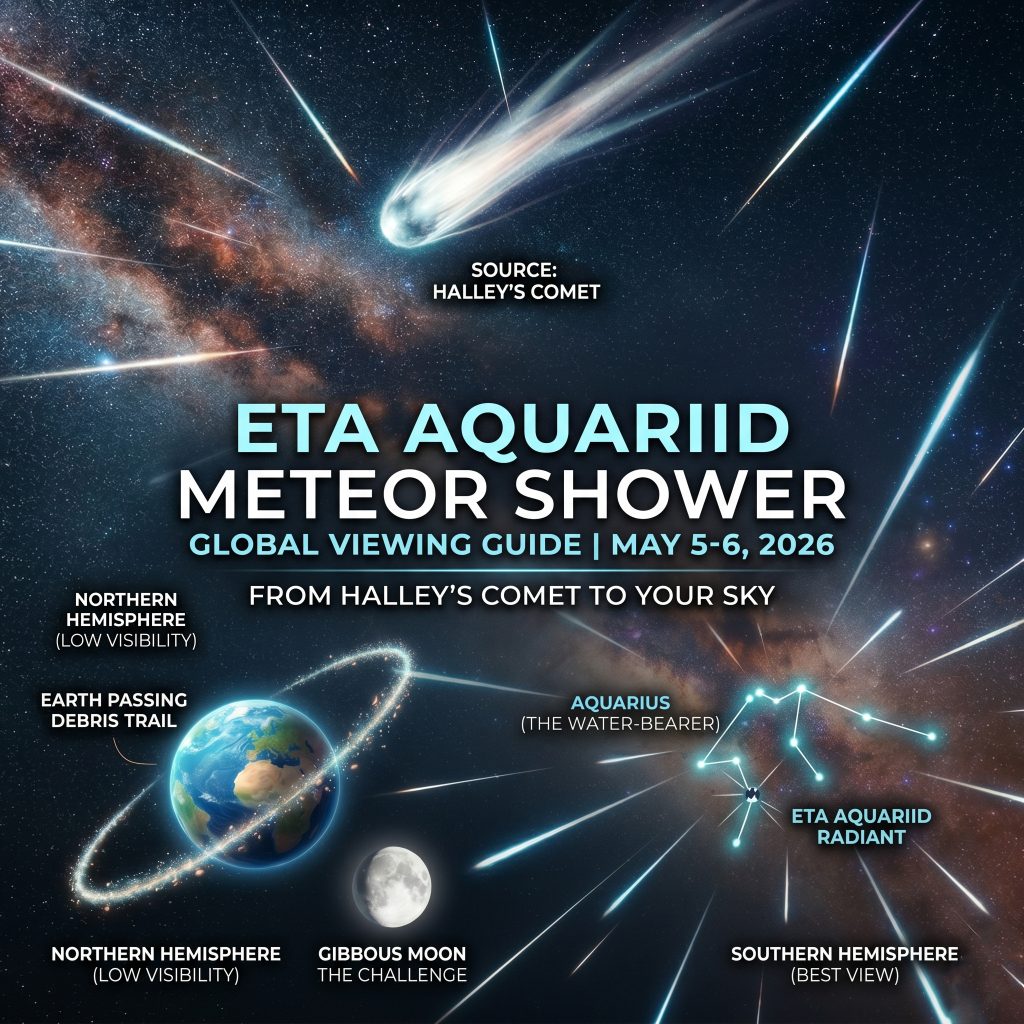
If you’ve ever wanted to see a piece of the most famous comet in history with your own eyes, tonight is your chance. The Eta Aquariid meteor shower is peaking over the next 48 hours (May 5–6, 2026). While Halley’s Comet won’t return to our neck of the woods until 2061, every May, the Earth “drives” through the debris trail it left behind centuries ago. Those tiny pieces of space dust hitting our atmosphere at 66 km/s are what we see as shooting stars.
The 2026 Forecast: What to Expect
This year, we have a bit of a “good news, bad news” situation.
- The Good News: The Eta Aquariids are famous for “persistent trains”—glow-in-the-dark trails that linger for several seconds after the meteor has vanished.
- The Challenge: In 2026, the Moon is a bit of a party crasher. It’s currently in a Waning Gibbous phase (about 80% illuminated), meaning its light will wash out the smaller, fainter meteors.
Pro Tip: To beat the moonlight, try to stand in the shadow of a large building or a row of trees. By blocking the direct glare of the Moon, your eyes can stay adjusted to the dark, giving you a much better chance of spotting the bright fireballs.
Global Viewing Guide: North vs. South
Because the “radiant” (the point where the meteors come from) is located in the constellation Aquarius, your location on Earth changes the view:
- USA, Canada & Europe: The radiant stays relatively low in the sky. You’ll see fewer meteors overall (roughly 10–30 per hour), but you have a better chance of seeing “Earth-grazers”—meteors that streak long and low across the horizon.
- Australia & the Southern Hemisphere: You are the stars of the show! Aquarius climbs much higher in your sky, offering rates of 50+ meteors per hour in dark conditions.
🌠 Live Local Tracking: Where to Look?
The most important rule of meteor watching is knowing when the radiant rises above your specific horizon. If the radiant is down, the show hasn’t started yet.
We’ve built a Live Meteor Forecast Dashboard to help you plan your night. It uses your current location to calculate:
- Exact Local Timing: When the radiant rises in your backyard.
- Hourly Compass Path: Exactly which direction to face at 2:00 AM vs. 4:00 AM.
- Moon Interference: A live calculation of how much the moonlight will impact your view.
👉 {Check the Live Meteor Dashboard here to get your local 2026 coordinates]
🎥 Live stream courtesy of Asahi Astro LIVE / Asahi Shimbun via the Subaru Telescope (NAOJ), Hawaii.
Quick Tips for Tonight:
- Best Time: The window between 2:00 AM and local dawn is the “Golden Hour” for this shower regardless of where you live.
- No Gear Needed: Put away the telescope! You need a wide-angle view to catch the streaks. Just bring a reclining chair, a warm blanket and if you’re a photographer, your camera and wide angle lens will do.
- Patience is Key: Give your eyes at least 20 minutes to adjust to the darkness. That means no checking your phone!
Happy gazing, and may your skies be clear!