The Caldwell Catalog is a collection of 109 deep-sky objects compiled by British astronomer Sir Patrick Moore, who often used the pseudonym Caldwell—his mother’s maiden name. Moore created this list in 1995 as a complement to the famous Messier Catalog, focusing on stunning celestial targets that Messier missed. It includes galaxies, star clusters, and nebulae from both the northern and southern hemispheres, making it a more globally inclusive list for amateur astronomers.
Most Caldwell objects are too faint to see with the naked eye, so a telescope is usually required to appreciate their detail and beauty—though a few brighter ones, like the Omega Centauri cluster (C80) or the Double Cluster in Perseus (C14), can be glimpsed with binoculars under dark skies.
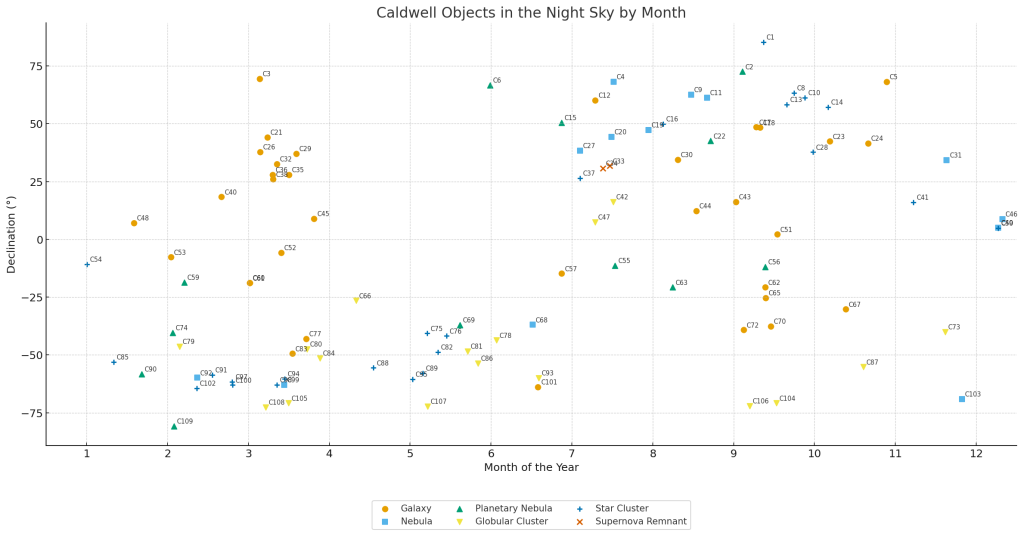
The chart below plots each Caldwell object by its declination (vertical axis) and by the month when it’s highest in the sky around midnight (horizontal axis, derived from right ascension).
Interactive Caldwell Object Finder by Month and Location
Not everyone shares the same sky. Because Earth is curved, your latitude determines how high each Caldwell object climbs—and some may never rise at all from where you are. This interactive planner reveals which objects are visible from your location and ranks them by how high they stand at midnight in each month.
Best Caldwell Objects at Midnight
Pick your latitude and month to see Caldwell objects that actually rise during the night around midnight at your location. The list is sorted by altitude at midnight, with a night chart showing altitude vs. time.
Night chart
(Top 12 by altitude at midnight) — X: hours from midnight · Y: altitude (°)Objects rising sometime tonight — sorted by altitude at midnight ()
| Object | Type | RA | Dec | Alt @ Midnight (°) | Max Alt (°) |
|---|
Finally, you’ll find the complete Caldwell catalog, featuring all objects from C1 to C109. Use the search function to quickly locate any target by its Caldwell or NGC number, constellation, or common name. You can also filter by object type—such as galaxies, nebulae, planetary nebulae, or clusters—and view the precise RA and DEC coordinates to help your telescope mount automatically slew to the selected object.
| Caldwell | NGC/IC | Type | Mag. | Right Ascension | Declination | Const | Common Name |
|---|