Few pieces of equipment have completely reshaped the landscape of modern astrophotography quite like the William Optics RedCat 51. When it first launched, it shattered the unwritten rule that serious deep-sky astrophotography required a massive, frustratingly complex, multi-thousand-dollar optical system.
Instead, the community was handed a sleek, anodized red cylinder roughly the size of a standard 70-200mm camera lens that produced flawless, pinpoint stars right out of the box. It transformed backyard astrophotography from a game of technical frustration into a highly portable, accessible pursuit.
However, the RedCat story isn’t static. William Optics is a manufacturer that tweaks, iterates, and entirely overhauls their equipment based directly on forum feedback from users. If you are shopping for a RedCat today—whether you’re buying the current flagship model brand new or hunting for a bargain on the used market—you will encounter a confusing array of generations, version numbers, and nicknames.
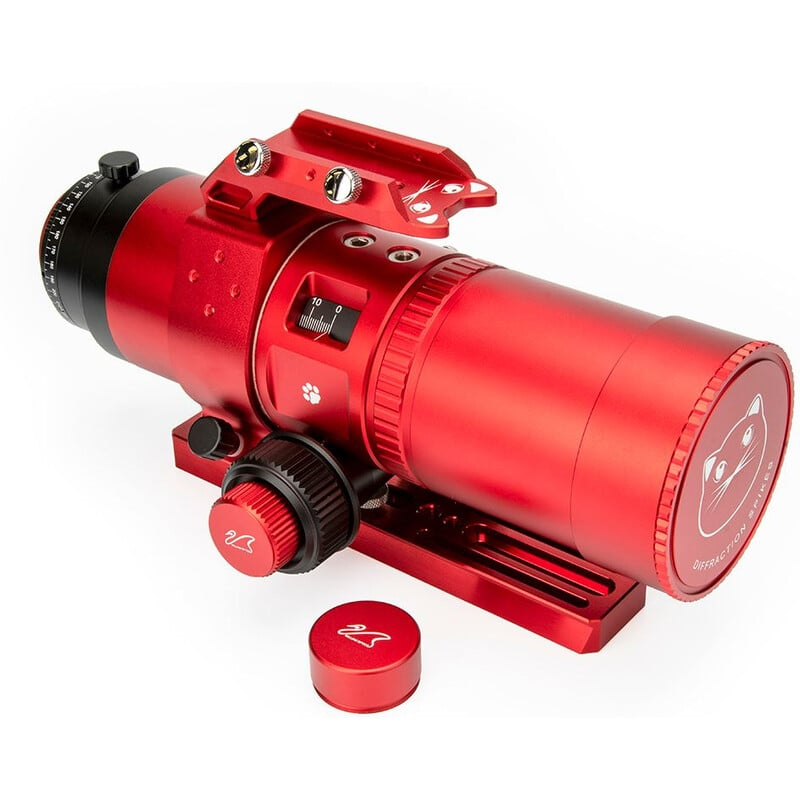
This comprehensive guide breaks down the “RedCat Phenomenon,” provides a chronological history of every single version ever made, uncovers the real-world limitations you must know before buying, and maps out the absolute best paths to purchase depending on your budget.
1. The “RedCat Phenomenon”: Why This Little Scope Dominates the Community
To understand why the RedCat 51 is consistently rated as one of the best astrophotography telescopes on the market, you have to look at what beginner astrophotographers faced before its release.
Traditionally, starting out meant buying a small doublet or triplet apochromatic refractor. Those scopes were great, but they suffered from two major headaches: field curvature and backfocus tuning.
A standard telescope lens bends light into a curved shape, meaning if the stars in the center of your image are perfectly sharp and in focus, the stars in the corners will look like stretched, elongated commas. To fix this, you had to buy a separate external “field flattener,” screw it into your imaging train, and use precise metal spacer rings to position your camera sensor exactly 55mm away from the flattener glass. If your backfocus was off by even 0.5mm, your corners were ruined.
The RedCat 51 completely eliminated that entire painful process by introducing a premium optical layout tailored specifically for imaging.
The Petzval Optical Magic
The secret sauce of the RedCat 51 is its 4-element Petzval design, utilizing premium FPL-53 and FPL-51 synthetic fluorite extra-low dispersion (ED) glass.
Unlike a traditional triplet refractor, a Petzval design places a secondary set of glass elements near the rear of the telescope barrel. This rear element cluster acts as a built-in, perfectly matched field flattener.
Because the flattener is integrated directly into the fixed optical array, backfocus calculations are entirely eliminated. You do not need to measure millimeters of spacer rings. If your camera sensor can reach focus on the RedCat 51, your image will be perfectly flat across the entire frame.
Full-Frame Coverage in a Pint-Sized Body
Most compact telephoto lenses or cheap entry-level refractors provide an image circle large enough to cover an APS-C crop sensor. If you attach a massive Full-Frame sensor (like the ZWO ASI6200MM/MC or a full-frame Sony/Canon mirrorless camera), the corners on lesser scopes suffer from severe darkening (vignetting) and distortion.
The RedCat 51 provides a massive 44mm to 48mm flat image circle. It natively illuminates and corrects even a massive full-frame sensor from corner to corner. Delivering this level of optical performance in a package that fits into an airline carry-on backpack changed the hobby forever. It allowed astrophotographers to ditch heavy, industrial equatorial mounts and pair their scope with ultra-light, highly portable star trackers.
2. The Chronological History: Tracking Every RedCat 51 Generation
Because William Optics practices rapid iterative design, the RedCat 51 has gone through four distinct mechanical evolutionary phases since its debut. While the internal glass, 250mm focal length, and fast f/4.9 focal ratio have remained virtually identical, the mechanical housing around that glass has completely transformed.
Here is how the telescope evolved step-by-step.
Generation 1: The Original Trailblazer (2019)
The original Gen 1 RedCat 51 looked and felt exactly like a high-end, manual photography lens.
- Focuser Style: It utilized a massive, rubberized helical focus ring wrapped around the entire body of the barrel. To focus the telescope, you grabbed the barrel and twisted it, just like a camera lens.
- The Features: It introduced the genius integrated Bahtinov Mask hidden inside the threaded metal lens cap. This allowed users to unscrew the front cap cover, expose an acrylic focusing grid, hit perfect focus on a star, and screw the cover back on without needing extra tools.
- The Limitations: Early Gen 1 units lacked a camera sensor tilt adjuster. More importantly, because automated astrophotography was exploding around this time, users wanted to attach electronic autofocusers (like the ZWO EAF). Because the focus ring was a massive, smooth rubber cylinder, attaching an autofocus motor required awkward, third-party 3D-printed brackets and rubber timing belts that frequently slipped, stretched, or bound up in cold weather.
Generation 2: The Ergonomic Upgrade (2021)
Listening closely to user feedback, William Optics introduced the Second Generation model to fix ergonomics and mounting headaches.
- Focuser Style: Retained the smooth, manual helical focus ring.
- The Improvements: The primary changes were structural and external. The short, stubby mounting foot of the Gen 1 was replaced with a significantly longer, 210mm dual-use Vixen and Arca-Swiss compatible mounting plate. This made balancing front-heavy or rear-heavy camera configurations on small tracker mounts incredibly easy.
- The Field Rotator: The rear camera field rotator (which lets you spin your camera to frame a target perfectly) received a heavier, far more secure tensioning screw to ensure that heavy imaging trains wouldn’t slip out of alignment when pointing straight up at the zenith.
Generation 2.5 (The MKII Gear Track Edition) (2022)
By 2022, electronic autofocusing went from a high-end luxury to an absolute necessity for most deep-sky imagers. William Optics rolled out a brilliant stop-gap solution often referred to as the MKII or Gen 2.5.
- Focuser Style: Helical, but heavily modified.
- The Critical Upgrade: The old rubberized grip ring on the barrel was completely abandoned. In its place, William Optics machined an all-metal focus barrel and integrated a precision gear track ring natively into the barrel chassis.
- Why it Matched User Demand: This gear track meant that astrophotographers no longer had to rely on slipping rubber bands or clunky aftermarket mods to automate their telescope. A ZWO EAF or similar autofocus motor could now mesh directly onto the scope’s body using a standard metal pinion gear. It was cleaner, more reliable, and completely revolutionized automated wide-field setups.
Generation 3: The Ultimate Revolution – The RedCat 51 WIFD (Current Standard)
In late 2023, William Optics decided that modifying a helical camera lens design was no longer enough. They completely threw out the original chassis architecture and built a true, ground-up miniature telescope using their proprietary WIFD (William Optics Internal Focus Design) system. This is the model actively sold brand new today.
- Focuser Style: Internal Rack-and-Pinion via side-mounted focus knobs.
- The Engineering Shift: In all previous generations, focusing the scope meant the entire outer barrel of the telescope physically twisted and extended or retracted. If you had a heavy camera, a filter wheel, and an off-axis guider hanging off the back, that shifting mechanical movement could induce tiny amounts of sag, mechanical flexure, and microscopic sensor tilt.
- How WIFD Fixes Everything: With the WIFD system, the outer aluminum chassis of the telescope is 100% rigid, sealed, and stationary. When you turn the dual-speed focus knobs on the side of the scope, a precision rack-and-pinion drive smoothly shifts only the internal glass elements back and forth inside the tube.
- The Autofocus Integration: Because it uses standard side-mounted focus knobs rather than a rotating outer barrel, an electronic autofocuser can mount directly to the side axle via a coupling bracket natively, just like a high-end triplet refractor. Sensor tilt and mechanical sag are completely, permanently engineered out of the equation.
3. Aesthetic & Special Edition Variants
Beyond the core mechanical generations, William Optics frequently releases limited-run boutique colors. Functionally and optically, these are identical to the standard versions of their matching era, but they look entirely different on a mount.
- SpaceCat 51: A gorgeous, matte space-gray anodized version of the Gen 1 and Gen 2 scopes. It became highly sought after by astrophotographers who wanted a stealthier, non-red look that perfectly matched premium carbon-fiber tripods.
- WhiteCat 51: A limited-run all-white powder-coat variant engineered specifically to visually match traditional white equatorial telescope mounts.
- ZWO AM5 RedCat Limited Edition: Occasional custom co-branded bundles that pair a matching color scheme with harmonic strain-wave mounts.
4. The Quick Reference Comparison Matrix
If you are looking at listings on online astrophotography classifieds or retail stores, use this quick-reference table to immediately identify what version you are looking at.
| Version | Focuser Mechanism | Distinct Visual Identifiers | Ideal Use Case |
|---|---|---|---|
| Gen 1 / V1 | Helical (Manual Twist) | Thick rubber diamond-grip ring on the barrel; short mounting foot. | Budget used buyers looking for a purely manual travel scope. |
| Gen 2 / MKII | Helical (Manual Twist) | Thick rubber diamond-grip ring; long red Vixen/Arca-Swiss plate. | Excellent value for manual tracker setups or DSLR landscape astro. |
| Gen 2.5 / MKII Gear | Helical with Metal Track | All-metal barrel; thin, visible metal gear teeth ring encircling the body. | Great for users wanting autofocusing while maintaining a slim profile. |
| RedCat 51 WIFD | Internal Rack & Pinion | Distinctly square-shaped rear outer housing; dual black focus knobs on the side. | The Gold Standard. Essential for heavy cameras, mono kits, and automated software. |
For examples of real-world astrophotos, check out astrobin.
5. Real-World Cons of the RedCat 51
No telescope review is authentic without talking about what a telescope cannot do. The RedCat 51 is a phenomenal instrument, but it is bound by the laws of physics. If you buy this telescope expecting it to do everything, you will be deeply disappointed.
Here are the real-world limitations you must accept before buying.
1. The Focal Length Scale: It is a Wide-Angle Lens, Not a Sniper Rifle
The RedCat 51 features a focal length of 250mm. To a traditional landscape photographer, that sounds like a telephoto lens. But to an astronomer, it is an ultra-wide field focal length. It is designed to capture massive, sweeping expanses of the night sky.
If your goal is to image any of the following targets, do not buy a RedCat 51:
- Planets: Target objects like Saturn, Jupiter, and Mars will look like tiny, brightly overexposed pinpricks. You cannot resolve Saturn’s rings or Jupiter’s Great Red Spot with a 250mm focal length telescope. For planetary imaging, you need thousands of millimeters of focal length, typically found in large Schmidt-Cassegrain telescopes.
- Small, Distant Galaxies: Aside from our massive neighbors like the Andromeda Galaxy (M31) and the Triangulum Galaxy (M33), the vast majority of deep-space galaxies (such as the Whirlpool Galaxy, Bode’s Galaxy, or the Needle Galaxy) are incredibly small. Through a RedCat 51, they will look like faint, microscopic smudges.
- Globular Clusters: Spectacular dense clusters of hundreds of thousands of stars, like the Great Hercules Cluster (M13), require high magnification to break apart the light into individual stars. A RedCat 51 will render them as tiny, bright fuzzy balls of cotton.
Target Profile: The RedCat 51 is a masterclass instrument for massive emission nebulae (the Orion Nebula, the North American Nebula, the Veil Nebula), dark dust lanes in the Milky Way core, and sweeping multi-panel mosaic projects.
2. Undersampling and “Square Stars”
Because the focal length is so short (250mm), pairing the RedCat 51 with a high-resolution, modern astrophotography camera containing industry-standard small pixels (like the 3.76 µm pixels found on the popular APS-C ZWO ASI2600MC or Full-Frame ASI6200MC) creates a technical phenomenon called undersampling.
Because the field of view is so wide, a single pixel on your camera sensor covers a relatively massive patch of the sky (exactly 3.10 arcseconds per pixel). When a pinpoint, perfectly focused star lands on your sensor, it doesn’t span enough pixels to resolve as a perfectly smooth, round ball. If you zoom into your raw images at 100% or 200%, you will notice your smallest stars look blocky or slightly square.
- The Solution: To fix this, you must set up your imaging software (like N.I.N.A., Ekos, or an ASIAIR) to Dither your frames—which shifts the telescope by a few pixels between every shot. When stacking your data in software like PixInsight or DeepSkyStacker, you can apply a mathematical process called Drizzle to reconstruct the spatial resolution and round out your stars. It works, but it adds processing time and requires beefier computer hardware.
3. Small Aperture Means Slow Light Gathering
The “51” in RedCat stands for its 51mm objective lens diameter. That is exactly 2 inches of physical glass surface area.
While its focal ratio is a respectably fast f/4.9, a 2-inch lens simply cannot collect the same physical volume of photons per minute as a 3-inch (71mm or 75mm) or 4-inch (100mm) refractor. If you are shooting faint, ghostly dark nebulae or trying to blast through severe light pollution from a suburban backyard, you will need to commit significantly more total integration time to your targets to achieve clean, noise-free images compared to using a larger aperture telescope.
4. Filter Swap Annoyances (Legacy Models Only)
If you opt to buy a used Gen 1, Gen 2, or Gen 2.5 RedCat 51, be prepared for a clumsy filter-swapping process. These legacy models lack an integrated filter drawer. To change from a broadband light pollution filter to a dual-band narrowband nebula filter, you have to physically unscrew your camera from the rear M48 adapter thread, screw a 2-inch filter directly into an internal adapter ring, and re-thread the camera back onto the telescope.
Doing this in pitch-black, sub-freezing weather is incredibly frustrating. Worse, re-threading your camera almost always rotates the camera sensor slightly out of its original orientation, breaking your framing alignment and forcing you to shoot a brand-new set of calibration flat frames for the second filter.
(Note: This is completely resolved if you buy the new WIFD version, which accommodates standard external filter drawers easily, or if you purchase an aftermarket filter drawer assembly for the legacy models).
6. Where to Buy: Your Best Options (New vs. Used)
Because the RedCat 51 has been around for several years, you have two excellent paths to ownership. Your choice should depend entirely on your budget and how much you value automated electronic focusing.
Path A: Buying Brand New
If you want the ultimate, headache-free experience, you should buy the William Optics RedCat 51 WIFD brand new from an authorized astronomy dealer. Buying new grants you a full manufacturer warranty, the iconic custom padded soft-shell carrying case, the integrated Bahtinov mask cap, and the absolute best mechanical design available.
The WIFD version is undeniably the right choice if you intend to run a fully automated setup controlled by a ZWO ASIAIR, a Mini-PC, or a laptop, as it natively accepts electronic autofocusers without any mechanical hassle.
Where to Buy the RedCat 51:
Path B: Hunting the Used Market
If you want to save anywhere from 30% to 50% off the retail price, checking used astronomy equipment classifieds (such as Cloudynights Classifieds or AstroMart) is a highly lucrative option.
Because the RedCat 51 is a legendary beginner telescope, thousands of imagers buy them, use them for a year or two to master the basics of the hobby, and then sell them to upgrade to longer focal length telescopes.
When shopping used, keep these safety tips in mind:
- Ask for Lens Photos: Ensure the seller provides clear, high-resolution photos of the front objective glass under a bright light. Look out for scratches, deep coating blemishes, or internal fungus. (Minor dust is completely normal and won’t affect your images).
- Verify the Version: Check the focus ring using our comparison matrix above. Make sure the seller isn’t trying to sell a Gen 1 manual scope for the price of a Gen 2.5 Gear Track version.
- Check for Tilt Adjusters: If buying a very early Gen 1 model, confirm whether it includes the rear bolt-on tilt adjuster adapter plate, as early production runs required users to buy it separately.
Final Thoughts: Should You Buy a RedCat 51?
Even with stiff modern competition from brands like Askar, the William Optics RedCat 51 remains an undisputed king of wide-field deep-sky astrophotography. Its internal Petzval glass eliminates the single most frustrating bottleneck beginner imagers face, turning the complex challenge of backfocus into a distant memory.
If you understand its limitations—that it is a wide-field nebula hunter, not a planetary sniper—and you pair it with a capable portable mount, it is an optical instrument capable of producing world-class, publication-grade imagery that you can pack right into a standard travel backpack.
Clear skies!
Did this guide clear up the confusing history of the RedCat series for you? If you’re planning out your mobile astrophotography setup or need advice on what camera pairs best with a 250mm focal length, leave a comment below and let’s talk gear!