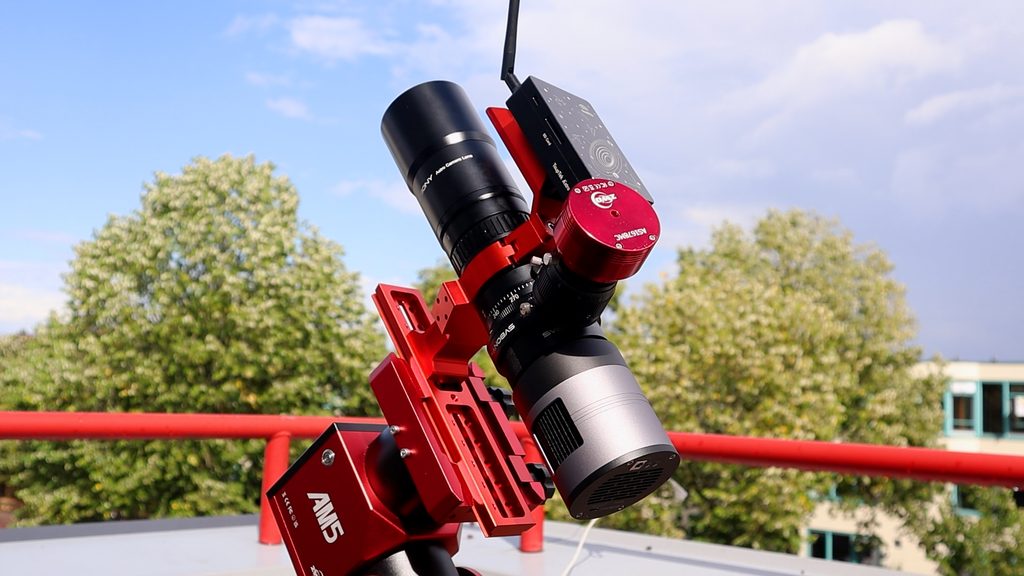
For astrophotographers who want a fast, dedicated wide-field imaging setup, finding a balance between optical quality, back-focus simplicity, and modular expansion is key. SVBONY’s SV545 45mm f/4.5 Petzval Astrograph aims directly at this sweet spot. Equipped with optional extra’s —such as the SVBONY’s Off-Axis Guider (OAG), a SV220 3nm Dual-Band Filter plus the SV226 Filter Drawer, and the SC571CC cooled camera —I tested the SV545 under urban skies on the expansive Veil Nebula complex (NGC 6960/6992) in Cygnus.
Optics & Build: The SV545 Refractor
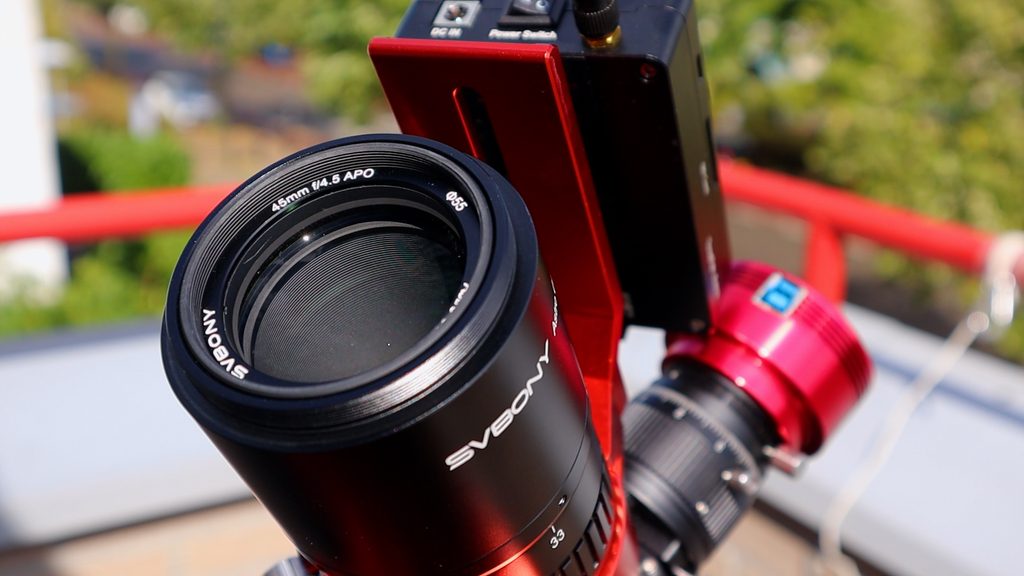
The SV545 is a fast, ultra-compact, light weight refractor lens built specifically for deep-sky imaging rather than visual observing.
- Aperture: 45mm
- Focal Ratio: f/4.5
- Focal Length: 203mm
- Optical Design: 5-element Petzval lens configuration (3 groups)
- Image Circle: 44mm (Full-Frame compatible)
Integrated Petzval Design
The standout feature of the SV545 is its internal Petzval optical layout. Standard doublets or triplets require adding an external field flattener and calculating back-focus down to fractions of a millimeter. While SVBONY recommends a standard 55 mm back-focus distance, the integrated field flattener makes this far less critical.
Operating across a massive 44mm image circle, the SV545 guarantees sharp, pinpoint stars across APS-C sensors (like the IMX571) and full-frame sensors without noticeable field curvature or edge distortion, meaning that stars should stay nice and round all the way to the edge of your images.
I used the following setup to test the SV545:
[SV545 Telescope] ➔ [Off-Axis Guider] ➔ [Filter Drawer + SV220 duoband filter] ➔ [SC571CC Camera]
SVBONY Accessory Ecosystem
1. Off-Axis Guider (OAG)
Using an Off-Axis Guider instead of a secondary guide scope eliminates differential flexure—a common cause of trailing stars during long exposures. The SVBONY OAG uses a small pick-off prism to feed light from the main optical path directly to a guide sensor.
- In Practice: Setting up the OAG requires precise focal alignment between the main imaging sensor (SC571CC) and the guide camera so both reach focus at the exact same point. In practice, off-axis guiding only works smoothly when paired with dedicated mini guide cameras (like ZWO’s mini series or similar form factors). Because the sensor on these dedicated guide cameras sits much closer to the front of the body, it can slide far enough down into the OAG stalk to reach the focal plane. During my session, I tried using an ASI678MC planetary camera on the OAG, but because its sensor sat too far back, it couldn’t be brought into focus. In the end, I switched to a separate guide scope configuration to handle autoguiding for the night.
2. SV220 3nm Dual-Band Narrowband Filter
To isolate emission nebulae under light-polluted skies, the SV220 3nm filter sits inside an SVBONY filter drawer. By isolating Hydrogen-alpha (Ha) and Oxygen-III (OIII) wavelengths down to a narrow 3nm bandpass, it blocks urban light pollution while maximizing contrast on deep sky objects.
3. Integrated Rotator & Helical Focuser
The SV545 features a built-in manual Camera Angle Adjuster (CAA) rotator. This allows 360-degree rotation of your camera train to frame wide DSOs (like aligning the Veil Nebula diagonally across the sensor) without losing focus. The integrated helical focuser offers smooth manual adjustments.
4. Electronic Auto Focusser
The SV545 can be outfitted with an optional electronic auto focusser and the telecope. For this session, however, I relied on auto focussing using the traditional focussing ring on the telescope. It required some effort to focus the telescope, but with the help of the Stella Vita focussing routine, I was able to finetune the focus for my imaging session.
Field Test: Capturing the Veil Nebula
The Veil Nebula complex (NGC 6990 and 6992 – or east and west veil nebula) stretches across nearly 3×3 degrees of sky. Paired with the APS-C sensor of the SC571CC (IMX571) at a 203mm focal length, this combination produces a wide field of view:
Yielding a 6.60° × 4.42° field of view (7.94° diagonal), these massive deep sky objects fitted neatly into a single frame with plenty of room around the edges for background calibration and framing adjustments. After polar aligning the mount, I slewed to the veil nebula complex and could frame it nicely using the smooth rotator of the SV545 in the preview window of the stella vita app. After that, I made an imaging plan to capture the veil nebula as follows:
Imaging Operations
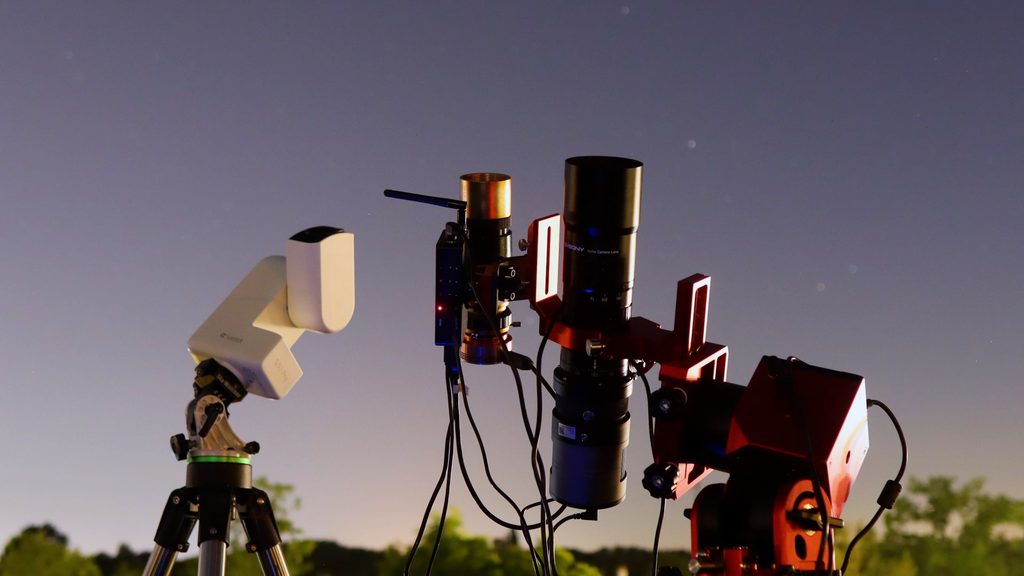
- Deep Sky Object: Veil Nebula Complex (Cygnus)
- Sub-Exposures: 300 seconds (5 minutes) with active autoguiding
- Total Integration: ~4 hours (48 frames)
- Control: Operated wirelessly via smart controller (Stella Vita)
- Mount: ZWO AM5N
- Camera: SC571CC; cooled sensor at -15°C
- Filter: SV220 2″ 3nm H-Alpha & OIII Narrowband
I had an additional SV226 filter drawer to place the SV220 in front of the camera sensor to capture the Ha and Oiii rich Veil nebula. This is one example of a 5 minute, unedited image of the veil nebula complex. Stars were almost perfectly round across the APS-C sized camera sensor with the veil nebula nicely centered in the frame.
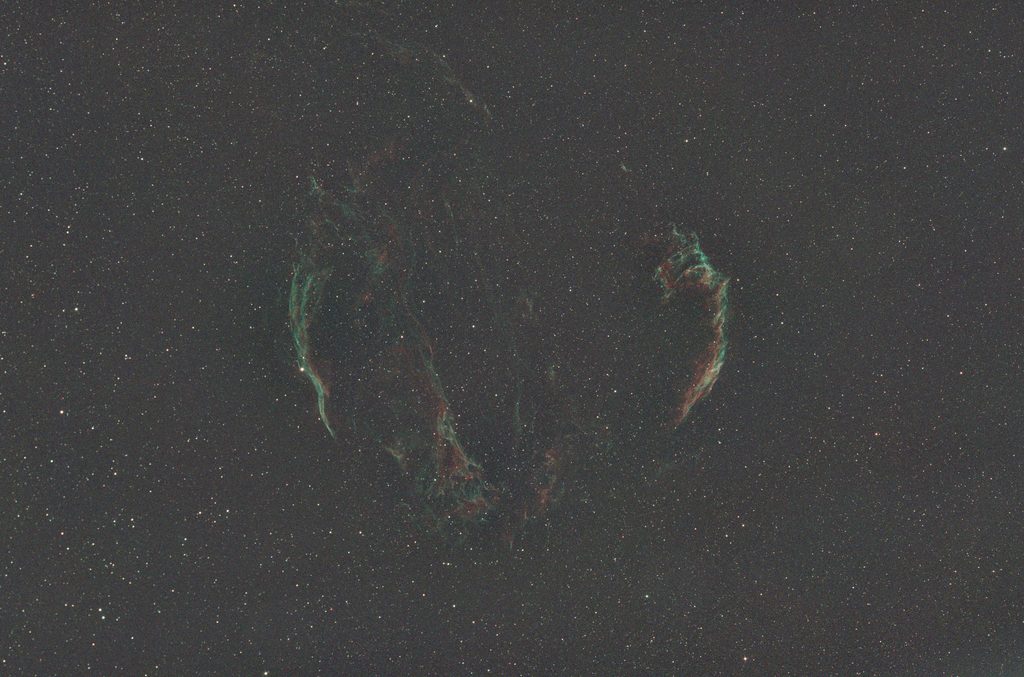
Here is my (processed) 24 MegaPixel result using Pixinsight to stack and process the frames.
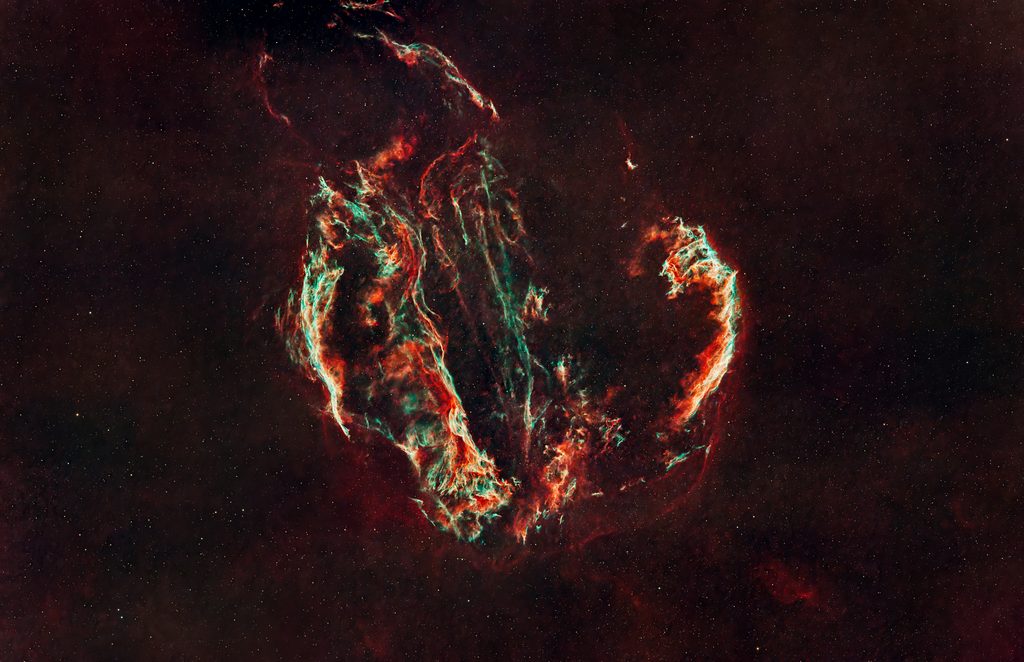
Performance & Final Image Results
- Star Points & Correction: Edge-to-edge star roundness was excellent across the entire sensor field. The Petzval design eliminated star elongation in the extreme corners.
- Filter Contrast: The tight 3nm bandpass of the SV220 cut through sea-level atmospheric haze and light pollution, revealing delicate red hydrogen threads bridging the Eastern and Western Veil sections.
Final Verdict & First Light Summary
As a hands-on first light review, the SVBONY SV545 has proven to be an exceptionally capable wide-field astrograph. Its standout advantage is the built-in 5-element Petzval design, which completely removes the headache of strict back-focus calculations and eliminates the need for an external flattener. Paired with fast f/4.5 optics and a massive 44mm image circle that easily supports up to full-frame sensors without corner vignetting, collecting rich data on wide DSOs becomes remarkably straightforward. The integrated 360-degree rotator allows quick, seamless composition adjustments, and when combined with the SV220 3nm dual-band filter, the contrast on emission nebulae under light-polluted skies is outstanding.
Naturally, operating a modular rig like this brings a few practical considerations. Fine-tuning the Off-Axis Guider requires careful distance calibration to ensure your main camera and guide camera hit parfocal alignment—a process made much smoother when using dedicated mini-style guide cameras. Additionally, the stock setup relies on a manual helical focuser, so automating your focus requires adding an electronic automatic focuser.
Overall, this initial imaging session showed incredible potential. The SV545 delivers tight star profiles, crisp edge-to-edge pinpoint stars, and rich color separation straight out of the box. I am planning to test this rig much further in upcoming imaging sessions to see how it handles different deep sky objects, varying camera setups, and extended exposure times under changing night conditions.
5% SVBONY Discount Code
Save 5% across Amazon & Official Store:
$100 Off SC571CC Camera
Exclusive camera coupon code: