There is a specific moment in every astrophotographer’s journey that changes everything. You’ve spent months, maybe years, shooting wide nebula fields with a crisp triplet refractor. You’ve mastered the Orion Nebula, tracked the Pleiades, and captured the vast tendrils of the Veil. But then, late one night, you look at your screen and zoom into a tiny, smudge-like distant galaxy or the pinhead-sized disc of Jupiter.
Suddenly, your wide-field refractor feels too small. You crave focal length. You want to dive into the swirling storm bands of gas giants or capture the fierce, twisting dust lanes of the Whirlpool Galaxy.
When you ask the astrophotography community where to turn next, one name gets whispered more than almost any other: Celestron EdgeHD.
But choosing an EdgeHD isn’t as simple as picking a size and adding it to a shopping cart. These instruments are powerful, complex, and unyielding. They can be your ultimate dream telescope or your heaviest mechanical nightmare.
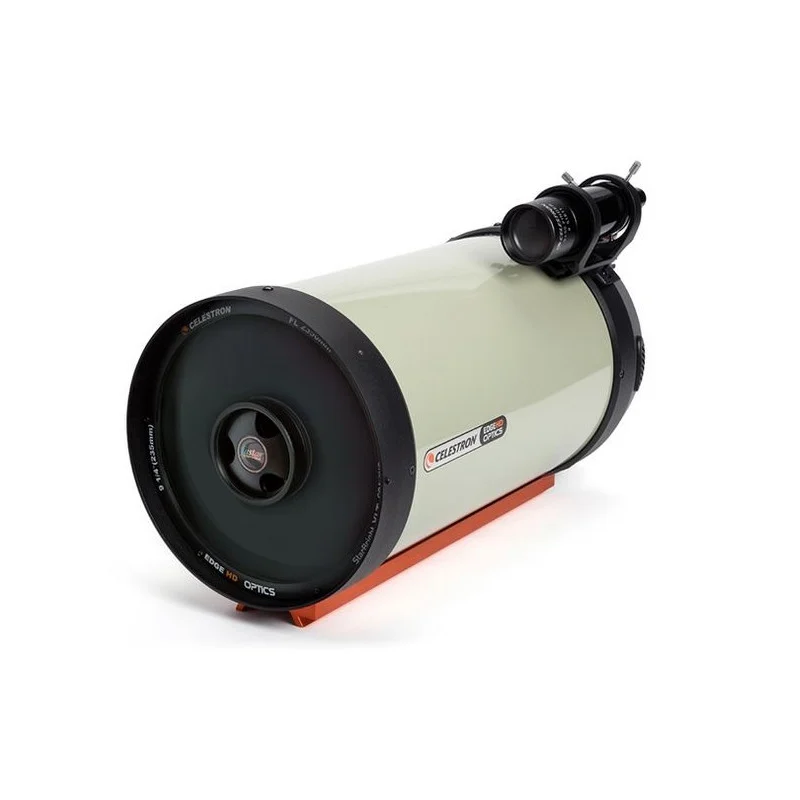
This guide is a deep-dive narrative journey through the EdgeHD ecosystem—how it handles against other optical designs, how the models differ, who its true rivals are, and how to snag one without draining your life savings.
1. Celestron EdgeHD vs. the rest
Before looking at the specific models, we have to address a fundamental question: Why choose a modified Schmidt-Cassegrain Telescope (SCT) like the EdgeHD over traditional optical designs?
A standard SCT is a masterpiece of compact design, using a spherical primary mirror, a secondary mirror, and a thin corrector plate at the front to fold massive focal lengths into a remarkably short tube. However, standard SCTs have a dark secret: coma and field curvature. As your camera sensor gets larger, the stars at the very edges of your frame begin to stretch into ugly, comet-like shapes.
The EdgeHD is Celestron’s “aplanatic” solution. They tucked a custom doublet corrector lens inside the central baffle tube. This flattened the field completely, providing pinpoint stars from the center to the absolute edge of a massive full-frame sensor.
But how does this modified SCT compare to other heavy hitters in the astrophotography world?
The Competitors on the Field
- Apochromatic (APO) Triplet Refractors: Refractors are the definition of “plug-and-play.” They offer pristine contrast, pinpoint stars, and zero thermal acclimation time or collimation worries. However, physics is a cruel master. A high-end 6-inch (150mm) APO refractor is massive, incredibly expensive, and still gives you less than half the light-gathering power of an 8-inch EdgeHD. For deep-sky imaging of tiny galaxies or planetary work, refractors simply lack the raw focal length and aperture required.
- Newtonian Reflectors: Newtonians offer the absolute best “aperture-per-dollar” ratio. A big 8-inch or 10-inch f/4 Newtonian is incredibly fast for deep-sky work. But they are giant wind sails on a mount, require constant collimation before every single session, and suffer from severe inherent coma that forces you to buy expensive external coma correctors. They are also notoriously difficult to balance and clumsy for planetary imaging.
- Maksutov-Cassegrains (Maks): Maksutovs are legendary planetary instruments. With thick, heavy front corrector lenses and slow focal ratios (often f/12 to f/15), they hold collimation beautifully and deliver razor-sharp contrast on lunar craters and planets. Their fatal flaw is deep-sky work: they are far too slow, take hours to thermally cool down, and their narrow fields of view make deep-sky tracking an agonizing process.
The Modified SCT
The EdgeHD stands proudly in the middle as the ultimate hybrid. It packs thousands of millimeters of focal length into a tube short enough to sit on a modest mount. With the addition of a focal reducer, it shoots deep-sky targets beautifully at f/7. Remove the secondary mirror entirely, and you can install a HyperStar system, converting the telescope into an ultra-fast f/2 wide-field astrograph. It is a chameleon that no other design can truly replicate.
2. Evolution of the Specimen: Are There Different Versions?
If you are hunting through online classifieds or browsing telescope storefronts, you might wonder if Celestron has silently upgraded the EdgeHD line over the years. Are there “Mark II” versions you need to watch out for?
The short answer is no. Celestron struck gold with the mechanical and optical design of the EdgeHD, and the optical tubes (OTAs) themselves have remained unchanged since their initial release. Every authentic EdgeHD ever produced contains the exact same core feature set:
- Flexible Mirror Clutches: Built-in tension locks that gently secure the primary mirror support, preventing “mirror flop” and keeping your targets perfectly centered during long imaging sessions across the meridian.
- Primary Mirror Vents: Rear mesh-filtered vents that allow hot air to escape from behind the glass, significantly cutting down the time it takes for the telescope to adjust to ambient night temperatures.
- Fastar/HyperStar Architecture: A removable secondary mirror assembly, letting you pivot from native high-focal imaging to hyper-fast f/2 wide-field work in minutes.
While the tubes haven’t evolved, the bundles have. Over the last decade, Celestron has changed the computerized mounts paired with these tubes—moving from older, heavy mechanical mounts like the CGEM series to modernized computerized mounts like the CGX or matching them with advanced strain-wave travel mounts.
3. The Apertures: Choosing Your Focal Weapon
Let’s walk through the four sizes of the EdgeHD family. Instead of just looking at raw numbers, let’s explore how each telescope actually behaves in the field, what it demands from you, and who it is truly built for.
The EdgeHD 8″ — The Gateway Astrograph
- Focal Length: 2032mm (f/10)
- Weight: 14 lbs (6.4 kg)
- Backfocus: 133.35mm
The 8-inch model is the undisputed darling of the intermediate astrophotographer. At just 14 pounds, it is incredibly forgiving. You do not need a forklift or a massive permanent pier to operate this telescope; it will ride happily on standard, accessible equatorial mounts like an EQ6-R Pro, an AVX, or modern strain-wave mounts like the AM5.
Because of its smaller volume, it cools down rapidly, meaning you can be imaging while your peers with larger scopes are still waiting for their internal air currents to settle. Combined with the widely available 0.7x focal reducer, it scales down to a manageable 1422mm at f/7, making it a phenomenal galaxy hunter.
The only real drawback is its tight native backfocus of 133.35mm. If you plan to run a complex imaging train—consisting of an off-axis guider, a massive filter wheel, an electronic rotator, and a cooled camera—every millimeter counts, and spacing can become a tight geometric puzzle.
Where to buy the Celestron EdgeHD 8″
The EdgeHD 9.25″ — The Optical Outlier
- Focal Length: 2350mm (f/10)
- Weight: 21 lbs (9.5 kg)
- Backfocus: 146.05mm
The 9.25-inch model is the fascinating black sheep of the Celestron family. It is not just an 8-inch scope stretched out; it features a completely unique optical geometry. While the 8″, 11″, and 14″ models all use a fast f/2 primary mirror, the 9.25″ utilizes a slower f/2.3 primary mirror.
This mechanical shift means the secondary mirror doesn’t have to magnify the central image as aggressively, resulting in what many optical purists consider to be the sharpest, flattest, and most well-corrected raw visual field of the entire lineup.
For years, the 9.25-inch was feared by deep-sky astrophotographers because Celestron didn’t offer a native focal reducer for it, forcing imagers to use finicky third-party glass. Thankfully, that is ancient history. Celestron engineered a dedicated 4-element 0.7x reducer tailored explicitly to the 9.25’s unique optics.
Even better? Unlike the 8-inch model (which shrinks down to a tight 105mm of space), adding the reducer to the 9.25″ doesn’t compromise your workspace—it keeps your backfocus wide open at its native 146.05mm. This gives you plenty of breathing room for a complex mono imaging train, making it a spectacular hybrid instrument for both deep-sky galaxy hunting and high-magnification planetary tracking.
Where to buy the Celestron EdgeHD 9.25″
The EdgeHD 11″ — The Master’s Choice
- Focal Length: 2800mm (f/10)
- Weight: 28 lbs (13 kg)
- Backfocus: 146.05mm
When you move up to the 11-inch EdgeHD, you cross an invisible threshold into serious, heavy-duty astrophotography. This telescope is a light-gathering powerhouse. On nights with steady atmospheric conditions (“seeing”), the detail the 11-inch can extract from planetary surfaces or distant galaxy cores is breathtaking.
It features the ideal 146.05mm backfocus and has a beautifully optimized, native Celestron 0.7x focal reducer that transforms it into a highly efficient 1960mm deep-sky weapon.
The trade-off is mechanical responsibility. At 28 pounds bare, once you attach cameras, heavy guiding rigs, and counterweights, you are pushing toward a 40-pound payload. This completely rules out budget or lightweight portable mounts. To guide successfully at nearly 3000mm of focal length, you need a high-end, heavy-duty tracking platform and a rock-solid tripod or pier. It requires patience, strength, and respect.
Where to buy the Celestron EdgeHD 11″
The EdgeHD 14″ — The Observatory Titan
- Focal Length: 3910mm (f/11)
- Weight: 46 lbs (21 kg)
- Backfocus: 146.05mm
The 14-inch model is an absolute titan. It is an instrument designed to live a permanent, pampered life inside a backyard observatory dome or on a heavy-duty concrete pier.
At a massive 46 pounds before accessories, setting this telescope up and tearing it down every night in a backyard is a recipe for physical exhaustion or accidental damage. At its native focal length of nearly 4 meters (3910mm at f/11), the magnification is so extreme that even the slightest breeze, a nearby footstep, or minor tracking imperfections will completely ruin an exposure.
However, if you have a high-payload premium mount, excellent local atmospheric conditions, and a permanent setup, the 14-inch EdgeHD operates on a professional research level. It resolves detail that makes commercial astro-images look like professional observatory data.
Where to buy the Celestron EdgeHD 14″
Check Edge HD astrophotos on astrobin.
4. EdgeHD vs. The Close Competitors
The commercial astronomical market isn’t a monopoly. Celestron faces fierce competition in the high-focal-length space. Why do these specific tubes remain so overwhelmingly popular despite alternative options?
1. Meade ACF (Advanced Coma-Free)
Meade’s ACF series was historically Celestron’s closest optical competitor. Like the EdgeHD, the ACF modified the traditional SCT design to eliminate ugly off-axis coma.
- Where Meade Won: The ACF design corrected for coma directly on the secondary mirror without needing a corrector lens inside the central baffle tube. This meant there was less glass in the optical path to cause transmission loss.
- Why EdgeHD Won (and why Meade fell behind): While the Meade ACF corrected for coma, it did not fully correct for field curvature. The EdgeHD flattens the entire field completely, meaning stars stay pinpoint all the way into the corners of a modern full-frame CMOS sensor. Additionally, Meade lacked an ecosystem equivalent to the HyperStar system.
- The Smart Buyer’s Warning: Meade Instruments officially ceased operations and closed its doors. While you will see plenty of Meade ACF scopes floating around the used market for low prices, buying one means you are completely on your own. There is no factory warranty, no customer support, and finding replacement parts or electronic boards is incredibly difficult. For a reliable, long-term imaging rig, the active Celestron EdgeHD ecosystem is the safer investment.
2. GSO / TPO Ritchey-Chrétien (RC) Telescopes
Ritchey-Chrétien telescopes use hyperbolic primary and secondary mirrors (the same design used by the Hubble Space Telescope). They have no front corrector glass, meaning they acclimate to cool night air incredibly fast and never suffer from dew building up on a front lens.
- Where RC Wins: They are pure mirror systems—zero false color, zero front corrector plate glass to dew over, and they are incredibly cheap for their aperture size.
- Why EdgeHD Wins: RCs are notoriously difficult to collimate. Aligning hyperbolic mirrors is a precise art form that can drive beginner and intermediate astrophotographers to absolute frustration. Furthermore, RCs have large central obstructions (bulky secondary mirrors), which degrades contrast for planetary imaging. The EdgeHD is significantly easier to collimate and holds that alignment far better over time.
5. The Smart Buyer’s Choice: New vs. Used
Investing in a premium optical tube like an EdgeHD is a major financial milestone. Knowing how to safely navigate the market can save you thousands of dollars.
Buying New:
When you buy an EdgeHD brand new, you are paying for peace of mind. You receive Celestron’s official two-year factory warranty, pristine optical coatings untouched by human fingers or outdoor dust, and factory-certified mechanical alignments. If the telescope encounters shipping damage or structural anomalies out of the box, Celestron’s customer support will swap it out.
Buying Used:
Because EdgeHD optical components do not degrade over time if cared for properly, the used market is a goldmine. You can frequently find used EdgeHD tubes selling for 30% to 45% below retail MSRP. Astrophotographers who upgrade to larger instruments often sell their pristine 8-inch or 11-inch tubes packaged with expensive add-ons—like custom aluminum carrying cases, dew heaters, upgraded dovetails, or even dedicated focal reducers—saving you a small fortune.
Critical Used Inspection Checklist
If you are buying a used EdgeHD from online forums (like Cloudy Nights or Astromart) or meeting a seller locally, use this safety checklist:
- The Flashlight Test: Shine a bright light down the front corrector plate. Do not worry about light surface dust (it has zero impact on imaging). Look for spiderweb-like patterns on the inside of the glass—this indicates fungus, which eats into optical coatings and ruins the telescope.
- Inspect the Corrector Rim: Check the outer edges of the front glass corrector plate for tiny hairline cracks or chips near the retaining screws. A cracked corrector plate is expensive to fix because the primary mirror and corrector plate are optically matched at the factory.
- Test the Focus Knob: Turn the focusing knob all the way clockwise and counter-clockwise. The motion should feel smooth, uniform, and slightly damp. If it hits rough patches, catches, or feels gritty, the internal baffle grease may have dried out or the focus screw could be bent.
- Verify the Corrector Alignment: Look closely at the primary corrector plate’s edge markings. If a previous owner removed the front glass to clean it and didn’t align it back to its exact factory orientation, the telescope’s optical performance will suffer from uncorrectable aberrations. Ensure there are no signs of messy home modifications.
Final Verdict:
When you weigh the Celestron EdgeHD against the broader landscape of astrophotography gear, its true value lies in its sheer versatility. While a premium APO refractor offers effortless plug-and-play sharpness and Newtonians provide cheap aperture, neither can match the EdgeHD’s ability to completely transform its identity. In a single instrument, you have a native f/10 powerhouse for resolving intricate planetary detail and distant galaxy cores, an optimized f/7 deep-sky workhorse with an integrated flat-field corrector, and—thanks to HyperStar compatibility—an ultra-fast f/2 wide-field astrograph. It successfully bridges the gap between different imaging styles, eliminating the off-axis coma and field curvature that traditionally plagued the classic Schmidt-Cassegrain design.
Navigating the lineup ultimately comes down to balancing your budget, imaging goals, and mount capacity. The 8-inch model remains the undisputed gateway for portable setups, while the legendary 9.25-inch stands out as an optical masterpiece with a dedicated 0.7x reducer that preserves its massive backfocus. Stepping up to the 11-inch or 14-inch titans unlocks professional-grade light-gathering power, though they demand high-end mounts and permanent or semi-permanent observatory setups to guide successfully at such extreme focal lengths. Whether you buy brand new for the factory warranty or hunt the used market to save up to 45% on a pristine tube, investing in an EdgeHD is an investment in a forever scope—one that will challenge, refine, and scale alongside your skills for years to come.
Clear skies!
Wido.