By Wido Oerlemans
June 17, 2026
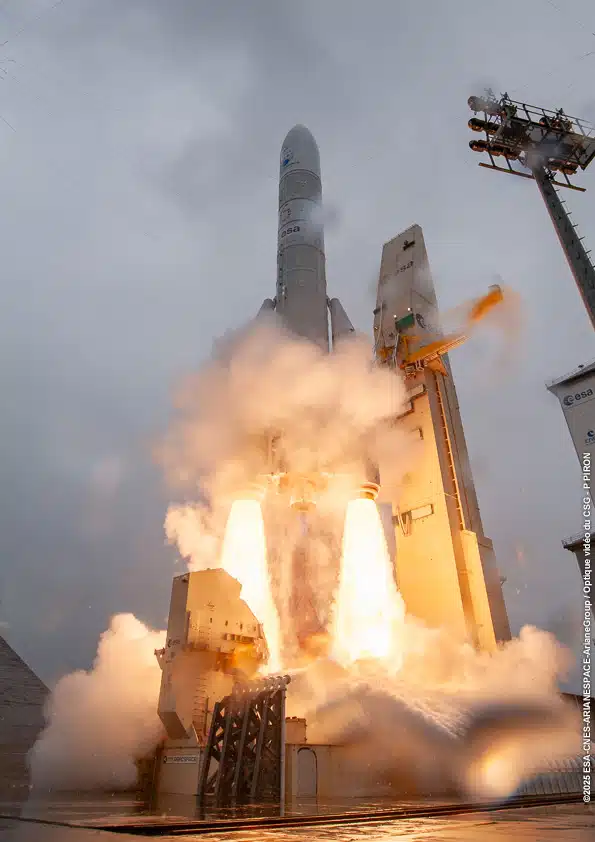
If you were watching the live streams today, you saw history happen. At 13:53 CEST (08:53 local time in Kourou), Arianespace pulled off flight VA269. The heavy-lift Ariane 64 configuration blasted off using its brand-new, upgraded P160C solid rocket boosters for the very first time, successfully hauling a massive stack of 36 Amazon LEO (Project Kuiper) satellites into low Earth orbit.
While it’s an incredible feat of aerospace engineering—breaking the record for the heaviest payload ever lofted by an Ariane rocket—it serves as a massive wake-up call for our astrophotography community. This flight officially pushes Arianespace’s contribution past 100 satellites, bringing the total Amazon LEO fleet to over 330 active satellites in orbit. With 15+ more Ariane 6 flights on the manifest alongside heavily backlogged Vulcan, New Glenn, and Falcon 9 schedules, the night sky is getting crowded fast.
With the multi-network era (Starlink + Amazon + Europe’s upcoming IRIS²) fully upon us, it’s worth looking at how this influx of metal overhead impacts us as amateurs and the folks running professional research observatories. The challenges—and solutions—are completely different.
The New Reality in our Raw Subs
We’ve all gotten used to scrubbing out occasional Starlink streaks. But as the Amazon LEO fleet climbs to its operational altitude of 630 km, we are facing a slightly different beast.
Because Amazon’s satellites fly roughly 80 kilometers higher than Starlink’s main shell, they suffer from a prolonged twilight penalty. They stay illuminated by the sun much longer after sunset from our perspective on the ground.
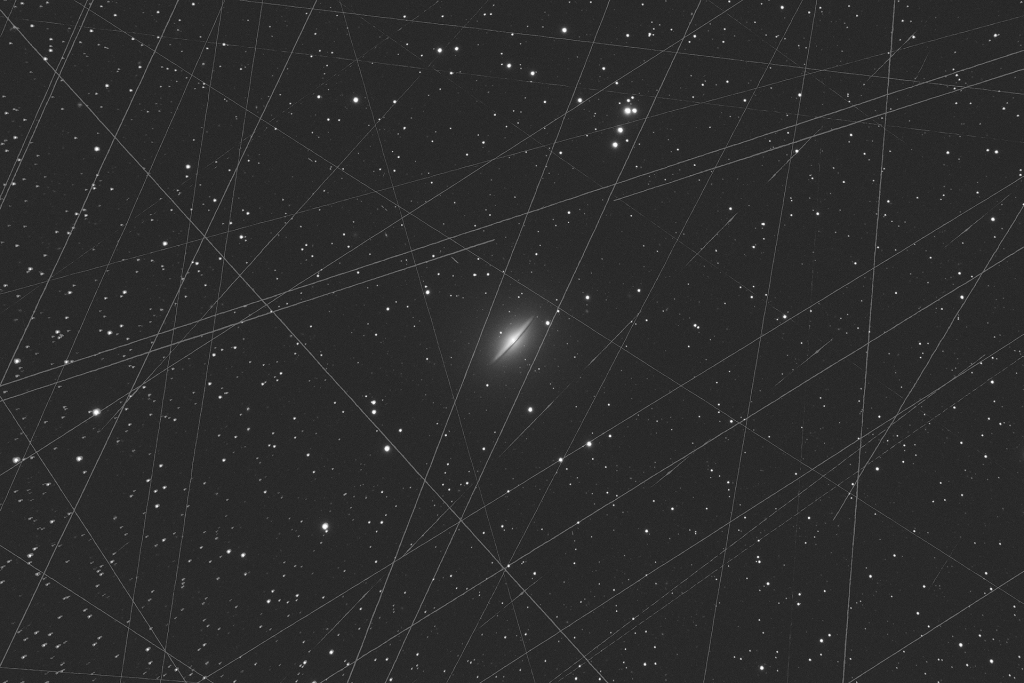
Worse yet, recent photometric tracking data shows these early Amazon satellites are highly reflective, averaging a visual magnitude of ~6.43, with geometric sun glints flaring up as bright as 4.5. If one passes through your frame during a 3-minute sub-exposure of a faint nebula, it will leave a bright, sharp, well-defined white line across your CMOS or CCD sensor.
The Amateur Perspective: An Inconvenience Fixed by Math
For those of us shooting deep-sky objects from our backyards, mega-constellations are an annoying inconvenience, but they are not a death sentence for our hobby.
Single long-exposure imaging (e.g., a single 15-minute exposure) may be officially dead. To survive the onslaught, our primary weapon is data volume combined with smart post-stacking routines. Instead of one long exposure, we shoot multiple shorter subs (e.g. 1 to 5 minutes). When you throw them into processing software like PixInsight, DeepSkyStacker, or Siril, you simply use Pixel Rejection Algorithms (like Sigma-Clipping or Linear Fit Rejection).
How Pixel Rejection Handles Satellite Trails:
- Step 1: You feed your stack of 30+ raw sub-exposures into the processing engine.
- Step 2: The rejection algorithm checks each pixel coordinate across every frame.
- Step 3: The engine flags the bright satellite streak as a temporary, statistical anomaly.
- Step 4: The trail is mathematically clipped out, outputting a clean master image.
Because the satellite is blazing across space at over 7.6 km/s, it only hits a specific pixel for a fraction of a millisecond in one single frame. The software recognizes that bright streak as an outlier and erases it, preserving the pristine nebula or galaxy data underneath.
The Professional Perspective: A Threat to Science
While amateurs can easily mask out the trails, professional astronomers are in a serious bind. For big science, mega-constellations present structural problems that math cannot easily fix:
- Saturated Sensors: Professional ground-based research telescopes—like the Vera C. Rubin Observatory in Chile—use ultra-sensitive, multi-billion pixel sensors designed to catch the faintest light from the edge of the universe. When a magnitude 6.4 Amazon satellite cuts across these sensors, it doesn’t just leave a line; it completely saturates the pixels, causing electronic “ghosting” and bleeding that can ruin the entire image matrix.
- Transient and Asteroid Hunting: Programs looking for Near-Earth Asteroids or fleeting cosmic events (transients) rely on software that flags anything that moves. Thousands of low-altitude satellites generate massive amounts of false positives, blinding automated systems looking for space rocks heading our way.
- Spectroscopy Data Ruin: If a satellite crosses the narrow slit of a spectrograph while a scientist is analyzing the chemical makeup of a distant galaxy, the reflected sunlight corrupts the data completely. You cannot “sigma-clip” a light spectrum.
Space Telescopes are No Longer Safe!
For years, the ultimate safety net for astronomers was simple: “If the sky gets too crowded on Earth, we will just launch our telescopes into space.” We assumed that space observatories operating hundreds of kilometers up would sit safely above the fray.
One Nature study by Howell & colleagues (December, 2025) proved that this is a dangerous misconception. Because many telecommunication constellations operate at higher LEO altitudes or utilize highly reflective solar panels and chassis (some stretching over 100 square meters), they orbit directly above, or pass right through the fields of view of, our premier space science platforms.
According to the comprehensive simulations in the Nature report, if the planned mega-constellations are fully completed (approaching over 560,000 satellites worldwide), the consequences for space-based astronomy are catastrophic:
- Hubble Space Telescope: More than one-third (39.6%) of all Hubble exposures will be contaminated with at least one bright satellite trail.
- Next-Gen Space Missions: For upcoming wide-field space observatories designed to map the cosmos—such as NASA’s SPHEREx, China’s Xuntian, and the European Space Agency’s ARRAKIHS mission—the contamination rate skyrockets to an unbelievable 96% or more.
Instead of escaping light pollution, our most advanced space telescopes will be actively photobombed in almost every single picture they take, driving up operational costs and severely limiting the detection of faint, distant galaxies.
What is Being Done?
To their credit, aerospace companies are actively working with the International Astronomical Union (IAU) to minimize their impact, but the physics of light reflection makes total mitigation incredibly difficult.
- Dark Coating and Mirrors: Companies are experimenting with anti-reflective mirror coatings, darkening the chassis of the satellites, and adjusting the tilt of solar arrays during twilight hours so they don’t reflect sunlight directly back down to Earth.
- Orbital Management: Advanced software tracking allows observatories to try and coordinate exposure timing around known satellite passes, but as the population of artificial objects climbs toward hundreds of thousands, finding an empty patch of sky to image is becoming mathematically impossible.
- Active Software Post-Processing: Astronomers are developing advanced predictive models to automatically mask out satellite trails in space-based data, though this ultimately increases the noise floor of the images and hides faint objects beneath the artificial glare.
The Rise of Satellite Trackers
While astrophotographers and professionals are adjusting their workflows, there is a rapidly growing sub-community that is absolutely buzzing today: The Satellite Trackers.
Tracking newly launched satellite “trains” has become a massive amateur sport. Following this afternoon’s deployment, these 36 satellites are flying in a tight, low-altitude injection altitude (~465 km). For the next few days, before they use their onboard thrusters to raise their orbits and disperse, they will fly across the sky in a tightly bound, blazing-bright, single-file line.
If you want to catch or image the “Ariane-Amazon Train” before it splits up, fire up tools like Heavens-Above, Calsky alternatives, or tracking scripts in Stellarium. Catching a fresh LEO train passing directly over a planetary transit or cutting through the Milky Way core has become a highly sought-after trophy shot in its own right.
Interactive 3D Satellite Tracking Map
Explore the true scale of the low Earth orbit networks. This live tracking engine renders the complete fleet of active objects, tracking planes, and real-time path trajectories.
Launch Live 3D Globe →Final Thoughts
Whether you see them as a nuisance to clip out of your deep-sky stacks, a major threat to professional astrophysics, or a target to actively chase with a fast-slewing alt-az mount, mega-constellations are here to stay.
Did anyone manage to see the launch or early passes of today’s VA269 deployment? Drop your comments below!
Clear skies!