By: Wido Oerlemans | June 27, 2026
It sounds like the ultimate too-good-to-be-true internet ad: A lightweight, dual-axis strain wave (harmonic drive) telescope mount with massive payload capacity, zero backlash, and a price tag that shatters mainstream retail.
If you have spent any time browsing astrophotography forums, YouTube, or AliExpress recently, you’ve likely seen them. Strain Wave (i.e. Harmonic Drive) mounts called “Teseek” and “Juwei” are generating a massive buzz and are actively promoted by “astro influencers”. At roughly half the price of mainstream giants like ZWO, these new budget mounts promise to bring the premium world of strain wave telescope mounts to the masses at a fraction of the cost.
But are they actually a revolutionary bargain, or a shortcut to a massive technical headache? Let’s pull back the curtain and look at the exact hardware, features, and real-world performance of these deep-discount wildcards in an ultimate head-to-head showdown. In this blog, we will compare the cheap Juwei and Teseek options against the well-established ZWO mounts.
A Note on Affordable “Brands” in the Harmonic Mount Market
Before diving into the specifications, it is important to clarify a vital reality about this market: names like “Teseek” and “Juwei” do not represent centralized corporations with a single, unchanging manufacturing “blueprint” like a regular Western brand or a well-known company like ZWO. Instead, they function as labels for an open-source, decentralized ecosystem. In Shenzhen’s bustling electronics districts, independent workshops often function by sourcing standard harmonic gearboxes and OnStep controllers from various local suppliers, assembling them into chassis, and selling them through different storefronts. Because there is no single “factory line” or centralized quality control, the exact internal specifications—gear ratios, motor types, and even chassis materials—can and do change between different batches and sellers. The following comparison is based on the specific, verified configurations and models I personally found across various local AliExpress storefronts. Treat this guide not as a list of corporate product specs, but as a map of the different hardware “recipes” currently circulating in the wild. For a glimpse into the agile, small-batch manufacturing environment that makes such innovations possible, check out this look at Shenzhen’s electronics manufacturing ecosystem.
Part 1: Hardware Show-down: Teseek-14 vs. Juwei-14 vs. ZWO AM3N
This class is built for mobile astrophotographers running wide-field setups, small apochromatic refractors, and compact (smart) scopes. Here’s an overview of the Teseek-14 & Juwei-14 versus the ZWO AM3N.
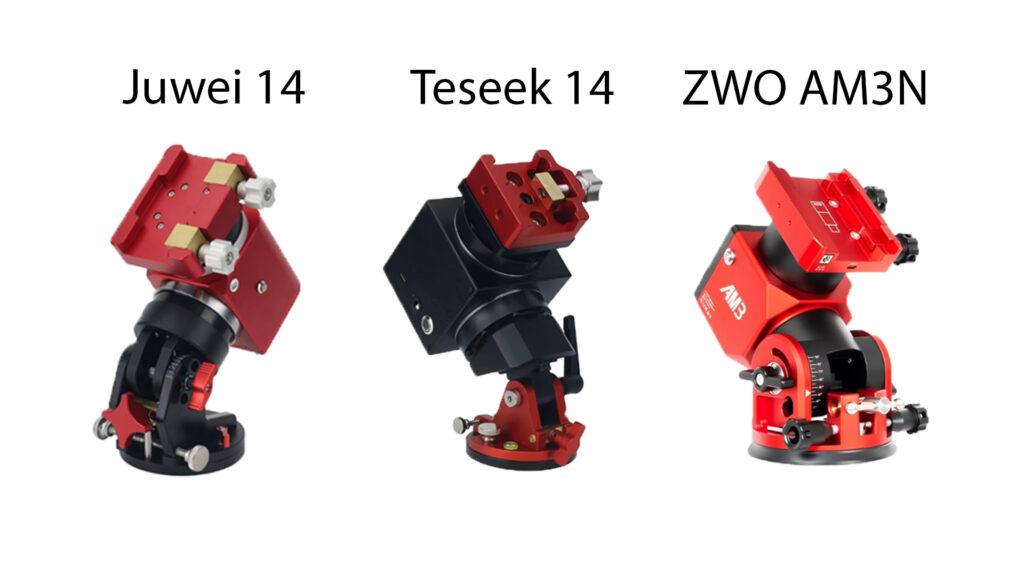
Specification Matrix: Size 14 Class
| Feature | Teseek 14 (Base Class) | Juwei-14 (Metal Shell) | ZWO AM3N (Mainstream Benchmark) |
|---|---|---|---|
| Average Street Price | ~$600 USD (~550 EUR) | ~$1050 USD (~950 EUR) | ~$1,499 USD (~1.890 EUR) |
| Mount Head Weight | 2.4 kg (5.3 lbs) | 3.35 kg (7.4 lbs) | 4.1 kg (9.0 lbs) |
| Payload Capacity (No Weights) | 10 kg (22.0 lbs) | 8 kg (17.6 lbs) | 8 kg (17.6 lbs) |
| Max Payload Capacity (With Weights) | ?? kg (not listed) | 13 kg (28.6 lbs) | 13 kg (28.6 lbs) |
| RA Drive Transmission | Size 42 Stepper motor -> 4:1 Timing Belt -> 100:1 Gearbox (400:1 Total Ratio) | Size 42 Stepper motor -> 4:1 Timing Belt -> 100:1 Gearbox (400:1 Total Ratio) | NEMA Stepper motor -> Synchronous Belt -> 300:1 Strain Wave Gearbox |
| DEC Drive Transmission | Size 42 Stepper motor -> Direct Drive -> 100:1 Gearbox (100:1 Total Ratio) | Size 42 Stepper motor -> 4:1 Timing Belt -> 100:1 Gearbox (400:1 Total Ratio) | NEMA Stepper motor -> Synchronous Belt -> 300:1 Strain Wave Gearbox |
| Safety Axis Brake | No (not in base version) | Yes, RA Axis Safety Brake | Yes, RA Axis Safety Brake |
| Telescope Saddle & Hub | Passive Dual Saddle (No upper power or data ports) | Passive Dual Saddle (No upper power or data ports) | Powered Dual Saddle (Integrated USB-C Hub + 12V DC Out) |
| Chassis Mainboard Ports | USB-C, RJ11 Hand Controller, ST4 | USB-C, RJ11 Hand Controller, ST4 | USB-C, RJ11 Hand Controller, ST4 |
| Wireless Communications | Built-in Wi-Fi & Bluetooth | Built-in Wi-Fi & Bluetooth | Wi-Fi & Native ASIAIR Bluetooth Pairing |
| Tripod Mounting Base | Flat Base (Standard 3/8″ Photo Thread Only) | Dual Base (Standard 3/8″ Photo Thread + AM3/5 Flange Pattern | Dual Base (Standard 3/8″ Photo Thread + Am3/5 Flange Pattern |
Teseek-14 vs Juwei-14 vs ZWO AM3N: The Hidden Trade-Offs: Plastic Shells, Metal Casings, Safety Brakes, and more…
Looking at the massive price jump from a $600 USD (€550 EUR) Teseek 14 up to a $1,499 USD (€1890 EUR in Europe!) ZWO AM3N, you might be inclined to go with the most affordable option and save a thousand dollars/euros! But before you smash that buy button, be aware that you aren’t just paying for a corporate brand name—you are paying for structural integrity and equipment safety.
The rock-bottom baseline model of the Teseek 14 achieves its ultra-low price point by utilizing a 3D-printed plastic housing (made from high-strength PETG-CF or ABS filament). While incredibly lightweight for travel, a plastic shell lacks the rigid stability of the full CNC-machined aluminum bodies found on the Juwei-14 and ZWO AM3N. Under heavy telescope loads or freezing winter night temperatures, plastic can flex, introducing subtle tracking wiggles that degrade long-exposure imaging.
The Essential Safety Brake
Even more critical is the electromagnetic safety brake. Because strain-wave (harmonic) gearboxes have zero natural resistance when unpowered, a sudden power failure or a pulled 12V cable mid-session will cause a heavy telescope rig to instantly free-flop downward, potentially smashing your expensive optics directly into the tripod legs.
Mainstream benchmarks like the ZWO AM3N and premium direct-to-consumer upgrades like the Juwei-14 feature integrated permanent magnetic safety brakes that lock the axis instantly if power drops. The absolute baseline Teseek 14 cuts this mechanism out entirely to save costs, putting your expensive telescope tracking setup at major risk.
Upgrading the Baseline Teseek
To bridge this safety gap, the Teseek-14 can be purchased in an upgraded configuration featuring a full metal shell and an electromagnetic brake. I highly encourage you to choose this configuration if you want to keep your optical equipment safe. On paper, this essential safety upgrade only bumps the Teseek-14 price up to about $649 USD (€595 EUR).
However, buyers must look incredibly closely at the “Package Included” checklist when shopping on direct-to-consumer websites. The absolute cheapest listings on the market often only include the stripped-down, bare-bones internal motor head. These bare packages completely lack the vital equatorial latitude wedge (the Alt-Az adjustment base) at the bottom.
Without that lower adjustment base, the mount is just a flat cylinder; you cannot physically tilt it or perform a polar alignment out of the box. To turn this bare motor into a functional tracking system, you need to purchase their matching latitude wedge base separately as an optional extra. Adding that missing hardware base will cost an additional $75 USD to $130 USD (€70 EUR to €120 EUR), depending on the kind of wedge you choose, which significantly narrows your initial savings and pushes your true total closer to $750 USD (€690 EUR).
Internal Structure vs. Outer Skins
Even after you piecemeal the Teseek 14 up to a functional $750 state, its structural foundation differs significantly from its premium competition. The upgraded Teseek 14 features an anodized metal outer skin wrapped over the main chassis box, but it relies on 3D-printed side covers and 3D-printed internal support brackets. This hybrid design keeps the total mount head remarkably lightweight, but it leaves the core framework susceptible to minor flexure when running heavy imaging setups or tracking in freezing outdoor temperatures.
The Juwei-14 eliminates 3D-printed components entirely from the structural core. Its main housing is fully machined inside and out from solid blocks of thick, CNC-machined aerospace-grade aluminum. This adds a bit of overall weight (3.35 kg vs the Teseek’s 2.5 kg), but it delivers a rock-solid, completely rigid industrial chassis. The ZWO AM3N matches the Juwei’s premium construction, offering a highly polished, fully CNC-machined structural aluminum frame with zero plastic load points in its core skeleton.
Managing the Cable Dangle
While both the Teseek and Juwei feature passive saddles—meaning your power and data lines plug into the moving chassis and must hang down, dragging through the air as the telescope tracks—ZWO introduces a fully Powered Declination Hub on the AM3N saddle. This design features a 12V DC power output and a USB-C data port built right into the top of the saddle clamp itself.
If you mount your ASIAIR or mini-PC on top of the telescope, you can power it straight from the 12v saddle port and run a short usb cable from the saddle to the ASIAIR and it will be able to control your mount. Because the electrical lines route internally through the middle of the mount, it completely eliminates the messy cables that normally dangle from the telescope to the stationary base, allowing for a full 360-degree rotation with zero risk of snagging mid-session.
Tripod Compatibility
Both the ZWO AM3N and the Juwei-14 feature a dual-compatible base right out of the box, meaning they can instantly attach to either a lightweight carbon fiber photography tripod (using the center 3/8″ thread) or a heavy-duty astronomy tripod like the ZWO TC40 (using the outer M6 bolt holes). In contrast, the budget Teseek 14 only includes a basic 3/8″ photo thread on its bare motor head; to safely mount it and polar align on a sturdy astronomy tripod like the TC40, you are forced to buy and attach their optional, separate latitude wedge base as discussed above.
Motor Drives & Practical Use
All three of these mounts use a multi-stage transmission, meaning a stepper motor drives a high-reduction strain wave gearbox. However, the exact mechanical reduction math dictates how you must configure them in your software:
The Teseek 14 opts for a highly symmetric gear layout, boasting a 400:1 speed ratio on the Right Ascension axis and a tighter 350:1 ratio on the Declination axis. Having such high mechanical reduction gears on both sides of the sky gives it excellent step resolution overall. The trade-off is that it requires highly specific aggression adjustments in your capture software (like N.I.N.A or ASIAIR) to prevent the ultra-sensitive 350:1 DEC axis from over-correcting and causing guide oscillations.
The Juwei-14 utilizes an asymmetric layout to optimize its internal space. Its Right Ascension (RA) tracking axis features a high-resolution 400:1 speed ratio utilizing a synchronous belt pre-reduction stage. However, its Declination (DEC) axis skips the belt entirely, utilizing a stepper motor direct-drive into a 100:1 ratio gearbox. While a 100:1 ratio is mechanically coarser on paper, it completely eliminates belt-slack on the DEC axis, resulting in field-proven autoguiding numbers that comfortably mirror its competition at 0.6″ to 0.8″ RMS.
The ZWO AM3N uses highly optimized, premium internal gearing paired with a custom synchronous pre-belt stage to reach a balanced 300:1 ratio on both axes. The real value here isn’t the ratio numbers—it is the Periodic Error (PE) profile. ZWO individualizes, maps, and tests every single mount head, guaranteeing smooth, predictable error curves that are incredibly easy for an autoguider to smooth out. The AliExpress clones use cheaper, industrial-grade gearboxes that suffer from steeper, more erratic PE spikes, meaning your autoguider loops must be set to rapid, (sub) 1-second exposures to stay on top of the deviations.
Hardware verdict
Choosing between these mounts is about deciding between a hands-on hardware kit versus a premium, complete package. The ultra-budget Teseek 14 delivers incredible value for its $600 baseline price point, but it relies on a piecemeal upgrade path—requiring you to buy an extra latitude wedge, and upgrade to a version that has a full-metal shell and an electromagnetic brake just to safely clear basic astrophotography hurdles. The Juwei-14 includes all those things right out of the box, and offers a fully CNC-machined aerospace aluminum chassis (vs. 3D-printed plastics inside the Teseek-14) and dual tripod compatibility at a competitive sub-$1,000 price point. However, if your priority is a polished out-of-the-box user experience, the ZWO AM3N commands a premium for good reason. Between the factory periodic error calibration, a highly innovative powered saddle hub that completely isolates cable-wrap internally, and native wireless ecosystem pairing with the ASIAIR ecosystem, it remains the structural benchmark for mobile astrophotography.
Part 2: Hardware Showdown: Teseek 17 vs Juwei 17 vs ZWO AM5N
This tier is designed to swing large triplet refractors, heavy imaging accessories, and large Schmidt-Cassegrain (SCT) or RASA setups. Here is an overview of the Teseek-17 & Juwei-17 versus the ZWO AM5N.
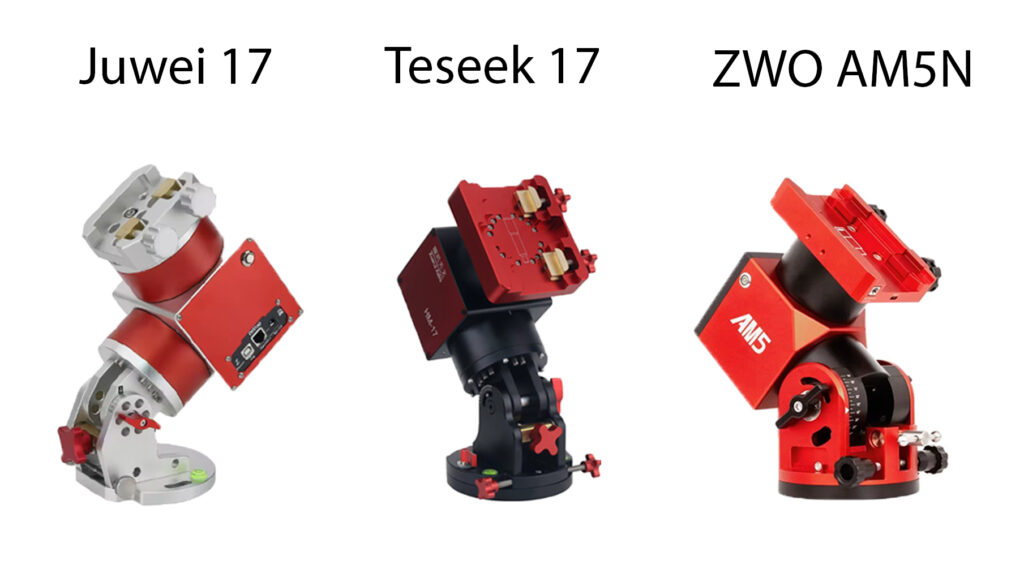
Specification Matrix: Size 17 Class
| Feature | Teseek 17 | Juwei-17 | ZWO AM5N (Mainstream King) |
| Average Street Price | ~$950 USD (~950 EUR) | ~$1050 USD (~1050 EUR) | ~$1,999 USD (~2.490 EUR) |
| Mount Head Weight | 3.2 kg (7.0 lbs) | 5.15 kg (11.4 lbs) | 5.5 kg (12.1 lbs) |
| Payload Capacity (No Weights) | 13.5 kg (29.7 lbs) | 13 kg (28.6 lbs) | 15 kg (33.0 lbs) |
| Max Payload Capacity (With Weights) | 18 kg (39.6 lbs) | 18–22 kg (39.6–48.5 lbs) | 20 kg (44.0 lbs) |
| RA / DEC Drive Transmission | Size 42 Stepper motor -> 4:1 Timing Belt -> 100:1 Gearbox (400:1 Symmetric Ratio) | NEMA 17 Stepper motor -> 4:1 Timing Belt -> 100:1 Gearbox (400:1 Symmetric Ratio) | NEMA Stepper motor -> 3:1 Synchronous Belt -> 100:1 Strain Wave Gearbox (300:1 Symmetric Ratio) |
| Safety Axis Brake | Integrated RA Axis Electronic Brake | Integrated RA Axis Magnetic Brake | Power-Off Brake (R.A. axis) |
| Telescope Saddle & Hub | Passive Dual Saddle (No upper power or data ports) | Passive Dual Saddle (No upper power or data ports) | Powered Dual Saddle (Integrated USB-C Hub + 12V DC Out) |
| Chassis Mainboard Ports | USB-C, RJ11 Hand Controller, ST4 | USB-C, RJ11 Hand Controller, ST4 | USB-C, RJ11 Hand Controller, ST4 |
| Wireless Communications | Built-in Wi-Fi & Bluetooth | Built-in Wi-Fi & Bluetooth | Wi-Fi & Native ASIAIR Bluetooth Pairing |
| Tripod Mounting Base | Flat Base (Standard 3/8″ Photo Thread Only) | Pier Hub Base (Sky-Watcher HEQ5/EQ3D Standard) | Dual Base (Standard 3/8″ Photo Thread + AM5 Flange Pattern) |
Teseek 17 vs Juwei 17 vs AM5N: Metal Shells, Safety Brakes, and Wedges
Looking at the heavy-duty Size 17 tier, the budget gaps shift dramatically. Unlike the smaller 14-class, the Teseek 17 does not require a piecemeal upgrade loop. Out of the box, its ~$950 price tag gives you an anodized metal outer chassis, a functional electromagnetic safety brake, and a built-in metal altitude-azimuth latitude adjustment wedge.
However, the structural trade-off comes down to industrial execution. While the Teseek 17 features a metal outer skeleton, it still utilizes 3D-printed plastic side covers and internal component brackets. Its integrated altitude-azimuth travel wedge is also noticeably lightweight and basic, built primarily for flat photo tripods.
Stepping up to the Juwei-17 eliminates 3D-printed parts entirely from the core frame. Its massive housing is carved entirely from solid blocks of CNC aerospace aluminum, resulting in a significantly heavier, rock-solid industrial frame (5.15 kg vs. the Teseek’s 3.2 kg). The ZWO AM5N matches this premium all-metal CNC design, providing an ultra-rigid, highly polished structural chassis with zero internal plastic flex points.
Managing the Cable Dangle
Just like the smaller class, both the Teseek 17 and Juwei-17 feature standard, passive dual saddles. Their core electronics and connectivity ports (USB-C, RJ11 handset, and ST4 guide ports) sit on the moving housing, requiring long cable loops that must swing through the air as the telescope tracks.
The ZWO AM5N completely isolates your cable routing. Its integrated Powered Declination Hub transfers power and USB-C data straight through the internal mechanics to ports located on the saddle itself. Furthermore, the AM5N mainboard supports native Bluetooth pairing directly within the ASIAIR operating system—allowing you to control the mount wirelessly.
Tripod Support and Practical Base Designs
The Teseek 17 is designed with an integrated travel wedge featuring a standard 3/8″-16 photo tripod thread, but for those requiring heavy-duty stability, many modern ST17 versions include a multi-functional base featuring three M6 bolt holes spaced in a circle. This M6 pattern serves as the industry standard for attaching harmonic mounts directly to dedicated astronomy tripods, such as the ZWO TC40, or various pier extensions without needing additional interfaces. If your specific Teseek 17 unit lacks these M6 holes, you can still achieve this rigid connection by purchasing a standard pier extension or adapter plate designed for AM5-style flanges, which screws onto your tripod’s 3/8″ bolt to provide the necessary mounting platform.
The Juwei-17 is built like an industrial tank, shifting away from photo tripods completely. Its wide, heavy baseplate is machined out of the box as a dedicated 125mm pier hub designed to drop straight into the classic Sky-Watcher HEQ5 or EQ3D tripod standard. It provides immense structural rigidity for heavy tracking, but it will not fit onto a flat photography tripod, nor a ZWO TC40 tripod, without buying a separate adapter plate.
The ZWO AM5N provides a universal dual baseplate out of the box that effortlessly bridges both worlds. It natively accepts both a standard flat 3/8″ photo thread pier and its own multi-bolt heavy carbon tripod mounting flange, giving you maximum stability without requiring aftermarket adapters.
Motor Drives
Both the Teseek 17 and Juwei-17 upgrade to heavy-duty, symmetric 400:1 reduction systems on both axes. The Juwei-17 goes a step further by using physically larger, high-torque NEMA 17 stepper motors. This gives the Juwei massive brute-force lifting power, meaning it won’t easily stall or slip when carrying off-center setups like an 11-inch Schmidt-Cassegrain telescope.
The ZWO AM5N uses a specialized 100:1 strain wave gearbox backed by a highly precise synchronous 3:1 belt pre-drive system (resulting in a 300:1 ratio). The practical performance gap here is massive: ZWO guarantees a highly refined periodic error profile strictly limited to under +/-10 arcseconds directly from the factory floor.
The industrial gearboxes used in the Teseek and Juwei 17 models have significantly rougher, more rapid internal teeth errors. While their total guiding performance can still hit a respectable 0.5 arcseconds in PHD2, it often forces you to use rapid 0.5-second guiding exposures and/or fine-tuned multi-star adjustments to constantly catch and suppress the mount’s steep error jumps.
Hardware verdict
Choosing between these larger mounts comes down to deciding between an affordable, open-hardware workhorse and a premium, plug & play ecosystem. The Teseek 17 and Juwei-17 include essential safety features like metal shells, safety brakes, and functional latitude wedges straight out of the box, delivering incredible payload capacities for around $1,000. However, the Teseek relies on a lightweight, somewhat flexible integrated travel base, while the industrial Juwei-17 forces you into the heavy, more stable Sky-Watcher tripod standard. For those who want plug-and-play perfection, the ZWO AM5N commands a premium for its individualized factory periodic error mapping, an internally routed powered saddle hub that completely eliminates cable wrap, and native wireless ASIAIR ecosystem integration.
While comparing raw physical dimensions and payload capacities is a great starting point, the true test of any harmonic mount happens in the dark. To understand if these budget clones can truly compete with ZWO, we have to look past the aluminum chassis and examine how they handle real-world software, guiding performance, and long-term customer support.
Part 3: Real-world use
ASIAIR vs NINA (or similar)
For ASIAIR users, the ZWO AM-series offers a highly integrated, single-brand ecosystem experience. Because the hardware and software are designed as a closed loop, the AM3 and AM5 can “home” themselves electronically using internal physical sensors, automatically sync location data, and recover seamlessly inside the app if tracking is interrupted. In contrast, commercial OnStep and OnStepX mounts—like those from Teseek and Juwei—are treated by the ASIAIR as standard, universal third-party devices. You simply connect via a physical USB cable and select “OnStep” from the mount dropdown menu. However, because these budget-friendly mounts typically lack internal electronic home sensors, your manual workflow shifts slightly: you must physically level the telescope to its “zero position” before powering the system on so the software knows its starting orientation.
When moving to N.I.N.A., both systems are essentially plug-and-play, completely eliminating the need for any DIY tinkering, code editing, or gear-ratio mapping. With Teseek and Juwei, the manufacturer flashes and locks down the OnStep firmware at the factory; to the end-user, it functions just like any standard commercial mount. You simply install the official OnStep ASCOM driver on your PC, click connect, and let N.I.N.A. handle the slews, plate solving, and meridian flips. The operational difference comes down to the control interface: ZWO relies entirely on its proprietary drivers and app ecosystem, while OnStep mounts give you an independent built-in Wi-Fi hotspot and web server, allowing you to modify hardware-level tracking limits or manually slew the mount via any web browser.
Ultimately, the choice does not come down to technical skill or coding, but rather a trade-off between premium hardware luxuries and pure value. If you want electronic self-homing and absolute native synergy within a single brand, the ZWO ecosystem delivers a seamless experience. But if you want to save a massive amount of money on a strain-wave mount without sacrificing automated imaging performance, a commercial OnStep mount offers a true plug-and-play alternative that “just works” in both N.I.N.A. and ASIAIR. In the modern astrophotography world… I’ll leave that conclusion up to you.
Guiding Performance: Theory vs. Reality
On paper, the ZWO AM5N benefits from factory-mapped periodic error charts, which smooth out tracking inaccuracies. While it is theoretically true that ZWO’s specialized gearboxes provide a cleaner tracking sinusoid than the industrial-grade components in Teseek or Juwei mounts, real-world reports from forums suggest the gap is surprisingly small. Many users confirm that once calibrated in PHD2, the Teseek and Juwei mounts match the 0.4″–0.8″ RMS guiding accuracy of the AM5N. The main difference is the “aggression” required: because the clones have steeper internal error jumps, they often require faster 0.5-second guiding pulses to stay locked on target, whereas ZWO’s smoother tracking allows for more relaxed 1.0–1.5 second exposures.
Open-Source vs. Corporate
On a general level, the primary divide is between an open-source ecosystem and a closed, corporate one. There is no single manufacturer “in charge”—these mounts are assembled by independent boutique stores and local electronic stores using varying internal components, leading to a lack of standardized parts or official manuals. This flexibility extends to your software: With the OnStep softare, you can control your mount with almost any open-source program you want to control your mount, but you will need to spend time to properly configure your mount. Also, if an update fails, there is no helpdesk to call. Instead, you rely on a massive, hyper-active online community of fellow Onstep tinkerers who are often incredibly fast at providing custom firmware patches or DIY repair guides.
Conversely, ZWO offers the exact opposite trade-off: a highly standardized, corporate product line. On the hardware side, every unit is identical, splitting neatly into the ultra-portable AM3N and AM5N. Because it is standard commercial hardware, you get predictable manufacturing consistency and unified documentation that decentralized clones simply cannot duplicate. However, ZWO products naturally pull users toward their broader ecosystem. While a ZWO mount works perfectly fine with open software like N.I.N.A., many ZWO users will likely opt for the popular ASIAIR controller and be confronted with a closed eco-system — the ASIAIR locks out competing dedicated camera and other assessories, heavily incentivizing you to buy their own ZWO products. Finally, that premium corporate backing has its own bottlenecks; some users on community forums complain about slow communication and inconsistent service from ZWO’s internal team when technical glitches happen.
Hidden Costs: International Import & Warranty
Le’s also talk about international import and warranty. Because Juwei, Teseek, or similar OnStep mounts often ship directly from Chinese warehouses, AliExpress uses a platform mechanism that strips local taxes from your shopping cart at checkout, leaving you to pay a surprise customs invoice upon arrival, which is highly dependent on your geographical location.
For European buyers, it probably remains a fantastic deal: you will be charged your local country’s standard VAT (typically 19% to 25%) and a small courier handling fee, adding roughly €220 to €260 to a €1,000 mount. Since a ZWO AM5N retails locally in Europe for around €2,200 to €2,400, European buyers still save up to €1,000.
For US buyers, however, current trade policies probably make this a financial dealbreaker: U.S. Customs has indefinitely suspended the old $800 de minimis duty-free exemption, and aggressive tariffs heavily penalize Chinese-manufactured machinery and telescope gear. The resulting customs invoice for tariffs, informal entry processing, and state use taxes will completely balloon your final cost past $2,400—meaning US buyers are far better off simply purchasing a fully warrantied ZWO AM5N or similar (Sky-Watcher, iOptron) mount domestically for $2,000 to $2,200 from local dealers who import via tax-advantaged ocean freight container blocks.
This brings us to the reality of the warranty. While listings on AliExpress often advertise a “1-year limited warranty” or a “90-day return policy,” executing this in the real world is a completely different story. If a 9 kg metal telescope mount head arrives defective, actually shipping it back to Asia with premium tracking and insurance can easily cost you between €120 and €200 out of your own pocket. Furthermore, an AliExpress warranty rarely means a replacement unit. Instead, it usually means the seller will diagnose the issue over a chat screen or email, send you a loose circuit board, and expect you to break out your own tools to rebuild the internal electronics yourself. That said, you are rarely truly alone—you have a massive, hyper-active community of fellow tinkerers online who are often quicker to provide a custom software patch or a DIY repair guide than any corporate support department.
When you buy a ZWO mount through a recognized, authorized dealer like Agena Astro or High Point Scientific in the US, or Astroshop in Europe, you are primarily paying for a local, commercial safety net. ZWO provides a standardized two-year warranty that protects against manufacturing and material defects under normal residential use. The critical advantage here is domestic logistics and dealer intervention: if your mount arrives dead on arrival or fails within the coverage period, you don’t have to deal with the stress and high costs of international shipping or customs brokers. Instead, your local shop serves as your primary point of contact—handling the return, swapping out components, or managing the official Return Merchandise Authorization (RMA) process directly with ZWO’s regional repair hubs on your behalf.
Final Verdict: Which Path Is Right for You?
If you are a tech-savvy tinkerer who enjoys spending time optimizing code and configuring hardware, Teseek and Juwei mounts offer incredible value for the money. You can achieve high-end tracking performance at a fraction of mainstream corporate costs, provided you are comfortable acting as your own technician.
However, because these mounts are decentralized, you must be careful about exactly which version you are buying and from whom. To help you navigate the marketplace safely, here is a breakdown of two reliable stores featured in the links below:
LittleLight Store (Independent Astro Boutique): This is a smaller, specialized boutique storefront with a 97.3% positive review score and around 485 followers. It is run by an active astrophotography developer known in the community as “LittleKarl.” Because he actively tests his own gear on popular platforms like N.I.N.A., he can actually step in to help you troubleshoot software bugs or technical configuration issues. In addition to stocking excellent variations of the baseline Juwei 14/17 mounts, Karl also sells his proprietary ClearSky house brand alongside the highly sought-after Scorpio Astro SA-17 series. The compact Scorpio SA-17 form factor shares a striking physical resemblance to the original ZWO AM5 model, though it features a passive saddle plate whereas the newer ZWO AM5N has transitioned to an integrated, powered saddle hub.
MAXGEEK (General Electronics Supplier): Boasting a 96.2% positive rating and over 5.7k followers, MAXGEEK operates like a larger general electronics liquidator. They stock a wide array of the upgraded Teseek and Juwei 14/17 class strain wave mounts. While their prices are highly competitive and delivery is reliable, keep in mind they are primarily high-volume retail shippers—don’t expect deep technical support or custom software advice if you run into an OnStep glitch.
Final Verdict
If you are a beginner or an imager who prioritizes time under the stars over troubleshooting, the ZWO AM3N / AM5N are the superior choice. You are paying for the peace of mind that comes with a formal warranty, standardized support from astroshops, and an integrated software ecosystem that most of the time “just works.” Choosing ZWO is choosing to pay for a streamlined experience from a well-known manufacturer in the astrophotography market, while choosing a clone is choosing to trade your time for a significant reduction in hardware costs.
It is worth remembering that even ZWO started as a small, enthusiast-driven disruptor in 2011, selling little more than the iconic ASI120 camera to planetary imagers. Today’s budget harmonic mounts are essentially in that same “early adopter” phase—they are rough around the edges, but they represent a massive shift in what is possible for the average hobbyist.
Pro-Tip: If you are contacting any AliExpress vendor, ask them specifically before you pay: “Does this unit include the electromagnetic safety brake, is the mount body fully metal (CNC) with no 3D-printed outer shell, does it include a heavy-duty alt-az wedge, a dual saddle (Vixen/Losmandy), and a base plate that natively accepts your favorite tripod (e.g., ZWO TC-40)?” Even with highly rated vendors, it’s always best to verify the exact build of the unit currently sitting in their warehouse.
3 Replies to “A Sub-$1,000 Strain Wave Mount?: Comparing the budget Teseek & Juwei 14/17 to the mainstream ZWO AM3N/AM5N”