Can the Dwarflab Draco beat the Seestar S50 Pro Smart Telescope? In this blog, I compare the official RAW sample data from the upcoming Dwarflab Draco, currently on pre-order with first deliveries planned end of december 2026, against images captured with my Seestar S50 Pro of the Eastern Veil Nebula (NGC 6992). I also compare techical specs between the two telescopes to help you decide which one is best for you.
Dwarflab recently released some first RAW images captured with their upcoming Draco smart telescope—specifically of NGC 6992, the Eastern Veil Nebula. Since I have the Seestar S50 Pro on hand, I couldn’t resist imaging the same object with the S50 Pro using a similar total exposure time from my Bortle 7 urban skies. So, in this blog, we’re going to take a close look at the RAW data from both telescopes. But before diving into data analysis, let’s compare the specs of both smart telescopes side-by-side so you’re aware of the main pros and cons .
Technical comparison
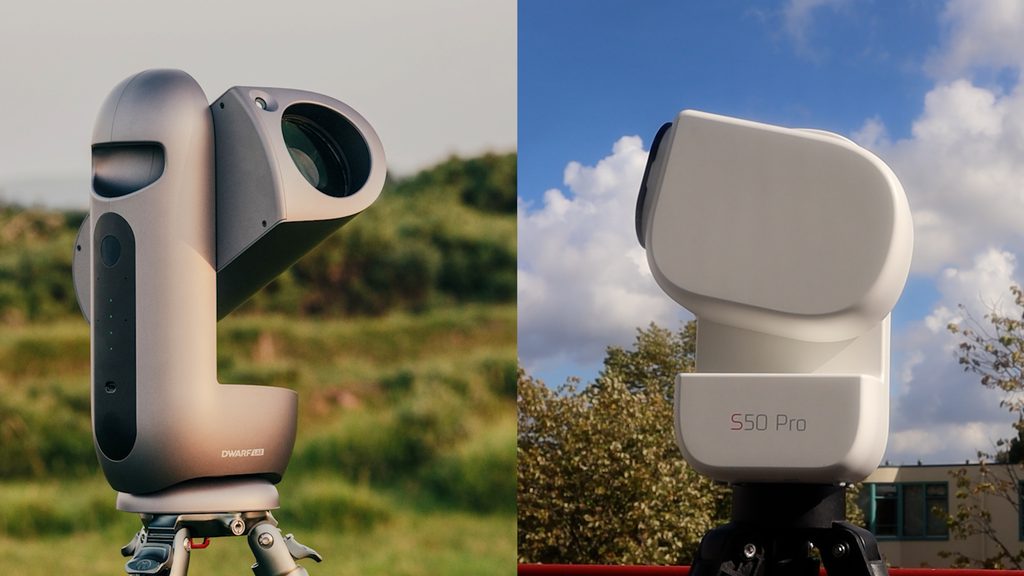
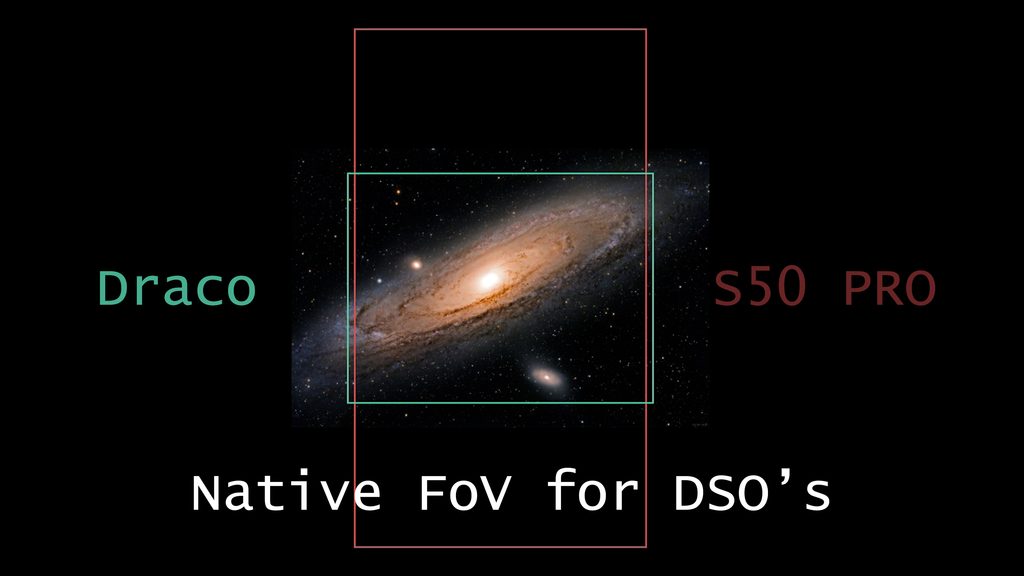
So let’s start with some advantages of the Seestar S50 Pro over the Dwarflab Draco. The Seestar S50 Pro is priced at $999, whereas the Dwarf Draco Standard Edition costs $1,399, and the SHO Edition $1,599. The Seestar S50 Pro weighs significantly less at 2.8 kg vs. 5.5 kg, and features a more compact form factor, making it easier to take it with you on field trips. It outlasts the Draco on a single charge with nearly double the battery life (9 hours vs. 5 hours). Moreover, the s50 pro has a wider native field of view in portrait mode of 1.38 by 2.45 degrees, with a 2.80 degree diagonal. The Draco features 1.65 x 1.24 degrees, and a 2.06 degree diagonal when used in deep sky mode.
Now let’s look at the potential advantages of the DWARFLAB Draco. I say potential as I haven’t personally tested it yet; it’s currently on pre-order with initial shipments scheduled for late 2026 or early 2027. Check the links below if you want more details on where to buy featuring vendor links and reliable shops across the USA and EU. Note that these are affiliate links, meaning I earn a small commission at no extra cost to you, helping me keep my YouTube channel and the astroforumspace website going.
🔭 Dwarflab Draco Smart Telescope Pre-Order
✨ ZWO Seestar S50 Pro
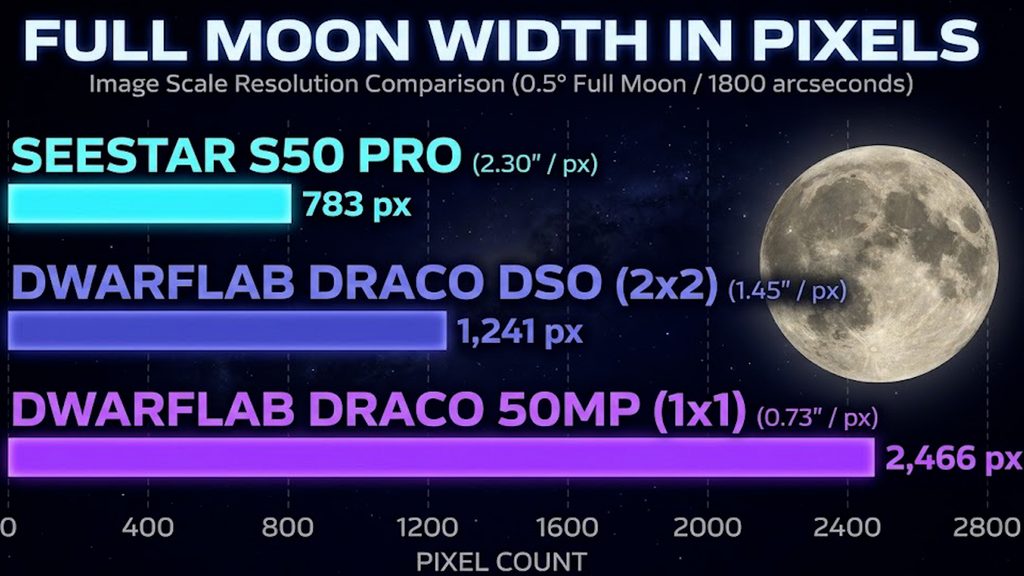
Draco has a larger 90 mm aperture compared to the Seestar S50 Pro’s 50 mm, meaning the Draco gathers nearly three times as much light and also more detail with a Dawes limit of 1.29 arcseconds versus 2.32 arcseconds on the Seestar. And thanks to its faster f/3.8 focal ratio as compared to f/5.2 on the S50 Pro, the Draco collects light nearly twice as fast on its camera sensor. That means you need significantly shorter imaging times to reveal faint details in deep-sky objects. The Draco also features a higher-resolution 50MP camera which is binned to 12.6 MP sensor in deep sky mode (4096 x 3072) versus a smaller 8.3 MP camera on the S50 Pro. The Draco delivers an image scale of 1.45 arcseconds per pixel in binned deep-sky mode, and 0.73 arcseconds per pixel in solar system mode—compared to a coarser 2.30 arcseconds on the S50 Pro. That gives the Draco notably finer digital resolution. And the best is yet to come.
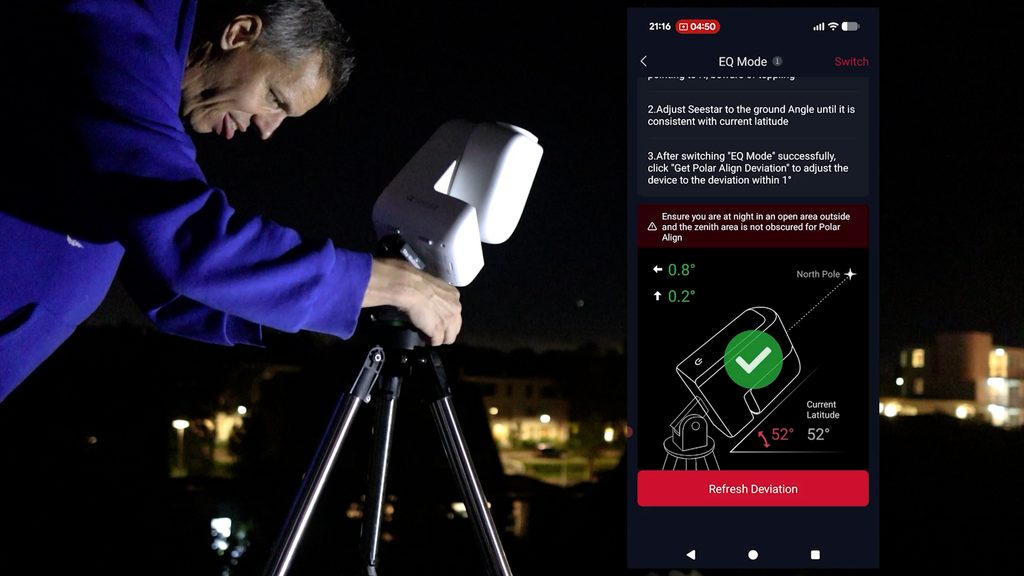
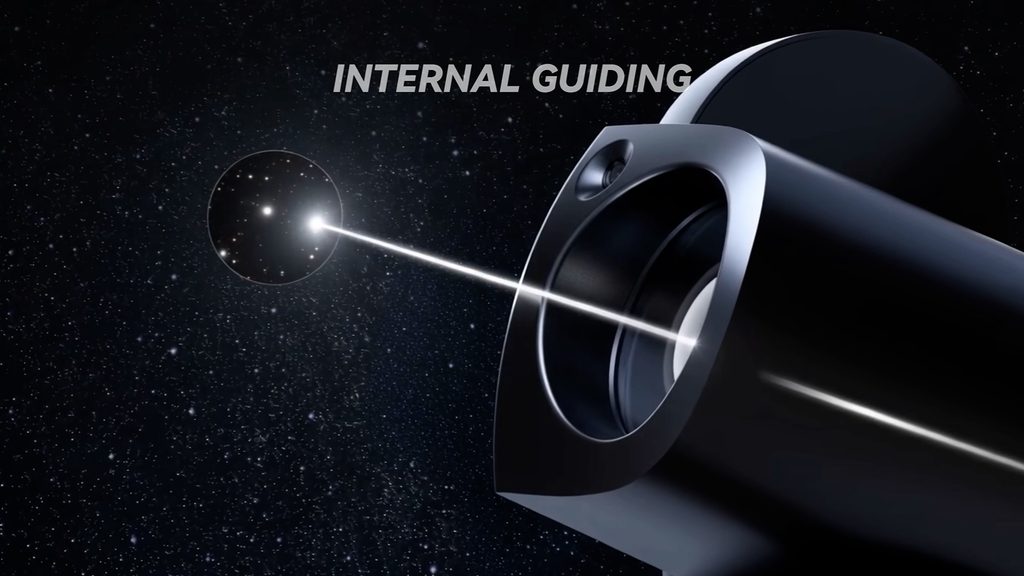
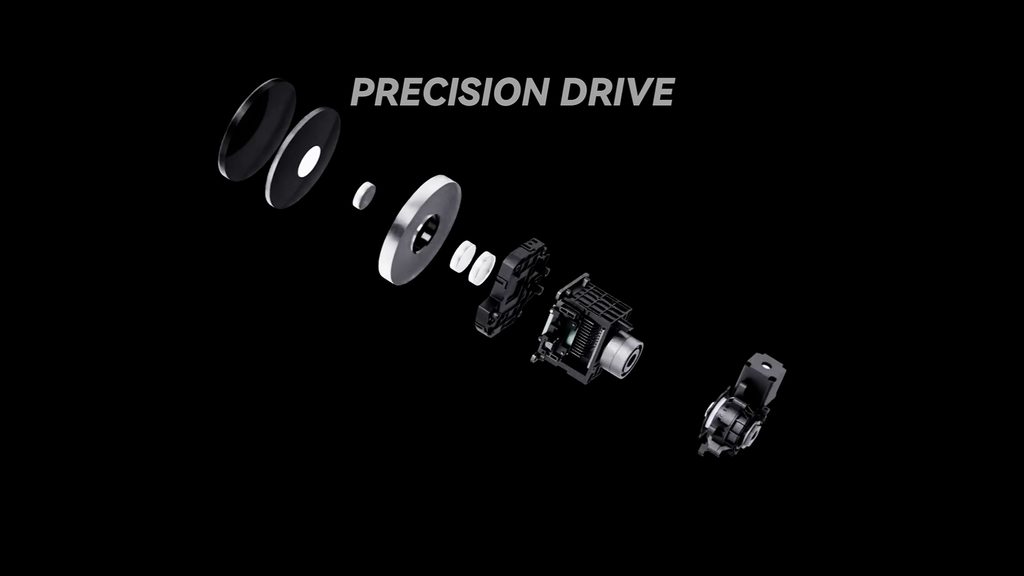
The Draco features built-in autoguiding and a physical sensor rotator that actively cancels out field rotation. That means you can take long exposures up to 300 seconds straight out of the box in simple Alt-Az mode which doesn’t require any polar alignment or equatorial setup. By contrast, the Seestar lacks autoguiding and exposures at limited to 60 seconds, which requires setting up an extra tripod wedge in EQ mode and performing a polar alignment procedure.
The Draco also features active TEC cooling, but don’t confuse this with a fully dedicated sub-zero cooled astrocamera. It lowers sensor temperatures by 5 to 10 degrees Celsius below ambient to cut down some thermal noise, while it uses that heat to prevent the front lens from fogging up. By contrast, the Seestar S50 Pro lacks active cooling and keeps its sensor fixed in portrait mode, though it does include an anti-dew heater.
Finally, both telescopes feature a built-in dark filter for automatic dark-frame calibration. The Seestar carries an IR-cut filter for broadband imaging, a dual-band H-alpha + O-III filter with 20 and 30-nanometer bandpasses, and an external clip-on filter for solar imaging. the Draco uses a tighter 13-nanometer dual-band H-alpha + O-III filter. The Standard Edition includes an internal ND solar filter to capture the Sun. The Draco SHO Edition replaces that internal solar filter with a built-in S-II + O-III dual-band filter to produce full SHO Hubble-palette images, while providing an external clip-on ND filter for solar observation instead. For broadband imaging, both Draco editions are equipped with a dedicated Astro filter with a bandpass of 430-690 nm.
Alright so all this is just a lot of tech talk which is nice, but let’s move on to the RAW data comparison so we can see how all these numbers translate into actual deep sky photos.
Examining the RAW Data
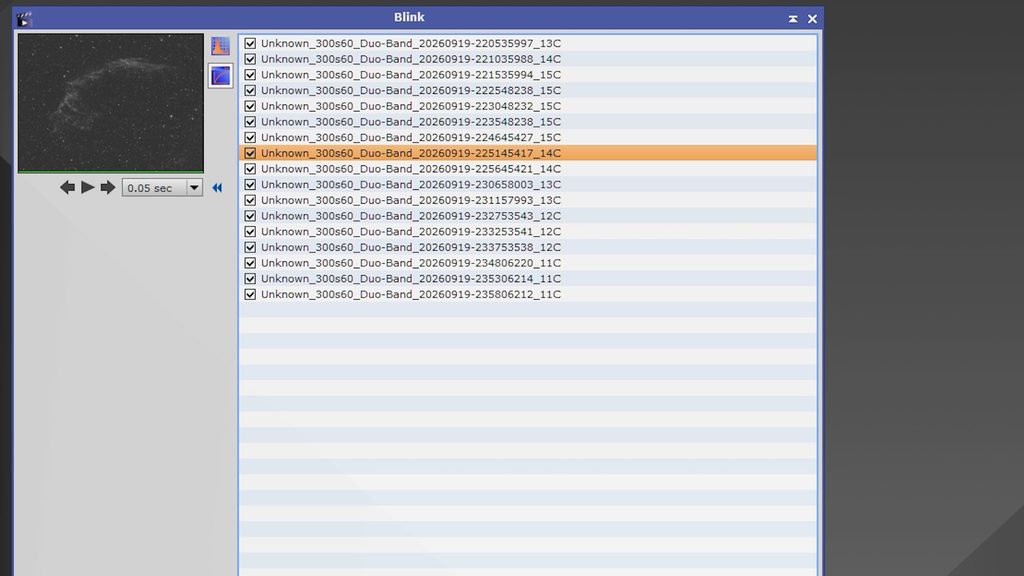
The RAW DRACO data consists of 17 individual 300-second exposures of NGC 6992—the Eastern Veil Nebula, part of the famous supernova remnant in Cygnus. I want to make two remarks about the RAW single exposures, starting with temperature control.
Sensor Temperature: The FITS headers recorded sensor temperatures fluctuating between 11°C and 15°C throughout the run. So this confirms we are dealing with a cooling system that will cool your camera sensor by a couple of degrees, but lacks dedicated sub freezing temperature control like we are used to having on our dedicated cooled astrocameras, so keep that in mind.
Total Imaging Time vs. Real Time: Also, the 17 frames were captured between 22:05 and 23:58 on September 19, 2026. That is a total elapsed window of 113 minutes to capture 85 minutes of exposure data, leaving nearly 30 minutes of extra overhead time. Of course, some of that overhead is attributed to saving frames and dithering every couple of frames to avoid fixed-pattern noise in your stacked image. But on the Seestar these processes take about eight minutes total (see below). DWARFLAB’s response was that they experienced passing clouds during the capture, which could be true of course. However, informal reports from early testers also suggest the Draco is still in its beta phase, and DWARFLAB is actively resolving reported software bugs ahead of the official release.
As for the Seestar S50 Pro, I captured a total of 108 sub-exposures at the maximum 60 seconds each with the S50 Pro in EQ mode, reaching a total integration time of 1 hour and 48 minutes across two imaging sessions. My total real-world time was one hour and 56 minutes, leaving an 8-minute gap between total session time and actual exposure time. That 8 minutes is completely accounted for by a ~3-second saving and initialization delay between individual frames, plus a ~10-second pause every 6 frames for automated dithering, which is essential for eliminating fixed-pattern noise in post-processing. Seeing how little overhead time was lost to dithering and readout, without any dropped frames, I was really impressed by this result. The Seestar fits headers do not report temperature, but the outside temperature was about 10°C, at night, so this matches the temperature conditions of the Draco dataset.
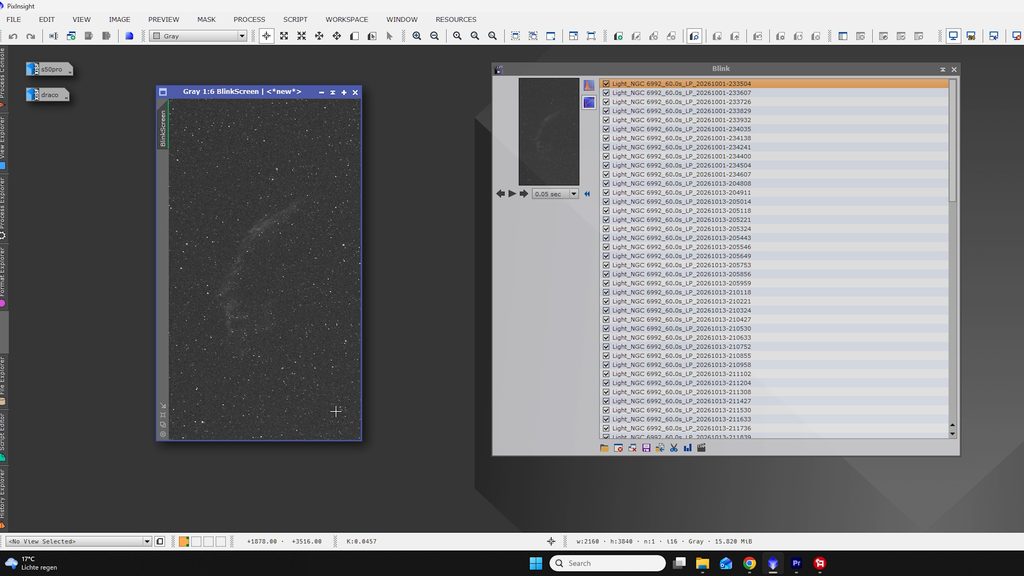
I stacked both datasets using the exact same procedure in PixInsight’s Weighted Batch Pre-Processing (WBPP) script, then matched the framing of the Seestar S50 Pro image to the Draco’s rotation for a direct, side-by-side comparison.
Stacked Draco Image vs Seestar S50 Pro
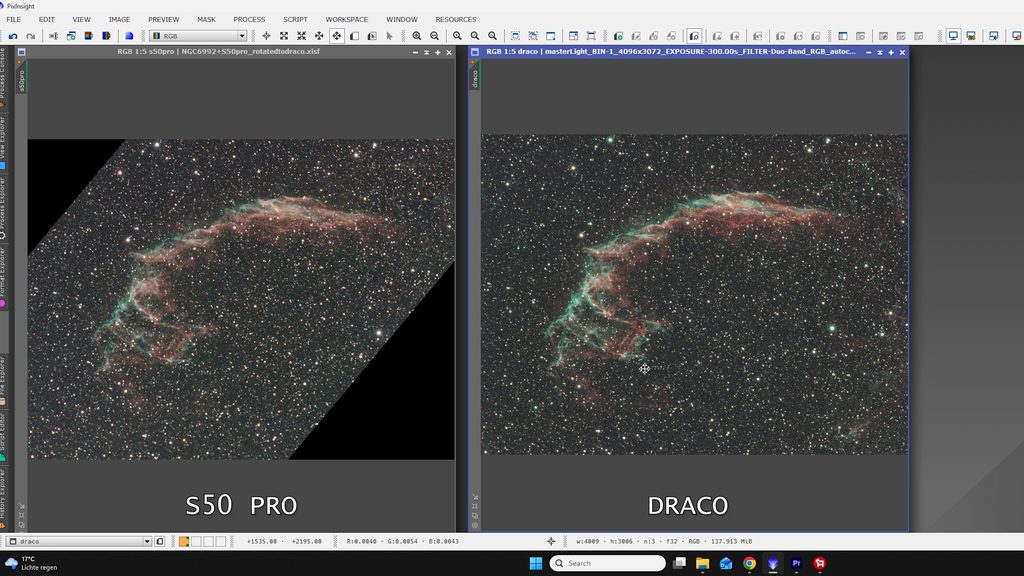
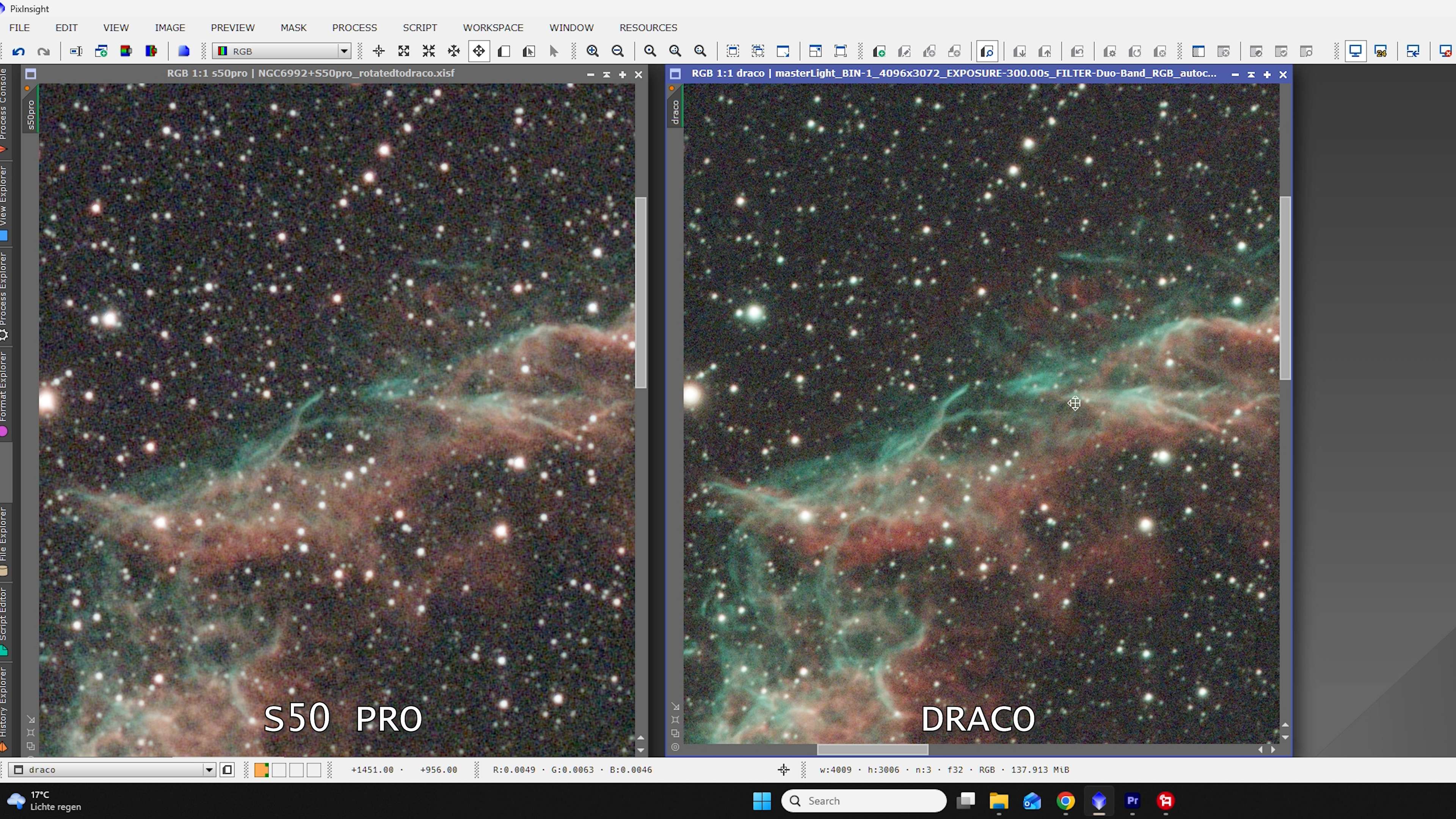
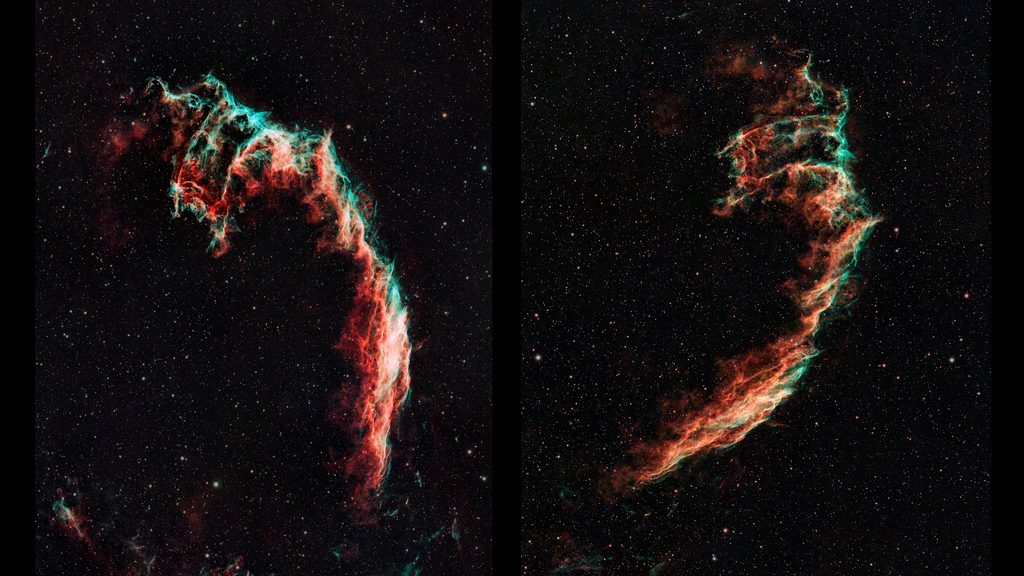
When visually comparing the stacked images, my initial reaction was that they looked quite similar. But when zooming in closely, several noticeable differences begin to emerge. For example, the stars captured by the Draco are somewhat tighter and show a bit more fine detail compared to the Seestar S50 Pro image. Also, because of it’s bigger aperture the Draco separates close star groups a bit better as compared to the S50 Pro.
The stars captured by the Draco also came out noticeably more colorful compared to the Seestar—which honestly surprised me at first, considering the Draco used 300-second exposures versus my 60-second shots on the S50 Pro.
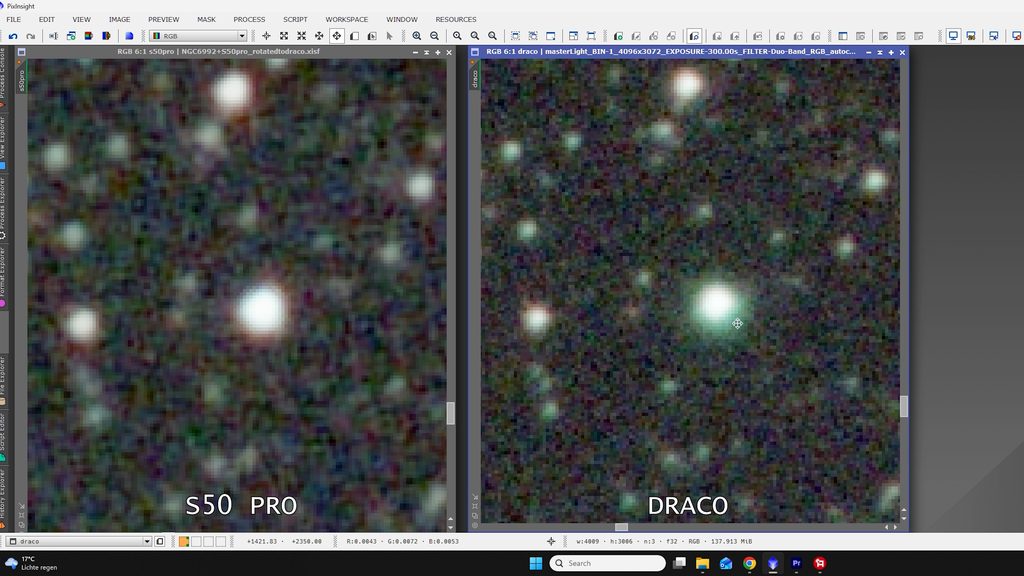
Typically, 5-minute subs risk overexposing star cores and washing out their color. One factor might be that the Draco’s tight 13-nanometer HO dual-band filter more aggressively cuts light pollution compared to the broader 20-to-30-nanometer filters on the Seestar S50 Pro. Also, I’m imaging from Bortle 7 skies, so light pollution like LED streetlights may dilute star color even when using a dual band filter.
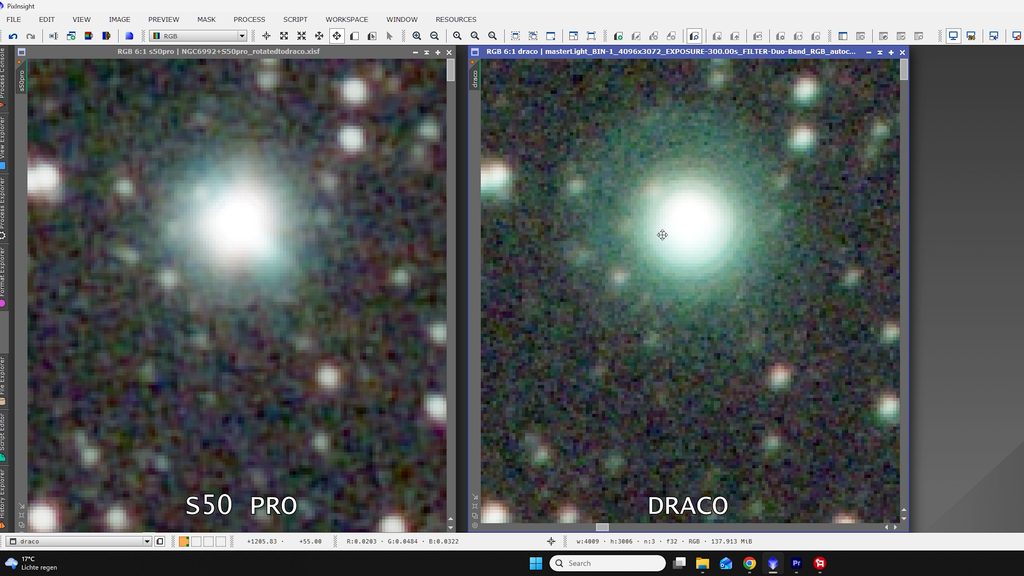
The halos around bright stars are a bit more prominent on the Draco, though they remain nice and round. This stronger haloing is probably a direct result of using 300-second exposures versus 60-second ones where Faint internal reflections off the filter are built up over 5 full minutes of exposure give them enough time to accumulate into visible halos around the brightest stars.
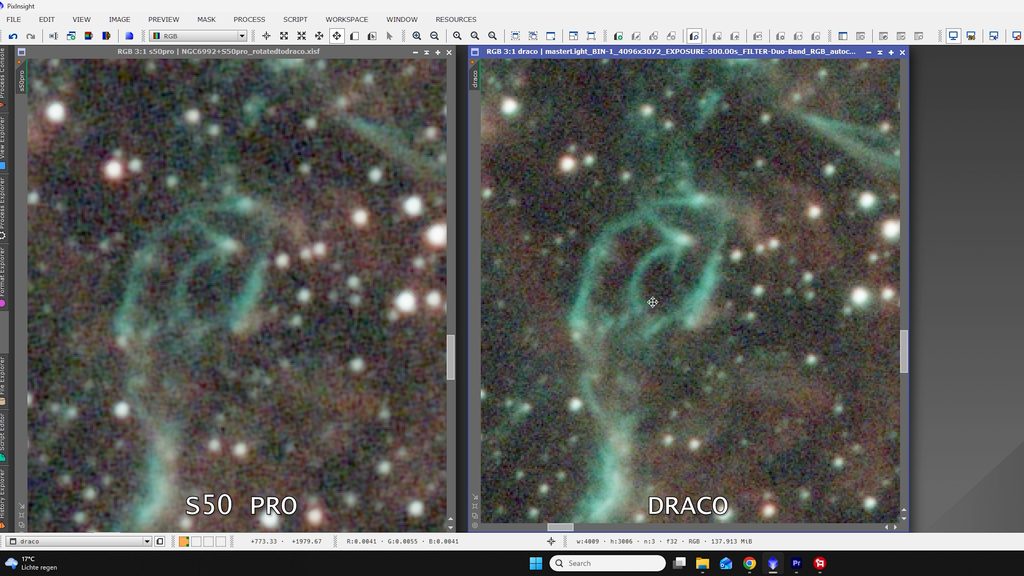
Where the Draco really sets itself apart is in the nebulosity, showing clearly more detail overall when zooming in. For example, looking at the head of the Eastern Veil Nebula, the Draco does a better job in pulling out the intricate, curly structure. You can also see sharper spikes along the outer edge of the east veil nebula, as well as faint hints of a red ribbon floating just above it in the Draco stack. By comparison, the S50 Pro renders these details somewhat blurrier, and that faint red ribbon didn’t show up at all.
So why do we see these differences? Well, let’s get a bit nerdy for a second.
First, the Draco’s 5-minute exposures at f/3.8 gather over 9 times more light per frame than a single 1-minute exposure at f/5.2 on the Seestar. That gives each individual 5-minute frame of the Draco a much higher Signal-to-Noise Ratio.
Second, both images were taken using dual-band filters. Because these tight narrowband filters block 90 to 95% of incoming light, weak light from the east veil nebula emissions trickle onto the sensor very slowly. A 60-second exposure simply isn’t long enough to push that weak signal from the Veil Nebula past the camera’s read-noise threshold. To reach peak efficiency in narrowband, you need multi-minute single exposures to cleanly capture the weak signal from the nebula above the camera sensor noise.
But, you may ask, since we roughly matched the total exposure time of the two stacked images, why doesn’t that solve the issue? That comes down to two reasons. Even with equal total integration time, 60-second exposures force the Seestar to read out the sensor five times as often, which adds extra camera read noise along the way which hurts your accumulated Signal to noise ratio. Also, because the Draco’s faster f/ratio, the S50 Pro would actually need roughly double the total imaging time to match the background signal-to-noise ratio of the Draco.
For broadband imaging, like galaxies or star clusters, you will not use the narrowband filters and capture much more light. In that scenario, the advantage of 5-minute versus 1-minute exposures would be far less prominent, as 60-seconds of the Seestar S50 Pro are already at near peak efficiency, especially in an urban, light polluted sky.
FWHM and Eccentricity (math) analyses
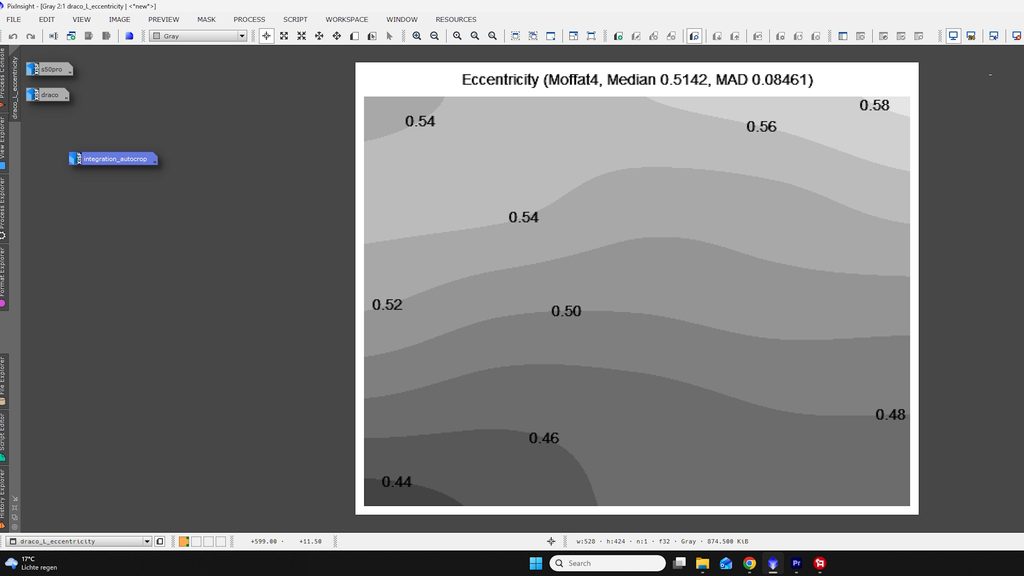
I also mathematically analyzed the stars of both stacks using PixInsight’s FWHMEccentricity script to confirm my visual findings. The Dwarf Draco yields a median FWHM of 3.51 pixels across all stars. At the Draco’s image scale of 1.45 arcseconds per pixel, that translates to a real-world FWHM of 5.09 arcseconds, with a Median Absolute Deviation of 0.24 pixels. The median eccentricity, which refers to roundness, across all stars measured 0.51 with a MAD of 0.08.
Looking across the stacked image of the draco, I did find a slight optical gradient where the eccentricity ranges from a better 0.44 in the bottom-left corner to a worse 0.58 in the top-right. This subtle gradient across the frame likely comes down to slight sensor tilt or microscopic play in the rotating sensor mechanism across 5-minute exposures. Still, I’m genuinely impressed by these numbers. It won’t beat my 80 mm APO refractor, as I demonstrated in my other comparison video, but reaching this level of optical performance on a fully automated smart telescope at this price point is a remarkable achievement.
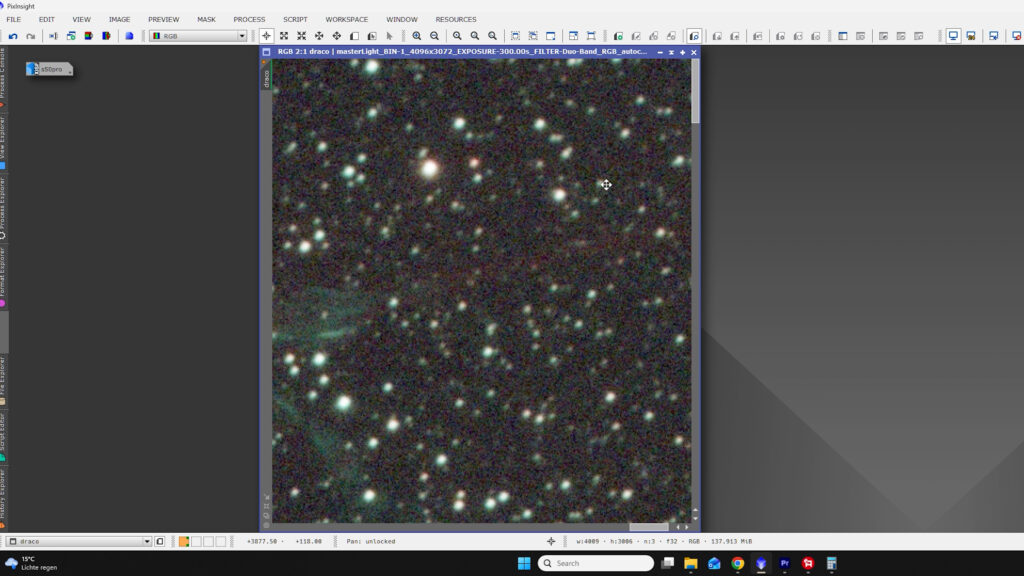
The Seestar S50 Pro stacked image yields a median FWHM of 2.90 pixels. At the Seestar’s image scale of 2.30 arcseconds per pixel, that translates to a real-world FWHM of 6.67 arcseconds, with a Median Absolute Deviation of 0.38 pixels. Across all detected stars, the median eccentricity measured 0.44 with an MAD of 0.11. Looking at field flatness, eccentricity ranges from 0.35 in the center up to 0.50 near the edges.
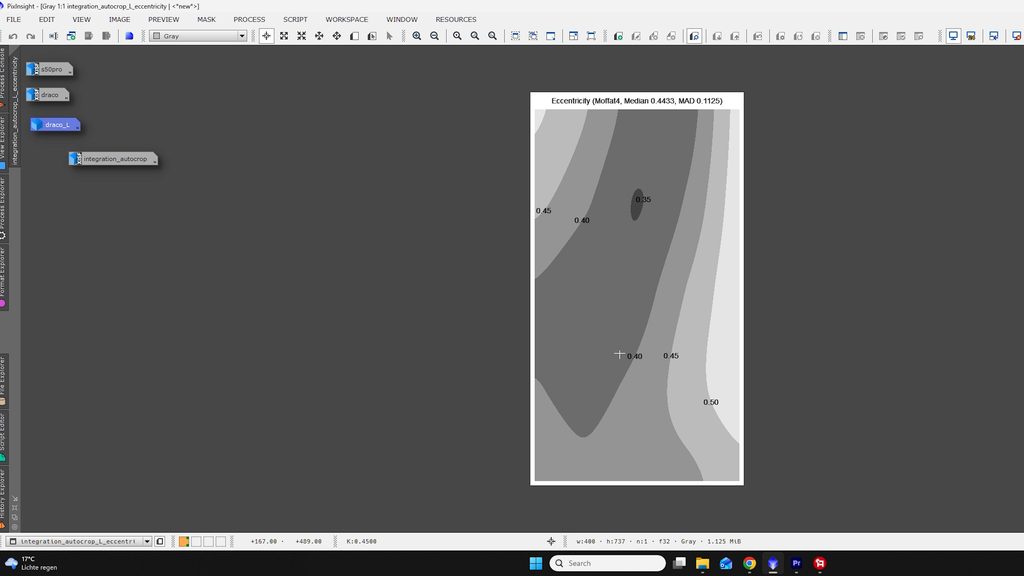
The FWHMEccentricity script mathematically confirmed what my eyes already saw: the Dwarf Draco records noticeably tighter stars than the Seestar S50 Pro, boasting a real-world 1.5 arcsecond advantage in FWHM. Interestingly, the Seestar S50 Pro maintained slightly better star roundness overall, scoring an eccentricity of 0.44 versus the Draco’s 0.51. That makes total sense, as short 60-second exposures give potential tracking errors much less time to elongate stars as compared to the Draco’s longer 5-minute guided exposures.
Conclusion
While the Dwarflab Draco remains on pre-order, its sample RAW FITS data already confirms optical superiority over the Seestar S50 Pro. The Draco produced sharper stars (1.5-arcsecond FWHM advantage), superior narrowband star color preservation, and noticeably greater detail in the nebula itself. The remaining questions surrounding the scope are less about its proven image quality and more about real-world usability as production units roll out: how seamlessly the Dwarflab app performs during live field sessions, how efficiently will the Draco be in collecting (vs dropping) long exposure photos, and how reliably the active TEC cooling and internal camera de-rotator drive operate during extended multi-hour imaging runs.
So in conclusion: Purely on optical results, the Dwarf Draco wins, which was to be expected given its larger 90 mm aperture (3x more light-gathering power), faster f/3.8 f/ratio (2x faster light capture), finer image scale, and 5-minute guided exposure capabilities. On the other hand, the Seestar S50 Pro is about 500 dollars or euros more affordable, it is more compact and lightweight, and its internal battery lasts nearly twice as long. Plus, the Seestar app is easy to use and its tracking performance in EQ mode is very good, with no dropped frames at 60-second exposures. Personally, I’d love to get my hands on a Draco to perform some real-world testing with the Dwarflab app and the camera derotation drive in alt-az setup before declaring Draco the absolute winner here. So what do you think? Is the Draco’s extra performance worth the higher price, or would you stick with the S50 Pro?
Clear skies!
Wido.