With many smart telescopes already on the market and more on the way, it’s becoming a challenge to decide which smart telescope best suits your individual needs. In this Best Buy guide, I compare various brands of Unistellar, Vaonis, ZWO Seestar, and Dwarflab’s Dwarf smart telescopes. Based on factors such as price, telescope type, camera, ease of use, real-world photo quality, storage capacity, weight, and size, this guide aims to help you make an informed decision. I conclude the comparison by discussing which smart telescopes are the best in their price class, ranging from an affordable $400 to a high-end $4000. I’ll be updating this Best Buy guide periodically as more smart telescopes become available.
last update: January 2026
The Rise of Smart Telescopes: Simplifying Stargazing and Astrophotography for All
Smart telescopes are becoming increasingly popular. The fundamental concept behind smart telescopes is to merely switch on the device, connect it to an APP on your smart device (phone/tablet), select a celestial object of interest, and then sit back and relax while the smart telescope handles all the challenging aspects for you. This includes locating the object of your interest in the night sky, tracking the object to keep it centered in your telescope’s field of view, and providing you with an excellent view of that object on your smart device (phone/tablet/iPad). Companies like Unistellar, Vaonis, and Dwarflab were among the first to develop smart telescopes with the primary goal of simplifying stargazing and astrophotography for ordinary people who don’t wish to invest days, months, or years mastering all the intricacies of our captivating hobby known as astrophotography. Due to its popularity, more established brands in the amateur astrophotography niche like ZWO, and more recently Celestron, have developed or are developing their smart telescopes.
If you’re looking for a side-by-side comparison, click the button below to launch my new interactive comparison tool.
Smart Telescopes Best Buy Guide: Choosing Your Celestial Companion
The primary objective of the Smart Telescope Best Buy Guide is to assist individuals in choosing the most suitable smart telescope. In this guide, I define a telescope as “smart” when the telescope is capable of autonomously locating, tracking, and capturing images of celestial objects in the night sky. This excludes traditional telescopes designed for naked-eye stargazing with an eyepiece. All featured telescopes are Wi-Fi-enabled and controllable through apps compatible with popular platforms like iOS and Android.
At present, this smart telescope guide includes the following brands: Celestron, Dwarflab, Unistellar, Vaonis, and ZWO Seestar telescopes. Some are older models but might still be relevant, as you could find used telescopes available from their original owners. The blog will be regularly updated to incorporate new smart telescopes as they become available.
I’ve taken various factors into account to help you find the ideal smart telescope:
- Price
- Telescope specifications (aperture, focal length, f/ratio)
- Camera sensor details (resolution, image scale, field of view)
- APP quality for smart telescope control
- Picture quality
- Photo and Video formats
- Storage capacity
- Weight and Size
- Astrophotography filters
You can find my recommendations for the best smart telescopes in different price ranges here:
- Best Smart Telescope for $400
- Best Smart Telescope for $600
- Best Smart Telescope for $1500
- Best Smart Telescope for $2500
- Best Smart Telescope for $4000
Price
The ZWO Seestar S30 and the Dwarf Mini are available for about $399, and are among the most affordable smart telescopes on the market today. The ZWO Seestar S50 at $499 and Dwarflab’s Dwarf 3 at $599 are also among the more affordable smart telescopes, as well as the Seestar S30 Pro at $599. These telescopes provide an economical entry point into deep-sky astrophotography. You can check out my detailed review of the Seestar S30 here, the Seestar S50 here, and my review of the Dwarf 3 is available here, Dwarf mini here, and the Seestar S30 Pro here. If you’re interested in Dwarflab’s older model, the Dwarf 2, my comprehensive review can be found here.
Vaonis currently offers the Vespera II, starting at $1,590, the Vespera II-X at $2,290 and their newer Vaonis Vespera Pro, starting at $2,799. You can find my review of the Vespera Pro here, the Vespera II here, and the Vespera II-X edition here. If you’re interested in the older, classic version of the Vespera, you can find my review here.
Unistellar has the Odyssey at $2,299, the Unistellar Equinox 2 at $2,499, the Odyssey Pro at $3,999, and the Unistellar EVscope 2, which tops the range at $4,899. Finally, the Celestron Origin Intelligent Home Observatory is priced t $3,999. Do these price variations correlate with differences in quality? Let’s explore further to find out.
↑ back to criteria
Telescope types
Telephoto and wide-field design
Although marketed as telescopes, Dwarflab’s DWARF models (e.g. Dwarf 3, Dwarf mini) feature telephoto and wide-field lenses instead of a traditional telescope design for capturing night sky images. This versatile combination makes DWARF telescopes ideal for both daytime nature and wildlife photography as well as nighttime astrophotography, serving as a multipurpose device.
Refractor telescopes
The ZWO Seestar (S30/S30 Pro/S50) and Vaonis Vespera (II/Pro), belong to the category of refractor telescopes, utilizing lenses to gather and focus light. The use of ED glass in refractor telescopes effectively reduces chromatic aberration, resulting in sharper and more color-accurate images compared to standard refractors.
Notably, the ZWO Seestar S30 and S50 adopts a triplet Refractor Telescope design, featuring a three-lens system, with one extra-low dispersion (ED) element. The additional lenses in a triplet, compared to a doublet, contribute to further correction of chromatic aberration, enhancing image quality and color correction. ZWO does not specify the exact type of ED glass used in their telescopes (e.g. FPL-51, FPL-53, or FCD-100), but does ensure an apochromatic, sharp and color accurate view of the night sky with their Seestar telescopes.
The Seestar S30 Pro and the Vaonis Vespera (II/II-X/Pro) adopts a Quadruplet Refractor Telescope design, incorporating a four-lens system. The Vespera II has a high quality, low dispersion S-FPL52 ED lens element. The additional lens elements in a quadruplet design, exceeding those in a triplet or doublet, significantly enhance color correction, resulting in exceptionally high-quality images in the field of astrophotography.
Reflector telescopes
Unistellar’s designs (e.g. Odyssey, Equinox 2, EVscope 2) all fall into the category of reflector telescopes, relying on mirrors to collect and focus light. Typically, a reflector telescope includes a curved primary mirror and a secondary mirror. Reflector telescopes are popular choices in astrophotography as they provide a large aperture at lower costs as compared to refractor telescope designs. But Unistellar’s telescopes are priced in the mid-range to high price categories in the smart telescope market.
This may be due to their innovative design where the optical tubes are prime-focus single-mirror telescopes, devoid of a secondary mirror or a coma corrector. In this design, the image directly reflects from the primary mirror to the camera sensor. This design may reflect some of the more expensive reflector designs on the traditional telescope market like Celestron’s RASA Telescopes.
Manual collimation is required for Unistellar’s Equinox and EVscope designs, but not for their Odyssey telescopes. Unistellar provides specific videos on how to achieve collimation. Despite these challenges, reflectors, with their larger apertures, excel in deep-sky astrophotography, capturing ample light for detailed celestial images.
Rowe-Ackermann Schmidt Astrograph
The Celestron Origin telescope features the advanced Rowe-Ackermann Schmidt Astrograph (RASA), an f/2.2 optical system with an ultra-wide field of view and sharp edge-to-edge clarity. Unlike traditional designs, RASA places the imaging sensor at the front, enabling faster and more efficient light capture. The compact 6” RASA in the Origin offers observatory-grade performance in a portable design. RASA’s speed and aperture surpass Newtonian reflectors, refractors, or other entry-level telescopes, delivering exceptional image detail in shorter exposures. While Celestron ensures the telescope is well-collimated out of the box, it is a mirror-based system, so periodic collimation may be required to align the camera with the mirror. Proper collimation is crucial to maintaining the telescope’s exceptional performance and capturing stunning astrophotography results.
Aperture, focal length, and f/ratio
In astrophotography, aperture and focal length are key. Aperture, the telescope’s lens or mirror diameter, determines its light-gathering ability—essential for capturing faint objects. Among smart telescopes, the largest apertures are in the Unistellar Equinox 2 and EVscope 2 (114mm), followed by the Unistellar Odyssey (Pro) with 85mm. The Vaonis Vespera II/Pro and Seestar S50 have 50mm apertures, while the Dwarf 3 (35mm), Dwarf mini (30mm), and Seestar S30 and S30 Pro (30mm) offer the smallest apertures.
Focal length, the distance from the lens or mirror to the image plane, affects magnification and field of view. Longer focal lengths provide higher magnification, ideal for detailed shots. The Unistellar Equinox 2 and EVscope 2 lead with 450mm , followed by the Unistellar Odyssey (320mm). The Seestar S50, Vaonis Vespera II/Pro have 250mm, the S30 Pro has 160mm, while the Dwarf 3, Dwarf mini, and Seestar S30 offer 150mm.
The f/ratio, calculated as focal length divided by aperture, is crucial in astrophotography. Lower f/ratios enable quicker exposures for capturing faint deep-sky objects, while higher f/ratios are better for bright targets like the Moon and planets. Among smart telescopes, the Unistellar Odyssey (Pro) has the lowest f/ratio at 3.9, followed by the Unistellar EVscope 2, and Equinox 2. The Dwarf 3 has an f/ratio 4.3, the Seestar S50, S30, Dwarf mini, and the Vaonis Vespera II/Pro all share an f/ratio of 5, and the Seestar S30 pro offers f/5.3.
↑ back to criteria
Camera sensors: Resolution, Image Scale, and Field of View
Sony STARVIS (IMX) sensors
All the smart telescopes featured in this overview come equipped with Sony STARVIS IMX sensors. Sony’s STARVIS CMOS image sensors use back-illuminated pixel technology and exhibit remarkable sensitivity, rendering them perfectly suited for applications such as astrophotography, security, and other scenarios with low-light conditions.
Resolution (MP)
The Vaonis Vespera Pro leads with a 12.5-megapixel sensor (3536 x 3536), followed by the Vaonis Vespera II, Unistellar Odyssey (Pro), Dwarf 3, and Seestar S30 Pro at 8 megapixels (3840 x 2160). The Unistellar EVscope2 offers 7.7 megapixels (2088 x 1536), the Celestron Origin offers 6.4 megapixels (3096 x 2080), and the Unistellar Equinox 2 6.2 megapixels (2048 x 1536). The ZWO Seestar S50/S30 and Dwarf mini have the smallest resolution at 2 megapixels (1920 x 1080), with ZWO using a portrait-oriented sensor, and the Dwarf mini features a landscape sensor.
Image scale
Image scale measures how much sky each camera pixel covers, expressed in arcseconds, with 1 arcsecond equaling 1/3600th of a degree. For context, the Moon spans about 1800 arcseconds (0.5 degrees). In astrophotography, an ideal image scale is 1–2 arcseconds per pixel, balancing sharpness and avoiding overly bloated or blocky stars. The optimal scale also depends on the target’s apparent size and personal preference, whether for wide fields or detailed close-ups.
The Unistellar EVscope 2 and Equinox 2 offer the finest image scale at 0.66 arcseconds per pixel, followed by the Unistellar Odyssey at 0.93. The Celestron Origin achieves 1.48, the Vespera Pro 1.60, and both the Vespera II and Seestar S50 2.39. The Dwarf 3 provides 2.75, the Seestar S30 pro offers 3.74, and the Seestar S30 and Dwarf mini have the highest image scale at 3.99 arcseconds per pixel.
Field of View
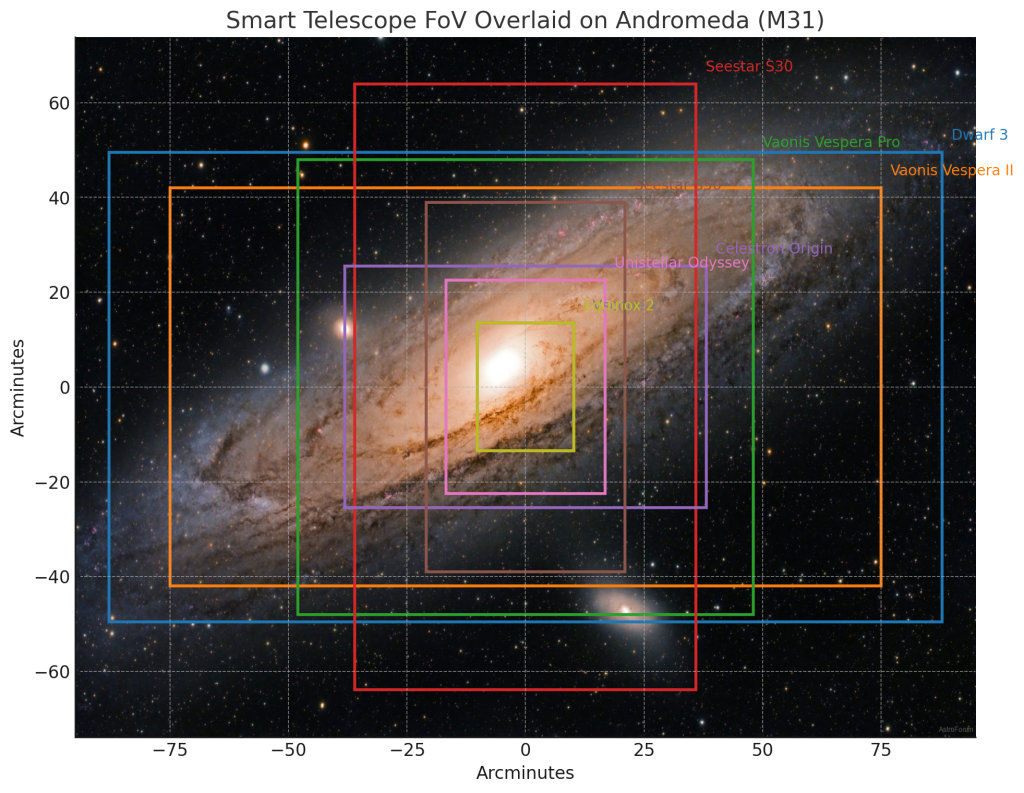
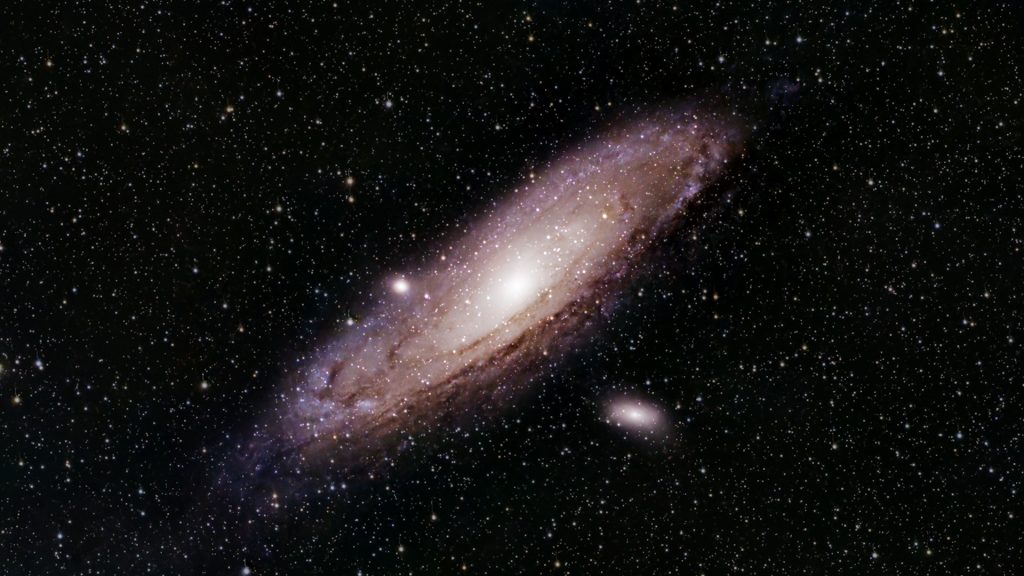
The Field of View (FoV) measures the portion of the sky visible in a single image. Wider FoVs are ideal for large nebulae or star clusters, while narrower ones are better for smaller objects like distant galaxies. For instance, the Andromeda Galaxy spans about 3°x1° (190 x 60 arcminutes), while the Whirlpool Galaxy covers just 11’x7′ (0.18°x0.12°).
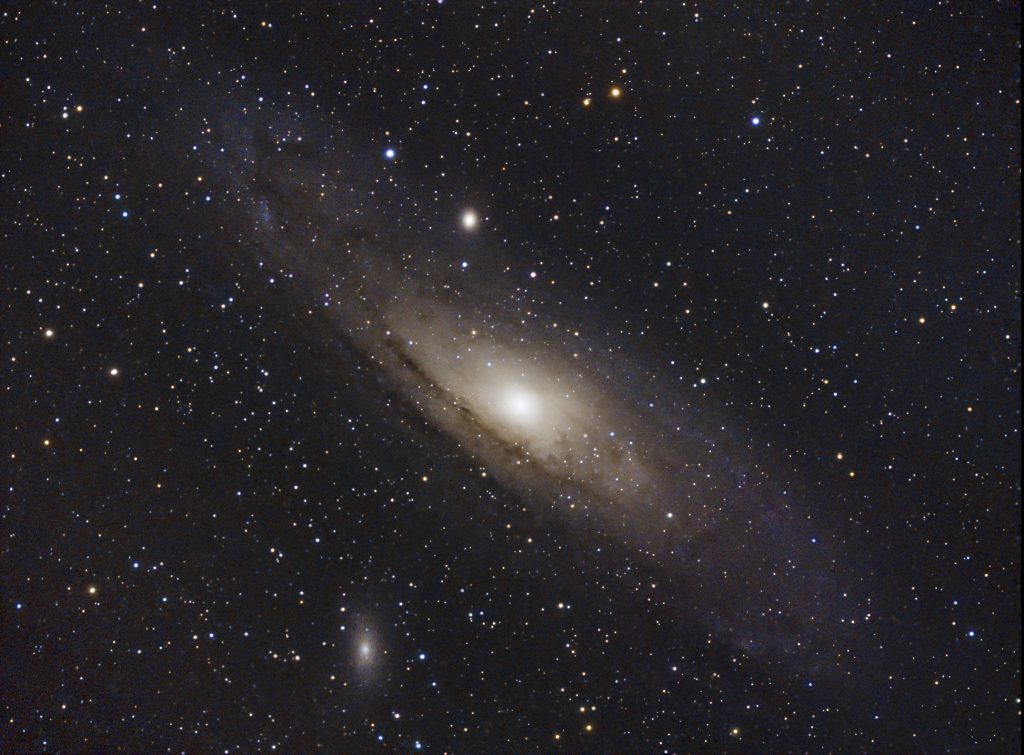
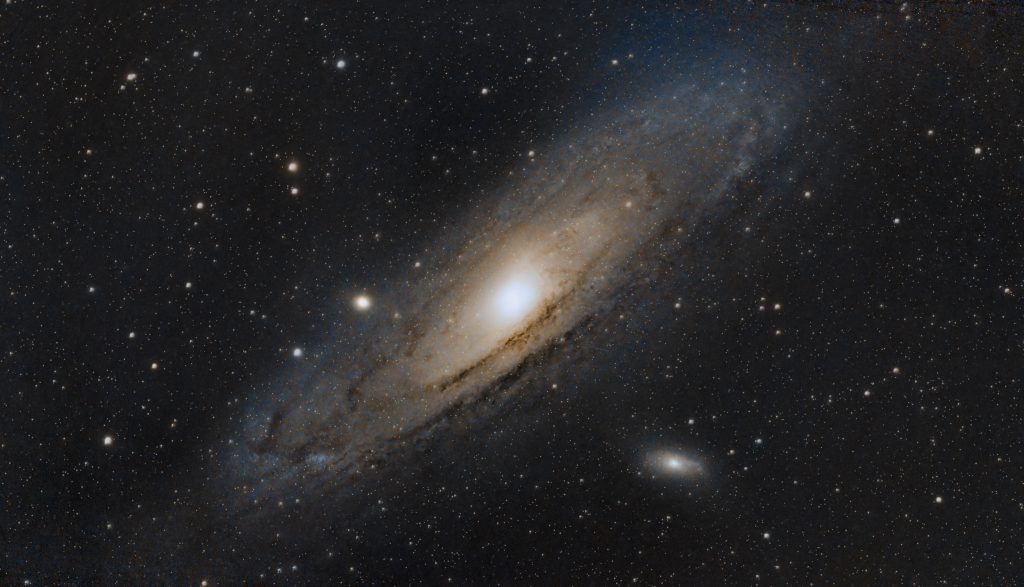
Among smart telescopes, the Seestar S30 pro has the widest FoV at 2.24° by 3.99° (portrait mode), followed by the Dwarf 3 at 2.93°x1.65° and the Vaonis Vespera II (2.5°x1.4°). The Vaonis Vespera Pro captures 1.6°x1.6°, the Seestar S30 covers 1.2°x2.13°, and the Celestron Origin 1.27°x0.85° . The Seestar S50 captures 0.7°x1.3° in portrait mode, while the Unistellar Odyssey provides 0.56°x0.75°. The EVscope 2 and Equinox 2 have the narrowest FoV at 0.34°x0.45°, just large enough to fit the full Moon. The figure below represents the differences in FoV for each of the telescopes with my astro-photo of the Andromeda Galaxy as a reference.
Explore my experimental Field of View App and compare every smart telescope’s viewing size!
Importantly, Seestar’s framing mode and Vaonis’s CovalENS can expand their telescopes’ FoV by two to four times by capturing and stitching multiple images into a single mosaic. However, this process takes more time, as different sections of the night sky must be photographed separately and then combined into the final image.
Smart Telescope Control via Wireless APPS
Each brand offers a dedicated app for wirelessly controlling their telescopes, available on both iOS and Android. After downloading and installing the app, you’ll be prompted to grant GPS access for precise sky tracking based on your location. Bluetooth and WiFi must also be enabled for a wireless connection. I’ve noticed periodic software updates, similar to other apps on your phone. Once the app is installed, simply open it, power on your smart telescope, ensure the mount is level, connect to the telescope’s WiFi, and you’re set to start. Keep in mind that some apps are more user-friendly and feature-rich than others, and updates often introduce new functionalities. Here’s my personal experience with different apps.
Seestar APP (S50/S30/S30 Pro)
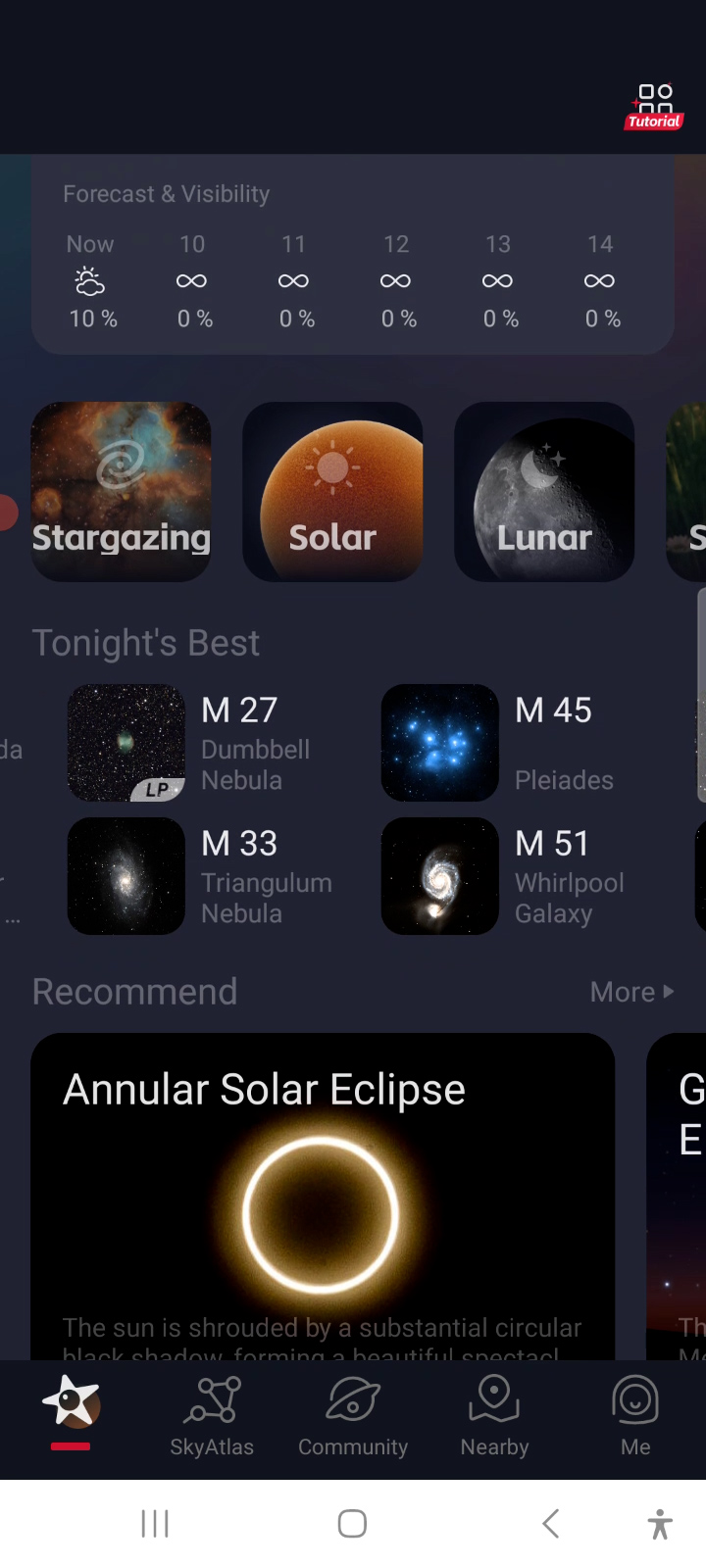
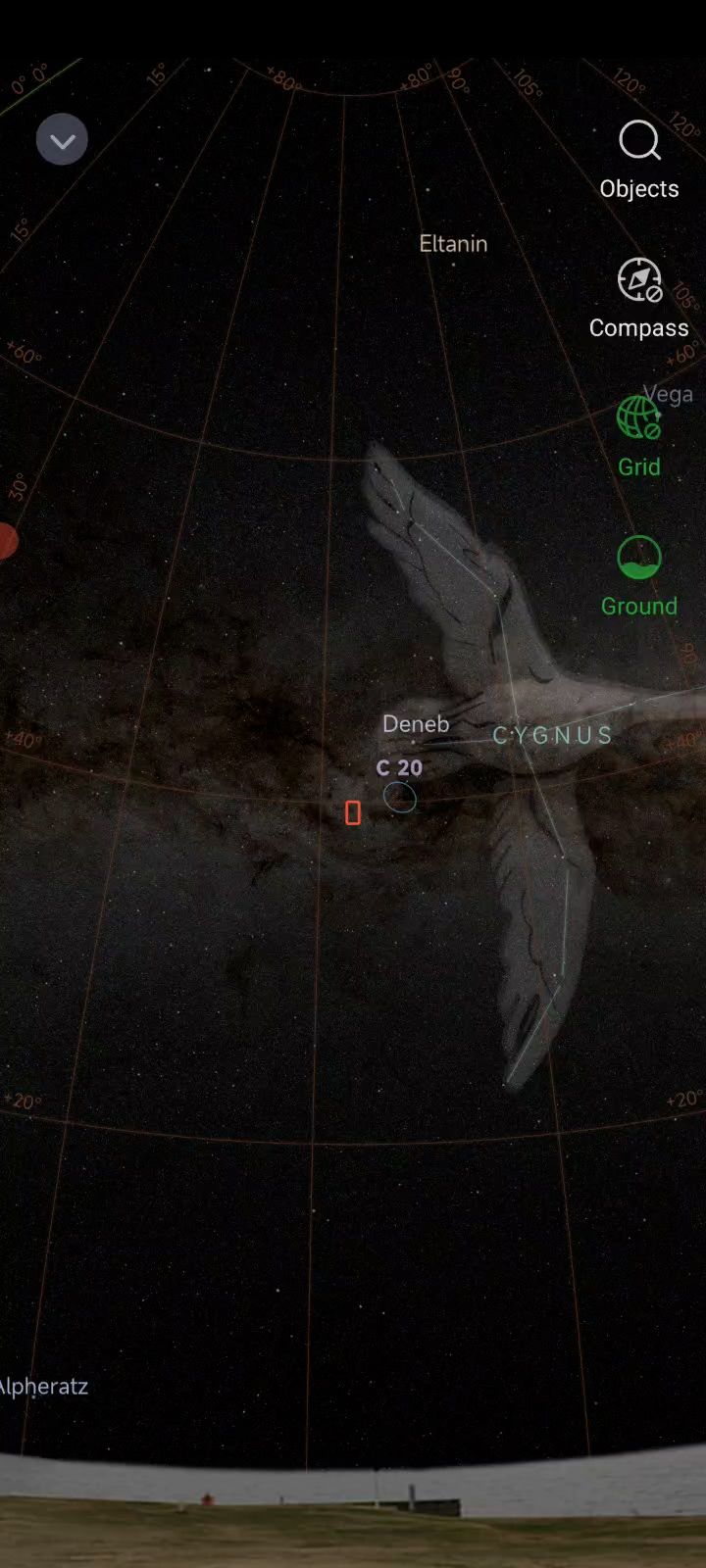
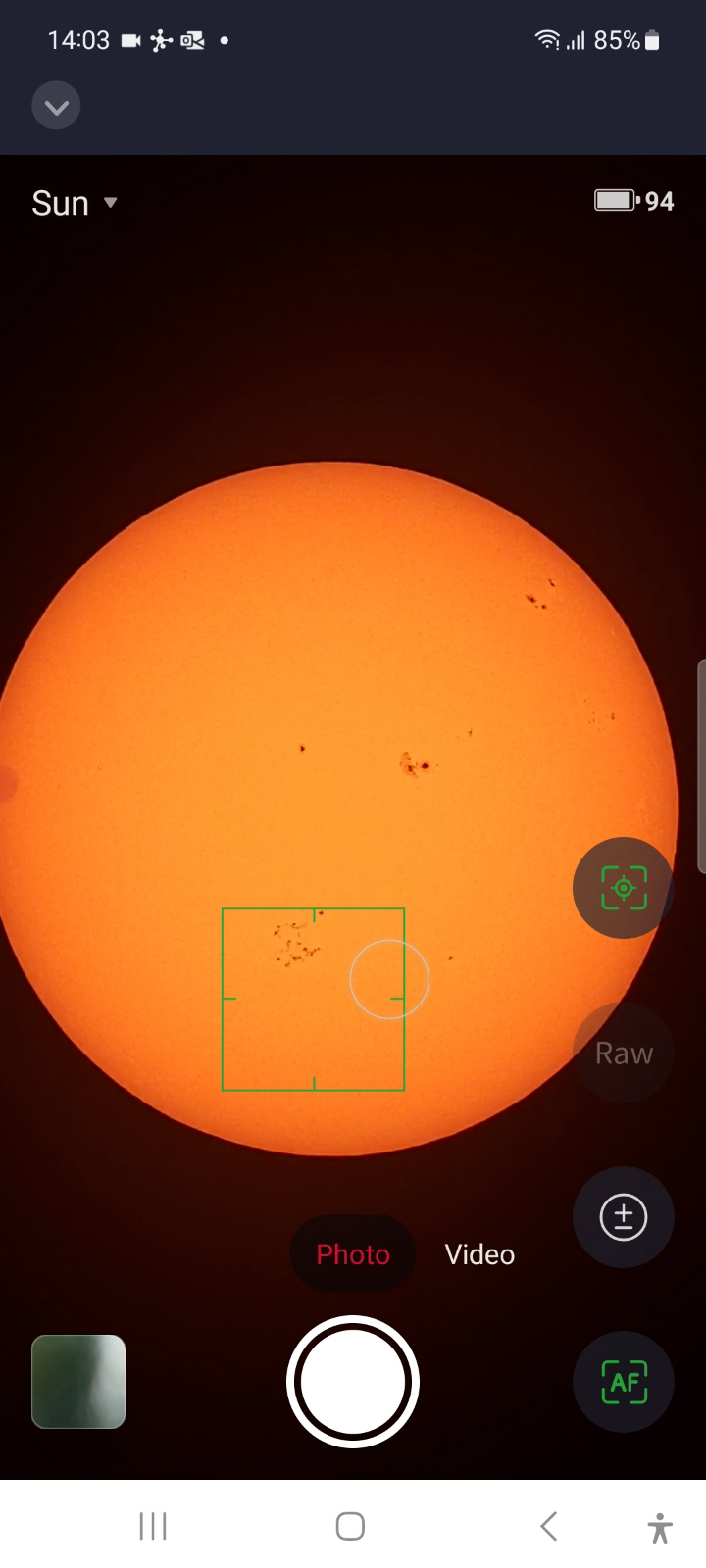
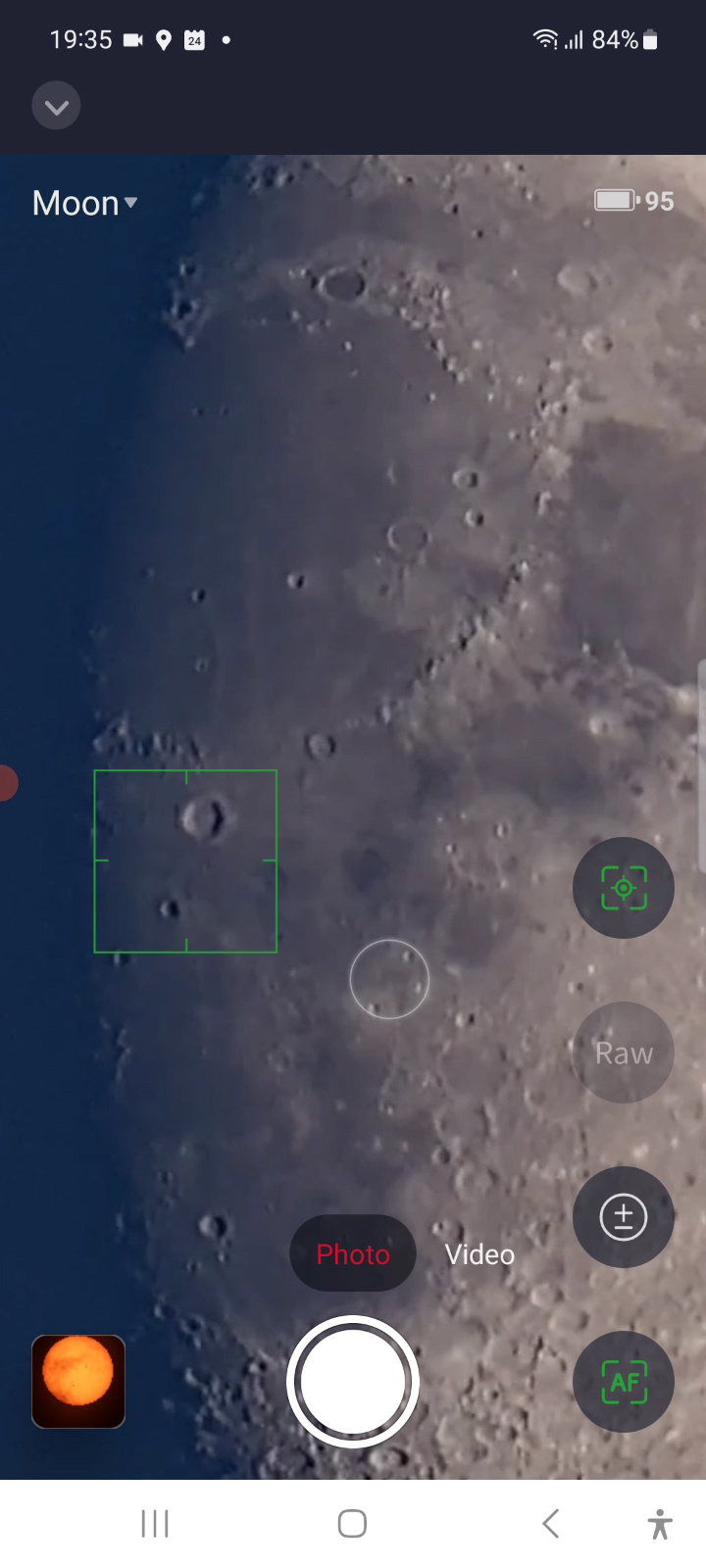
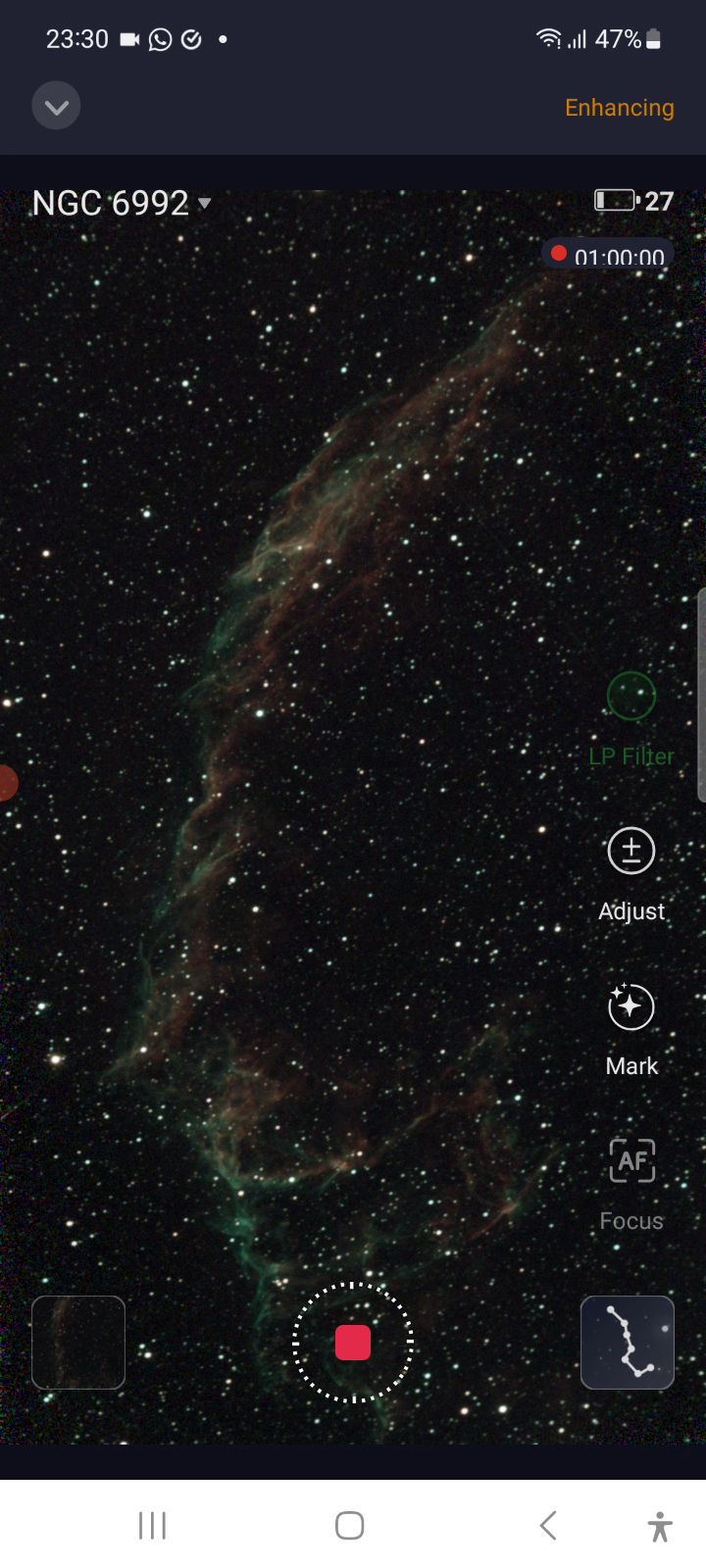
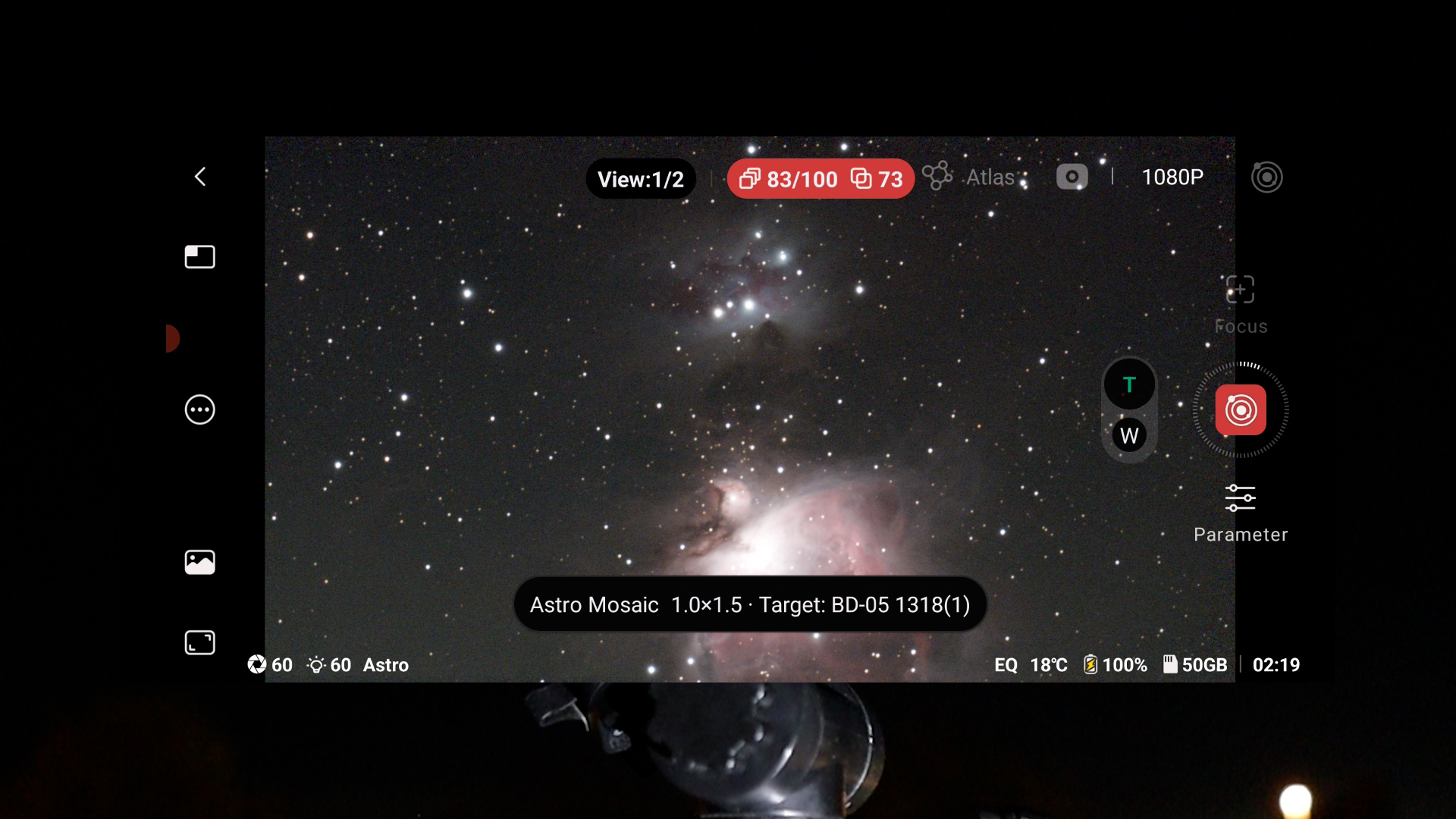
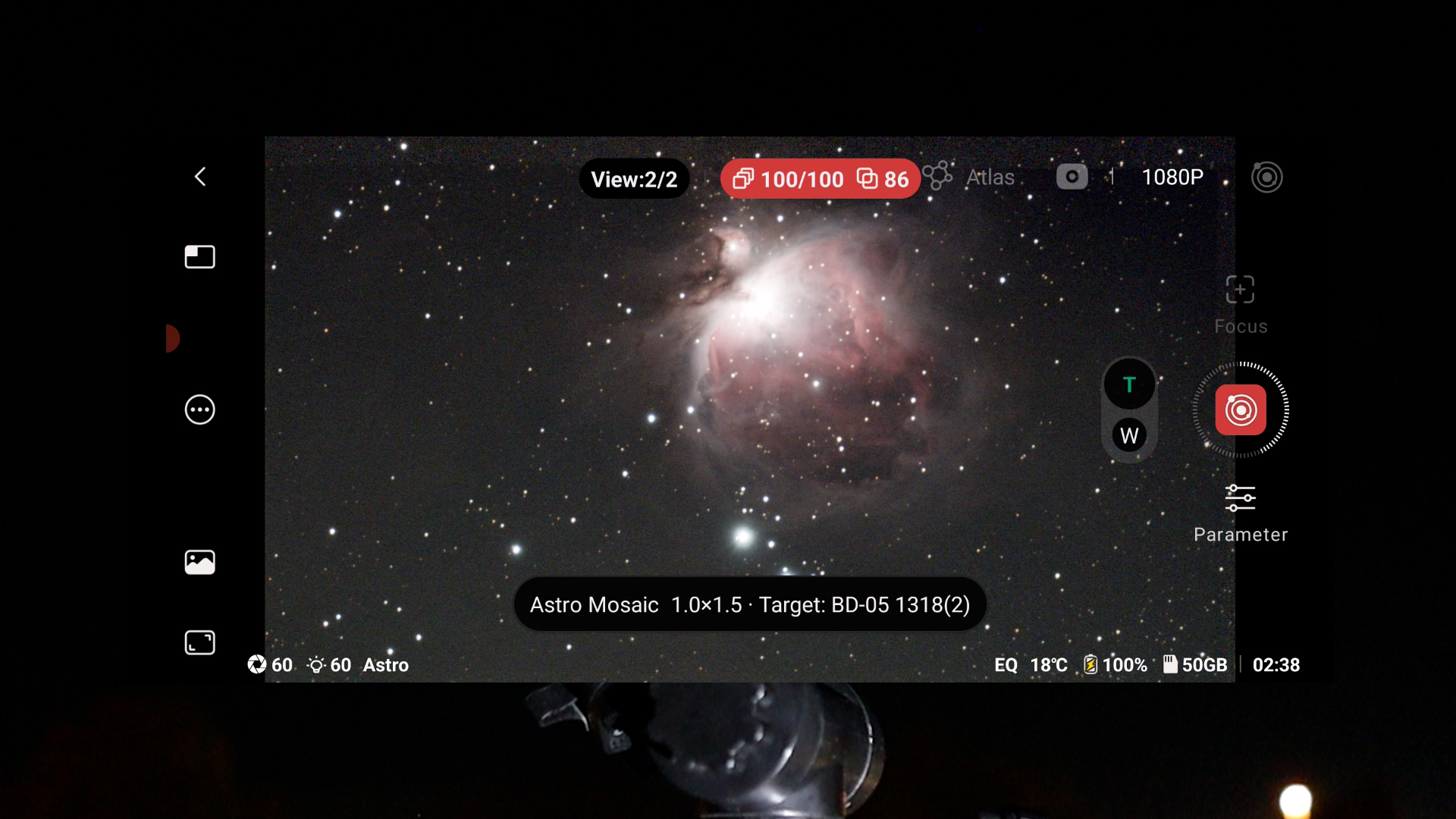
The Seestar app, designed for ZWO Seestar smart telescopes, is a well-crafted tool suitable for both novice and experienced astronomers. It provides key information like moon phase, weather forecast, and recommended celestial objects based on your location. The app features a virtual sky atlas, a searchable database of celestial bodies, and detailed information on selected targets. Users can easily select an object, and with a tap on “go gazing,” the Seestar S50 automatically slews to the target, centers it in the view, and starts calibration with 10-second photo stacking for improved views. There’s a special EQ mode available for the mount to capture images up to 60 seconds. Special modes for lunar, solar (with filter), and planetary observations are included, with automatic camera settings and up to 4x digital zoom for planetary views. The app also allows users to capture up to 2x the original field of view and rotate deep-sky objects to their liking. It also offers a community tab for interaction and a scenery mode for daytime use, making it versatile for activities like birding or wildlife photography. Its automation enhances the stargazing experience with both video and photography capabilities. The ZWO team is very active and you’ll receive regular updates to further improve your experience.
Singularity APP (Vaonis Vespera)
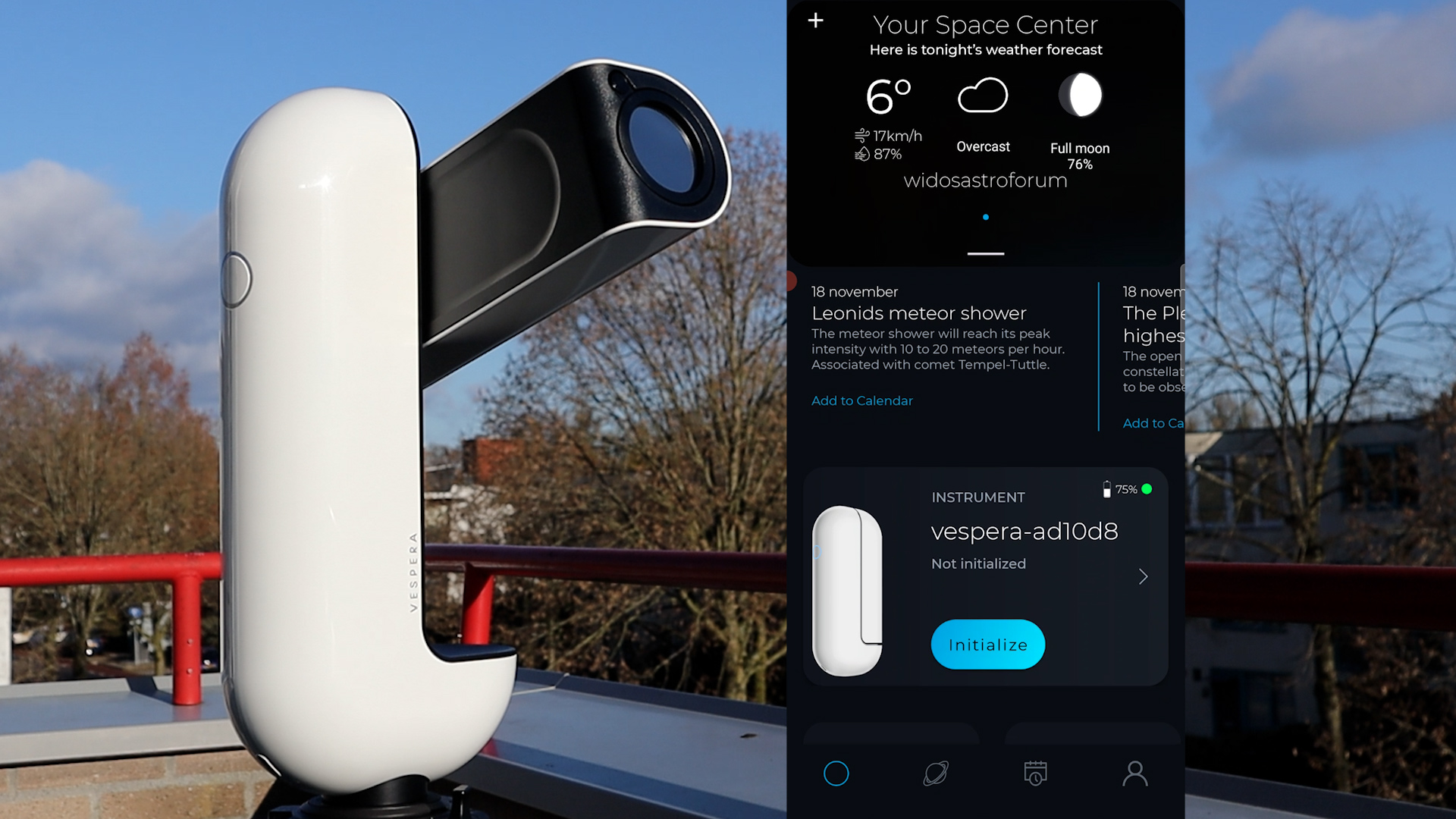
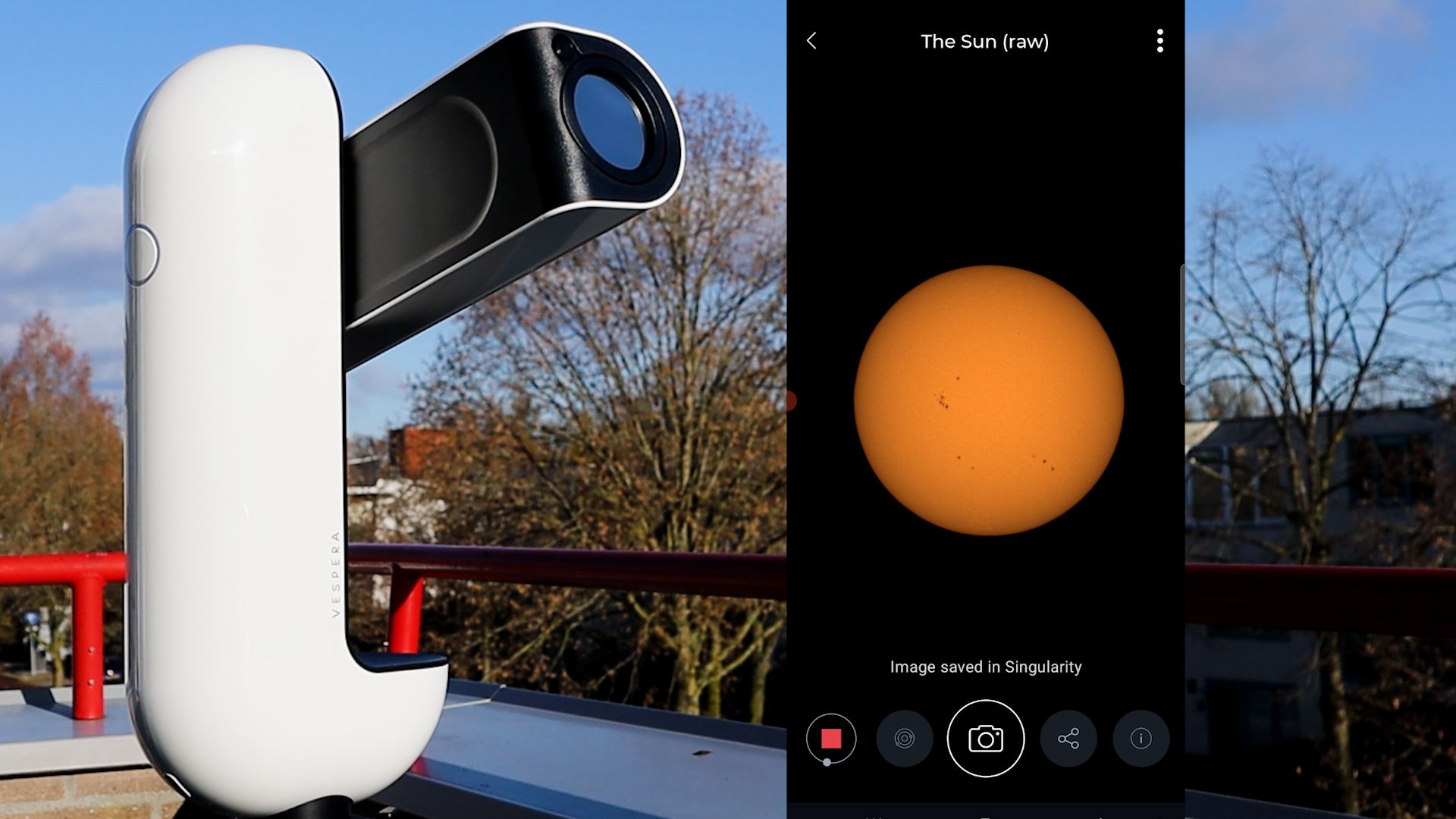
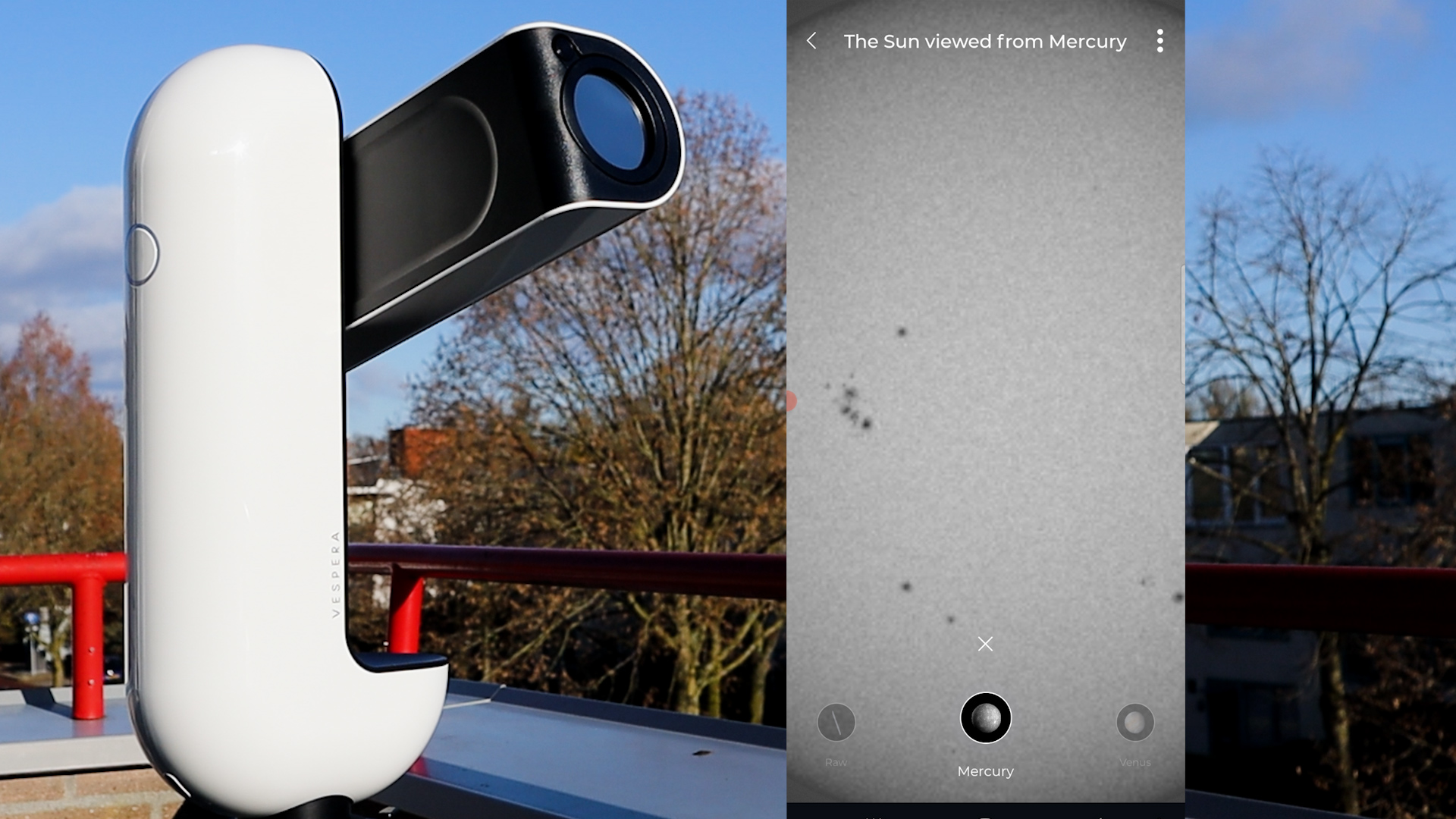
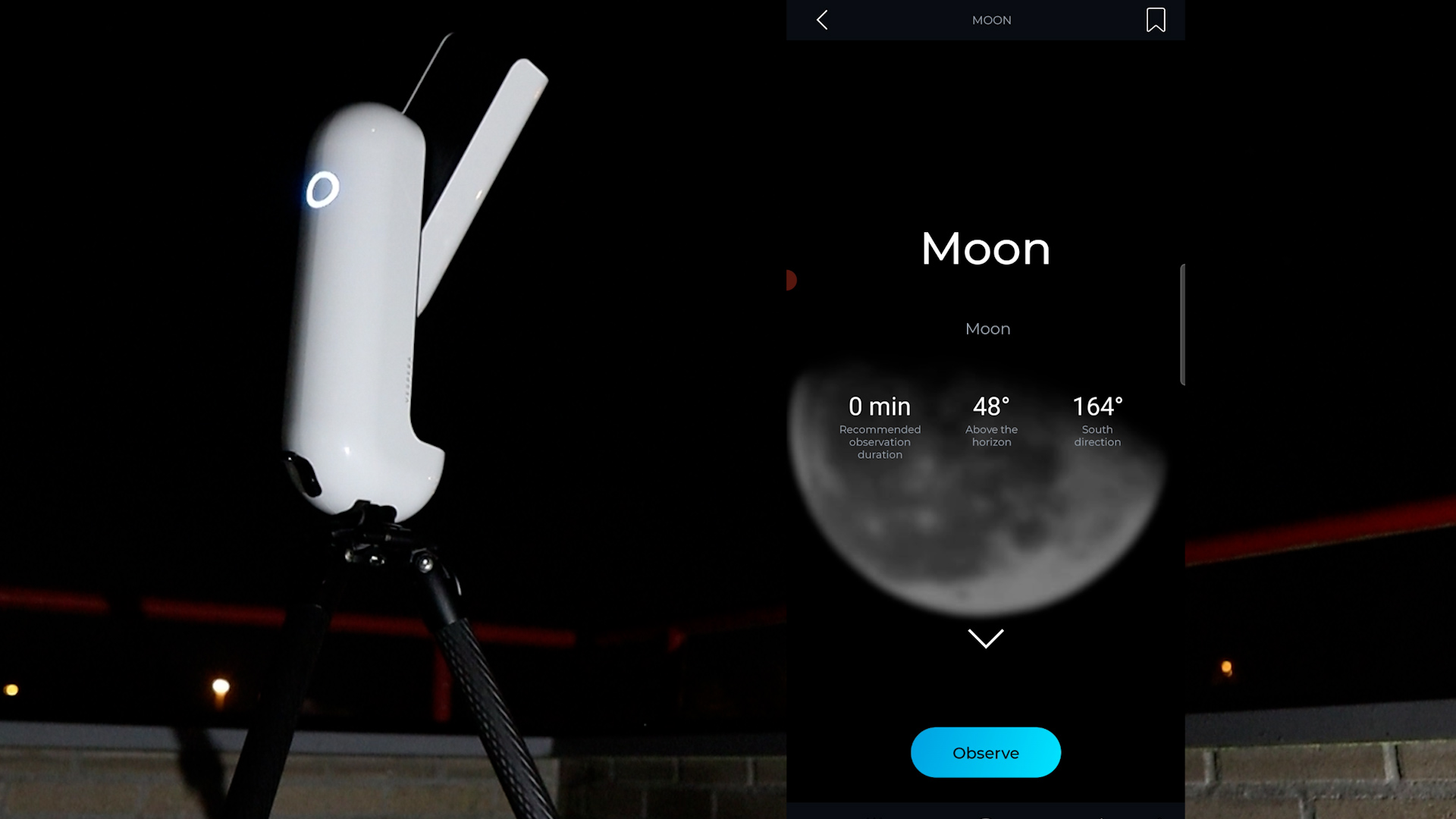
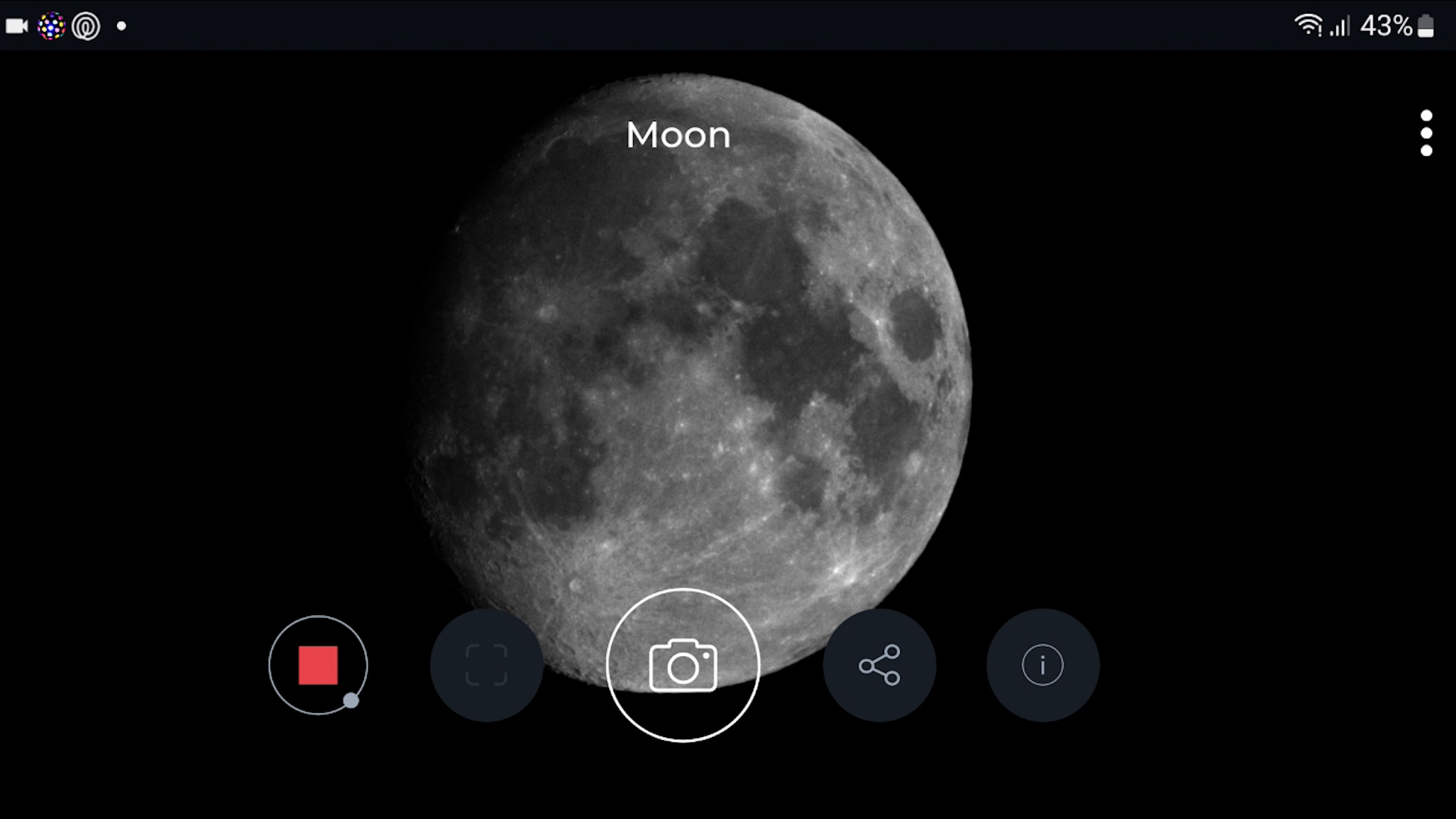
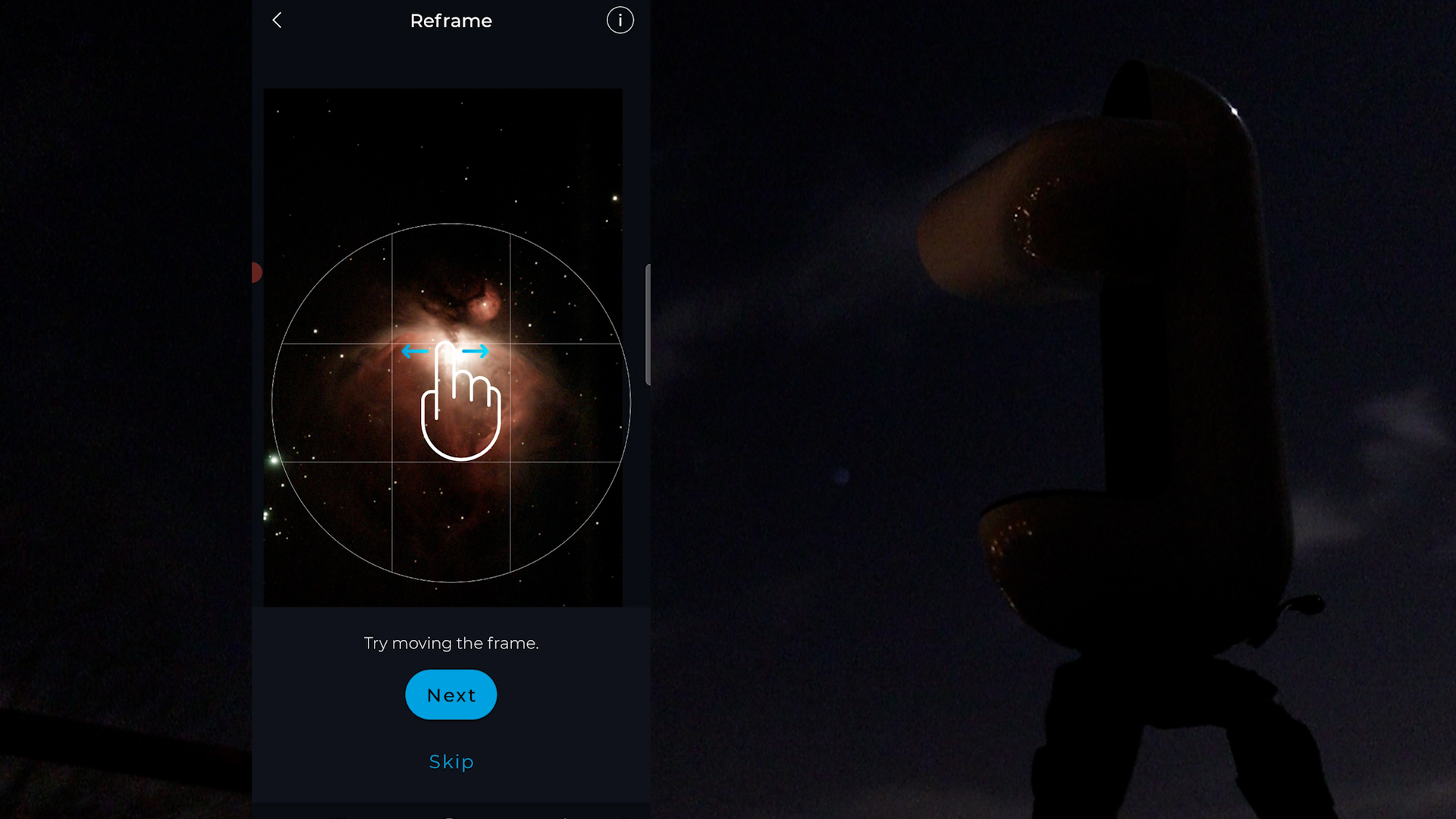
Vaonis offers the Singularity app for their smart telescopes. The main screen provides a weather forecast, upcoming astronomical events, and articles on using Vaonis telescopes and image processing, with direct links for purchasing accessories. In the exploration tab, users find recommended targets, as well as categorized listings of celestial objects, constellations, and Messier objects. The constellation feature details observation times, directions, altitudes, and more about selected targets. After a brief initialization, Vaonis telescopes automatically slew to the target, perform autofocus, and deliver live feeds on connected devices. Solar mode, requiring a solar filter, includes a feature showing the Sun’s size from different planets. The app also supports collaborative observation, letting multiple users join and control the telescope remotely. The “plan my night” option allows users to schedule sessions, and the covaLENS panorama mode capture larger parts of the night sky for large objects. The app is beginner-friendly and intuitive.
Dwarflab APP (Dwarf 2, 3, mini)
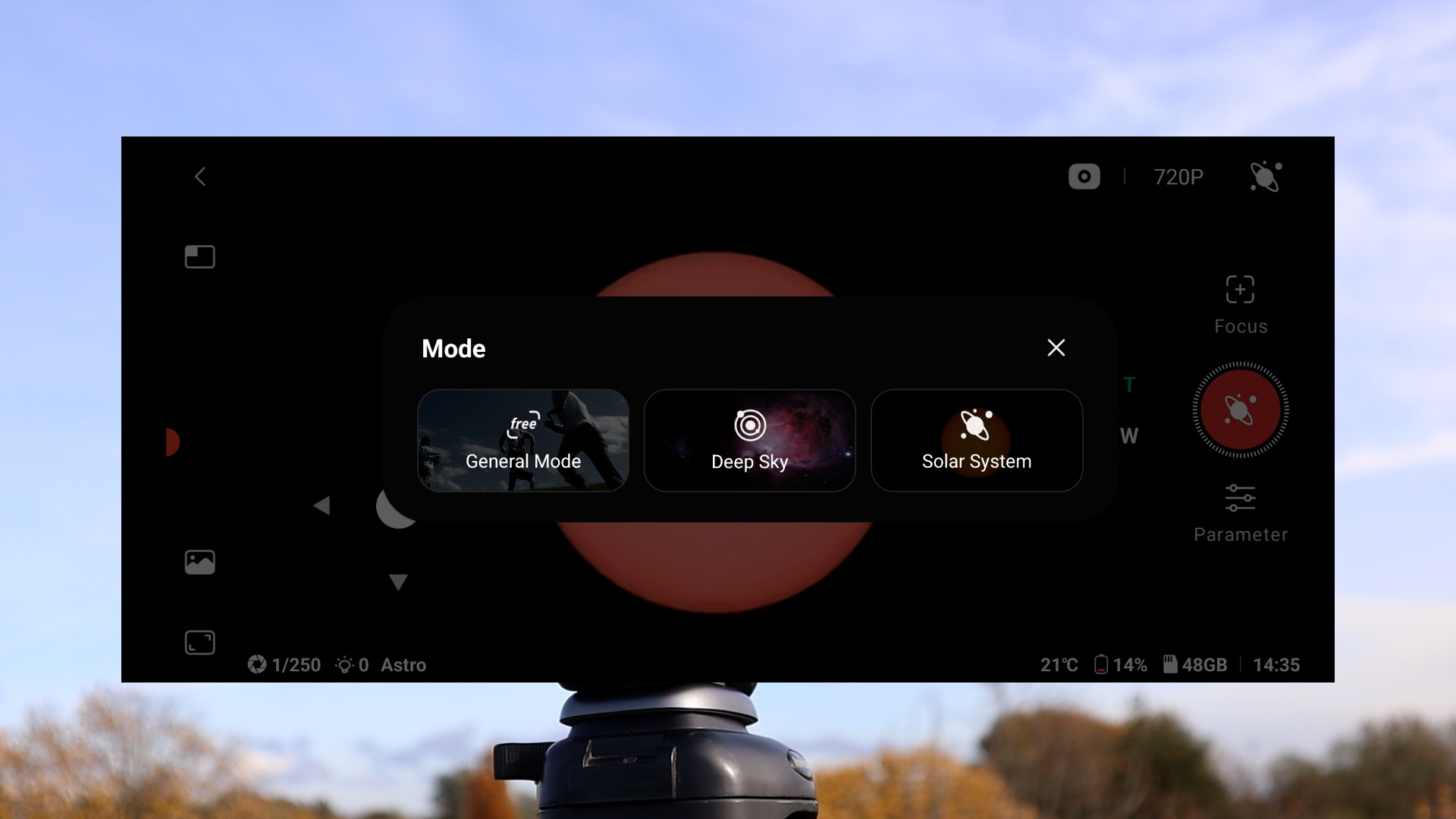
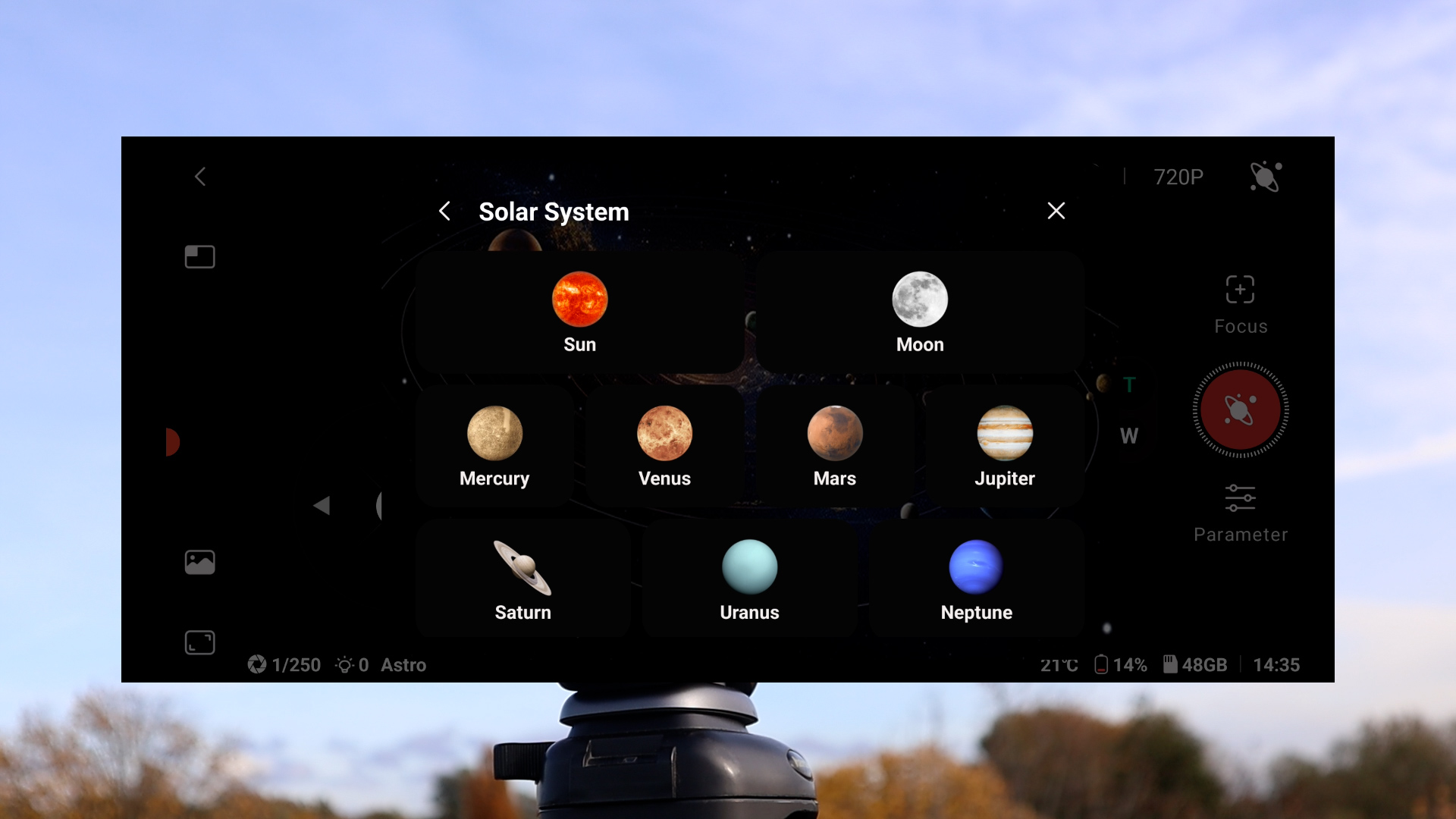
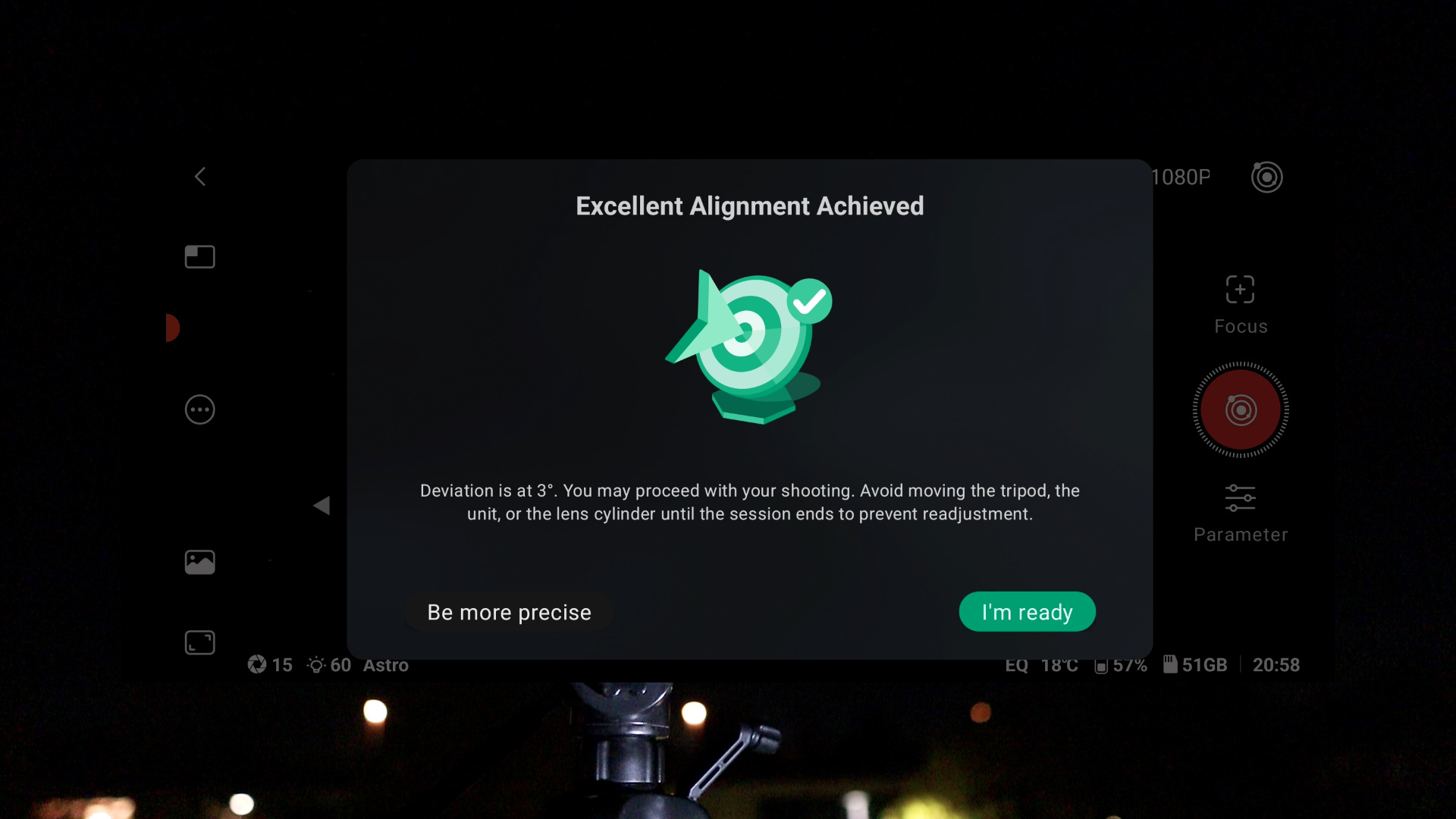
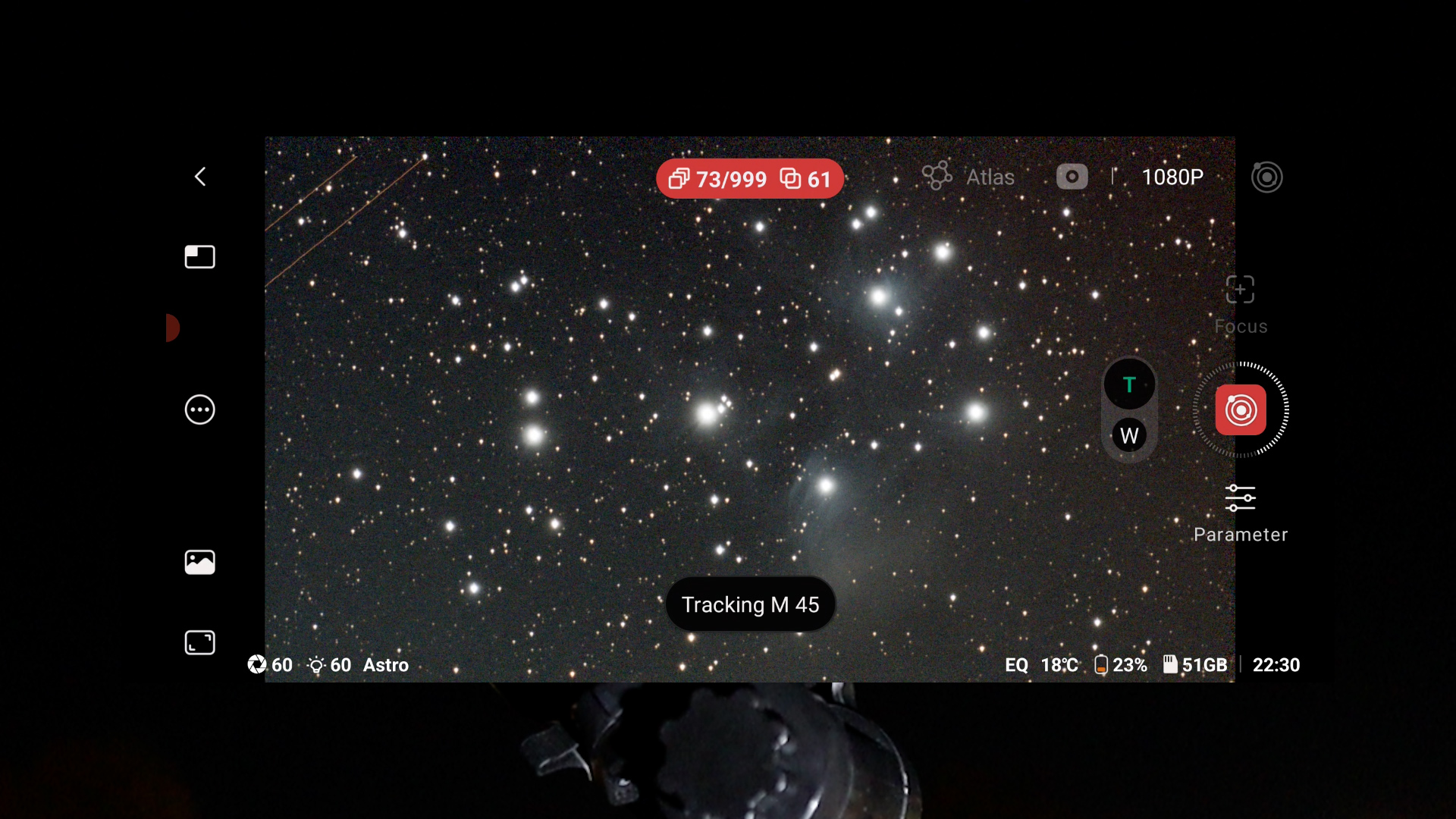
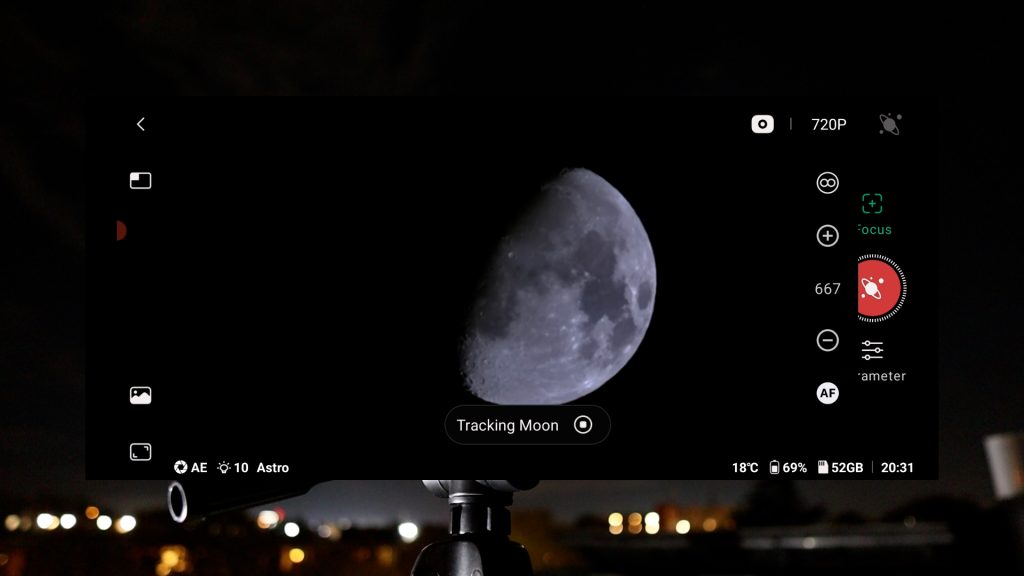
The Dwarflab app is designed for both nature and wildlife photography, as well as astrophotography. It offers live views from wide-angle and telephoto lenses, with a smooth switch between them for capturing subjects. The joystick-like button controls telescope movement, and the speed dial adjusts slewing speed. Although automatic tracking is somewhat inconsistent, it can follow moving subjects. The app supports photo, video, and timelapse modes for daytime use. With the Dwarf 3, Dwarflab introduced a virtual sky atlas for easier object search, tracking and an experimental EQ mode (polar alignment procedure), allowing users to capture longer exposure photos and collect more faint light from deep-sky objects. EQ mode also reduces problems concerning field rotation, which is common in smart telescopes and alt-az tracking. The app also includes automatic settings for Sun and Moon capture, adjusting shutter speed and gain for detailed observation. Dwarflab has put a lot of effort into improving their app, and the latest update (autumn 2025) now makes it easy to use even for complete beginners.
Unistellar APP (EVscope 2, EQuinox 2, Odyssey)
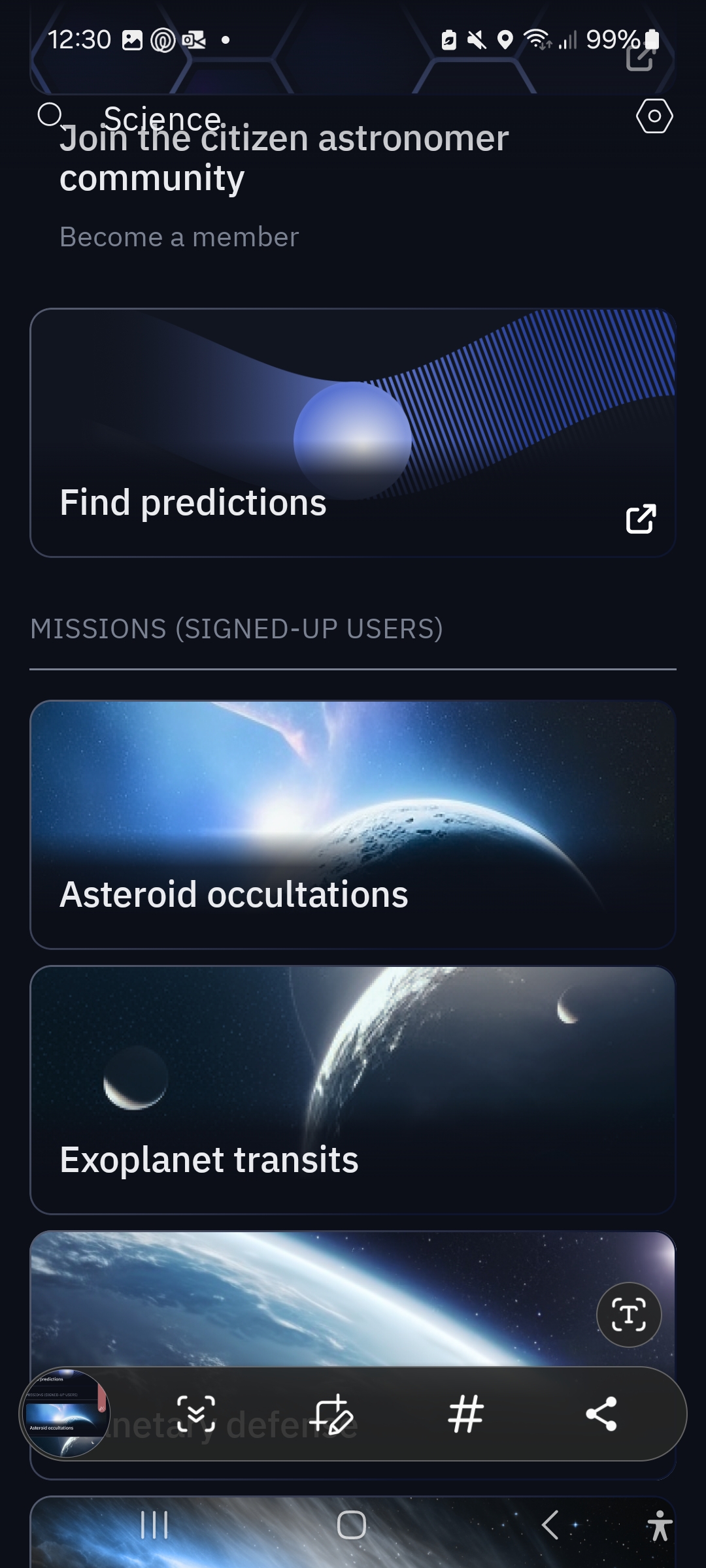
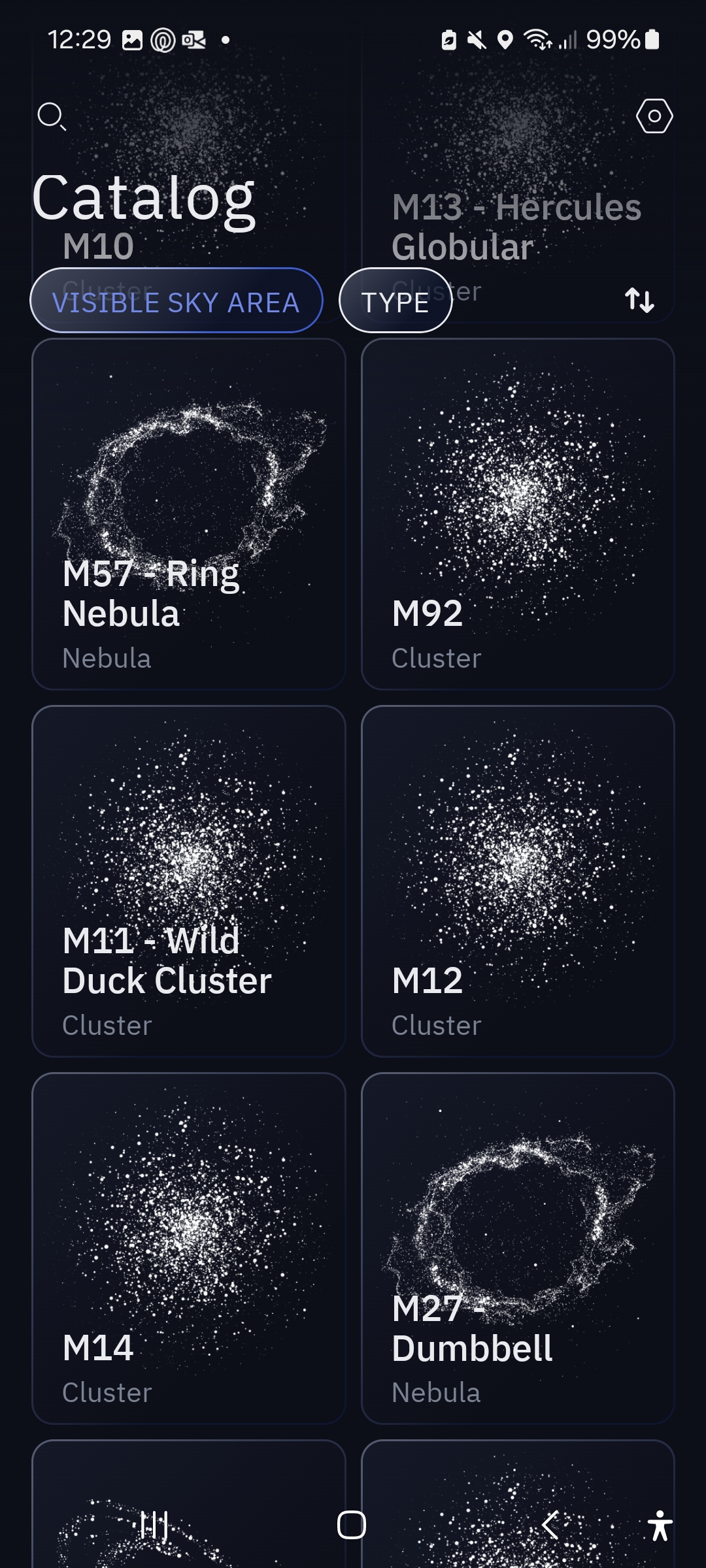
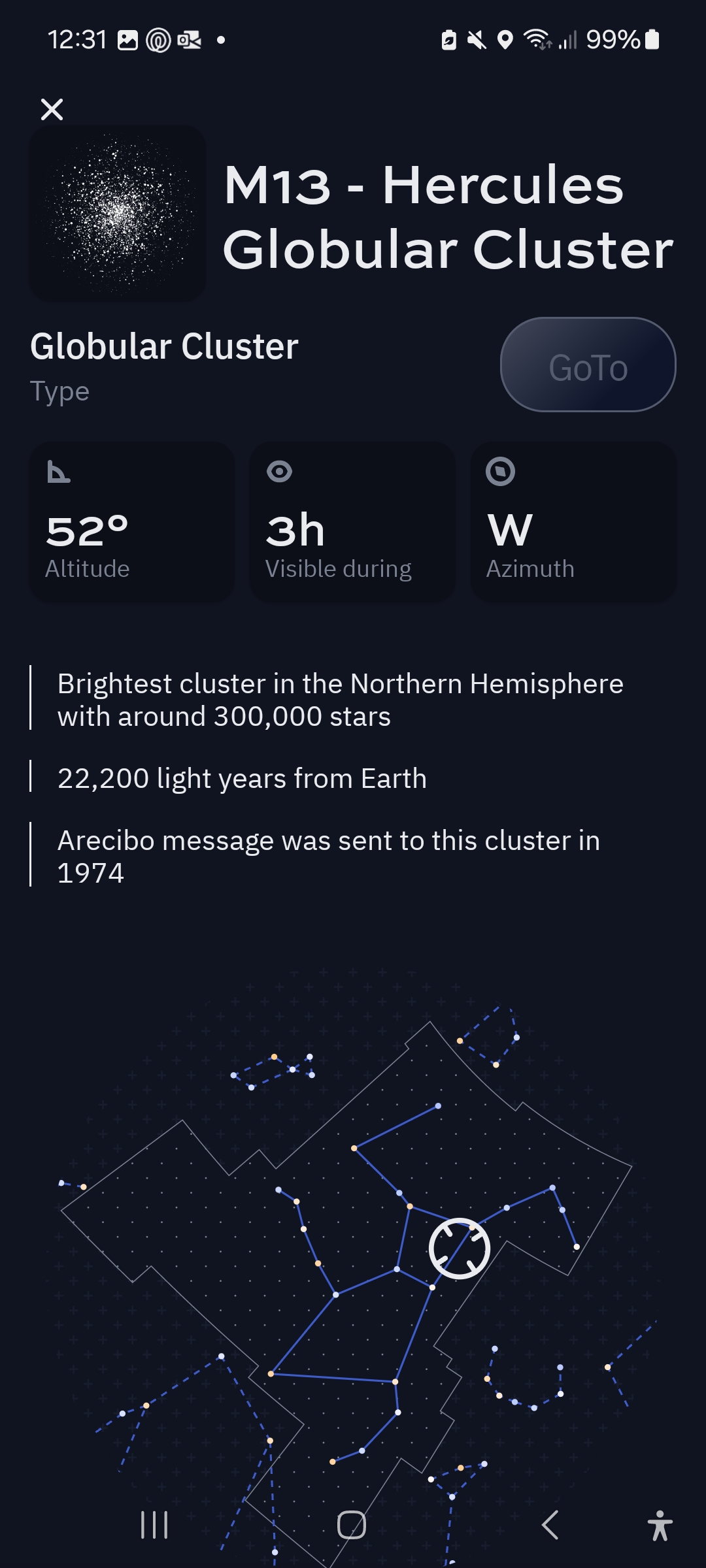
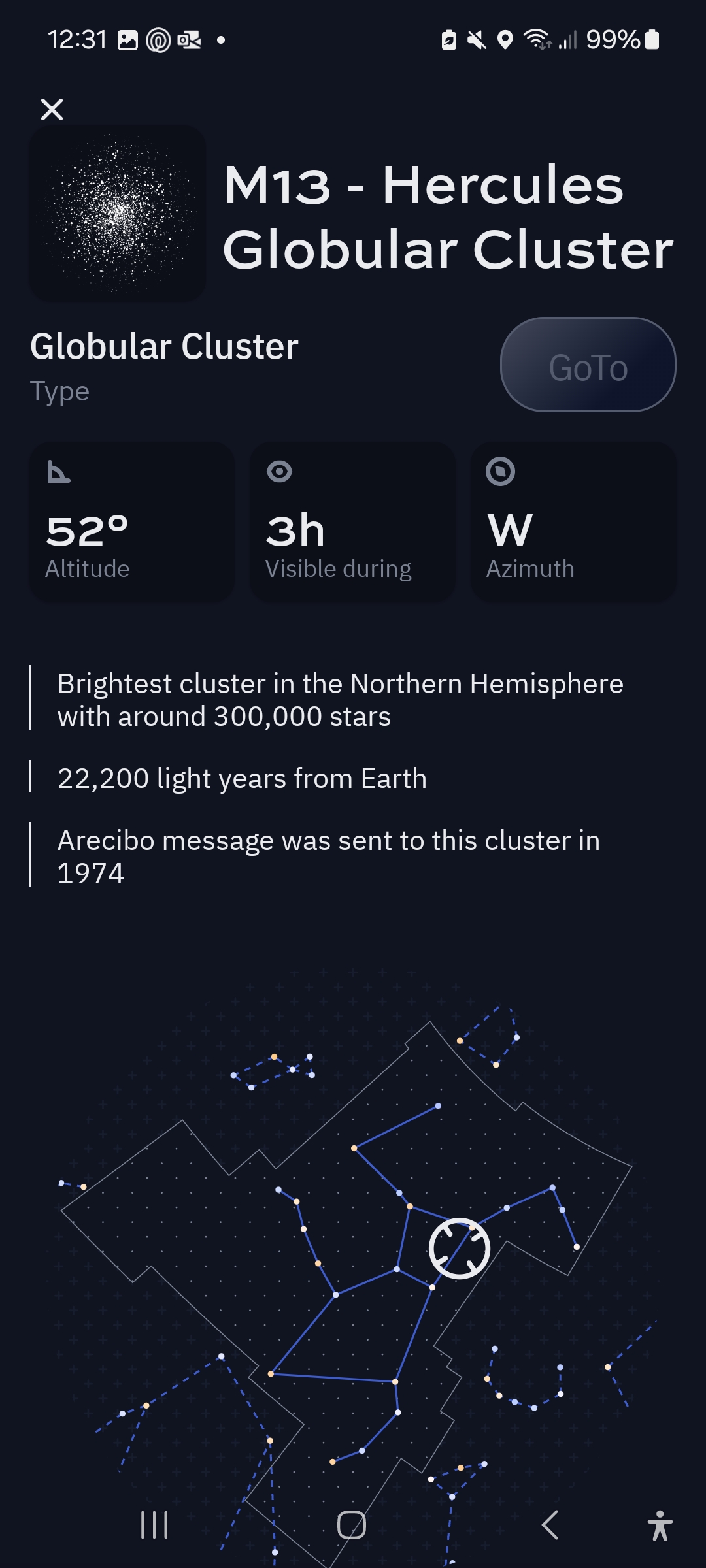
The Unistellar app provides an intuitive home screen with recommended targets and helpful guidance for first-time users. It features categorized lists of celestial objects—such as solar system targets, nebulae, galaxies, star clusters, and stars—along with a searchable catalog of over 5,000 objects. Selecting an object reveals its description, location, and optimal viewing times. The app supports up to 10 connected devices, highlighting the brightest and best-positioned objects for easy observation. Once a target is selected, the telescope automatically slews to it and begins live stacking images. Additionally, the app connects users to a global citizen astronomy community, enabling participation in science missions and sharing stunning astrophotography results. It makes exploring the universe accessible and engaging for all levels of stargazers.
Celestron Origin APP (Celestron Origin Intelligent Home Observatory)
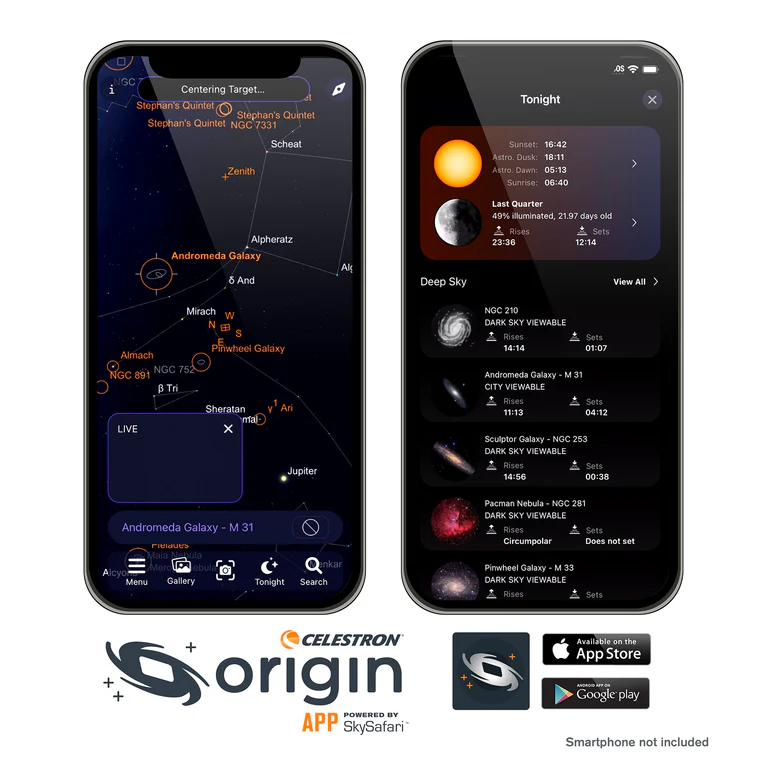
The Celestron Origin’s companion app transforms how you explore the night sky, making astronomy simple and engaging. Setup is effortless with StarSense technology: place the telescope outside, turn it on, and connect to the app. Within minutes, Origin aligns itself by mapping star patterns and is ready for use. The app offers an intuitive planetarium interface powered by SkySafari™, letting you explore the sky in “compass mode.” Tap any highlighted object or use the “Tonight’s Best” list for curated celestial targets based on your location and time. Once selected, Origin automatically centers the target, tracks it, and starts capturing 10-second exposures at the press of a button. Real-time AI algorithms process images to enhance detail while preserving your data. Share the experience with friends through live device streaming or cast to your TV. Origin ensures everyone, from beginners to experts, can enjoy breathtaking cosmic views with ease.

↑ back to criteria
Photo & Video formats
All smart telescopes in this overview support multiple photo formats like JPEG, FITS, and TIFF files. JPEG (Joint Photographic Experts Group) utilizes lossy compression, discarding some data to achieve smaller file sizes. Because of their limited size, JPEG files can be readily shared with friends and family, or on social media.
In contrast, FITS (Flexible Image Transport System) files employ lossless compression, crucial for preserving scientific data in astronomy, and are stored in a 16-bit format, which provides more color depth. These higher-quality FITS files are often used for post-processing, where you can (re-)stack multiple images of a celestial object and recreate your final image to your liking. While smart telescopes do the stacking and processing of pictures automatically for you, there’s also the option to download the FITS files on your computer and use third party Astro-processing software to enhance your pictures. Post-processing Astro-pictures has its learning curves, but it gives you more autonomy to create astrophotography pictures to your liking.
TIFF (Tagged Image File Format) files are used by smart telescopes to save a final, stacked picture of a celestial object in 16-bit lossless compression, preserving the image quality and true color of the picture. They are also better suited for post-processing images, as compared to JPEG files This creates two options; you can either recreate the entire stacking process by restacking the individual fits files, or you can take the automatically stacked TIFF file for further processing.
In addition to this, the Dwarf 3, Mini, and Seestar S50/S30 also support video. The Dwarf 3 includes an option to take MP4 videos, while the Seestar S50 stores videos in MP4 and AVI RAW format. MP4 files have a smaller file size due to the advanced compression algorithms and are great for immediate sharing. The Seestar S50 also stores solar and lunar videos in uncompressed 16-bit AVI RAW, which is excellent for manual post-processing using third party software tools like Autostakkert! and Registax.Videos are also exciting as it provides you with the opportunity to record lunar and solar eclipses. Note that you can also stack and process FITS images using autostakkert.
↑ back to criteria
Image Quality
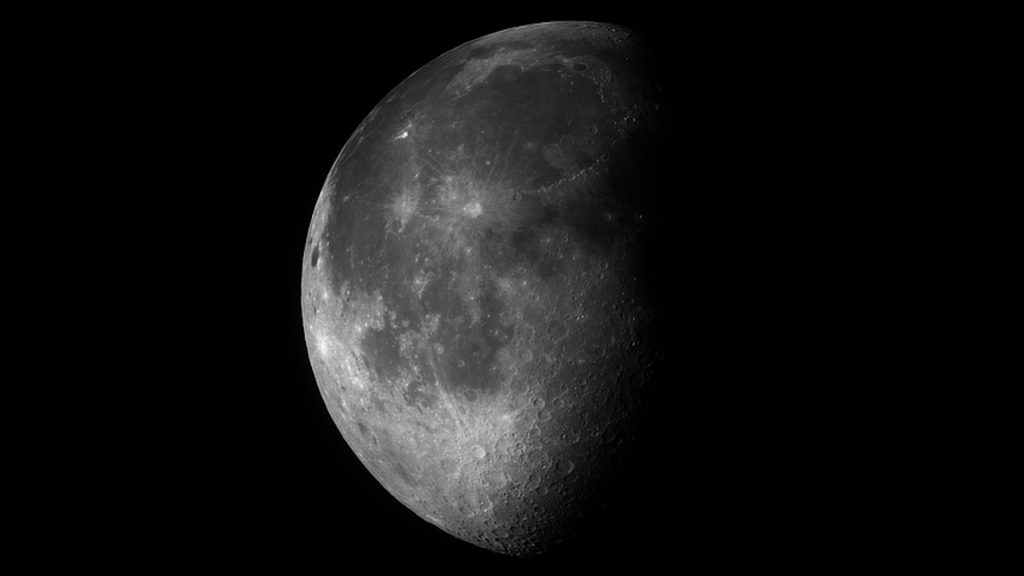
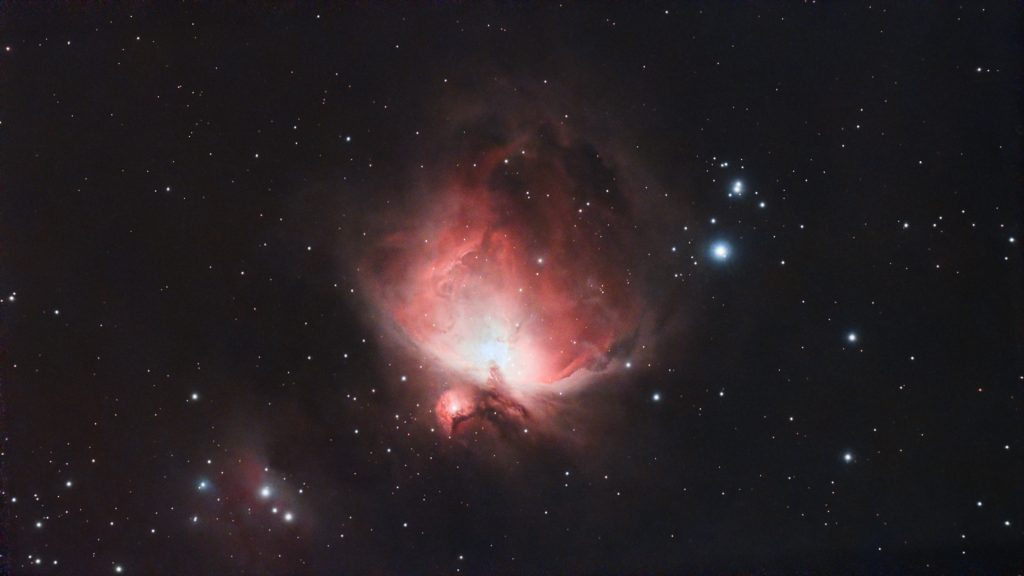
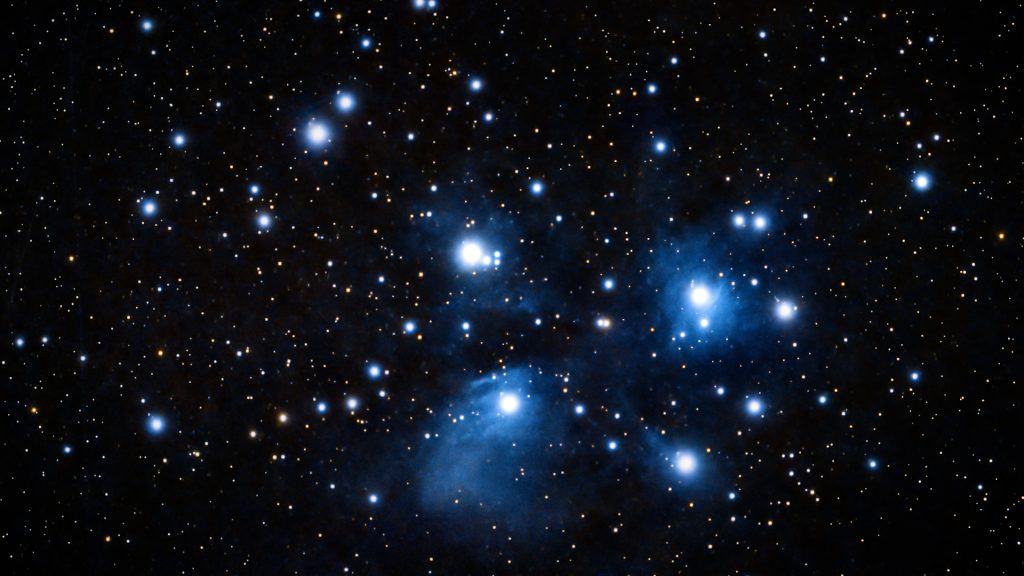
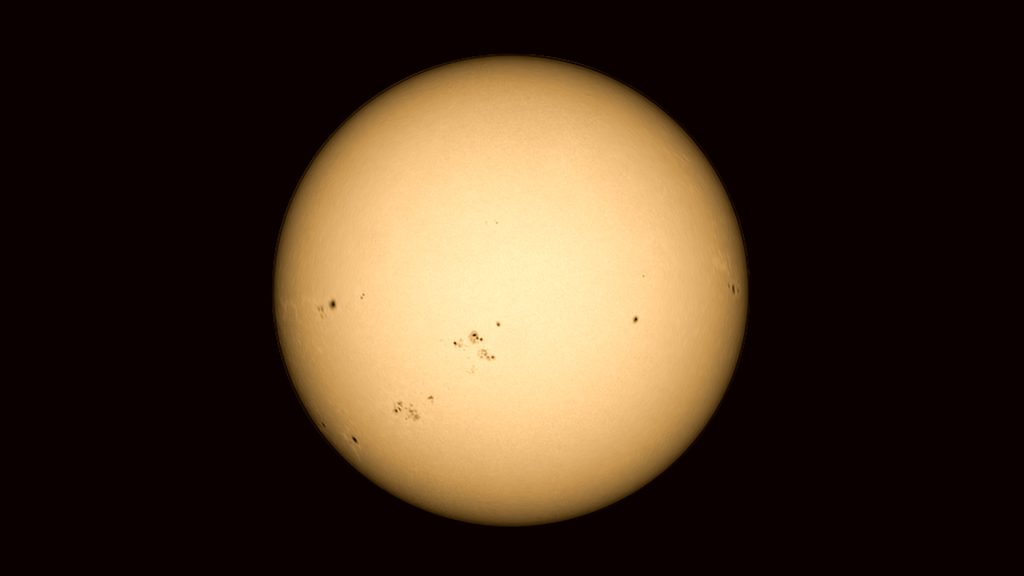
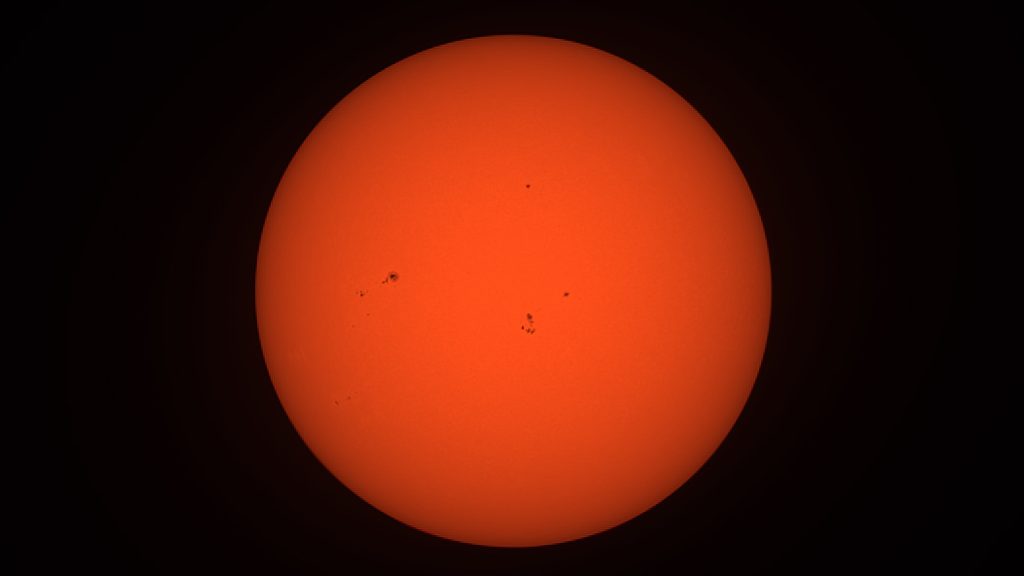
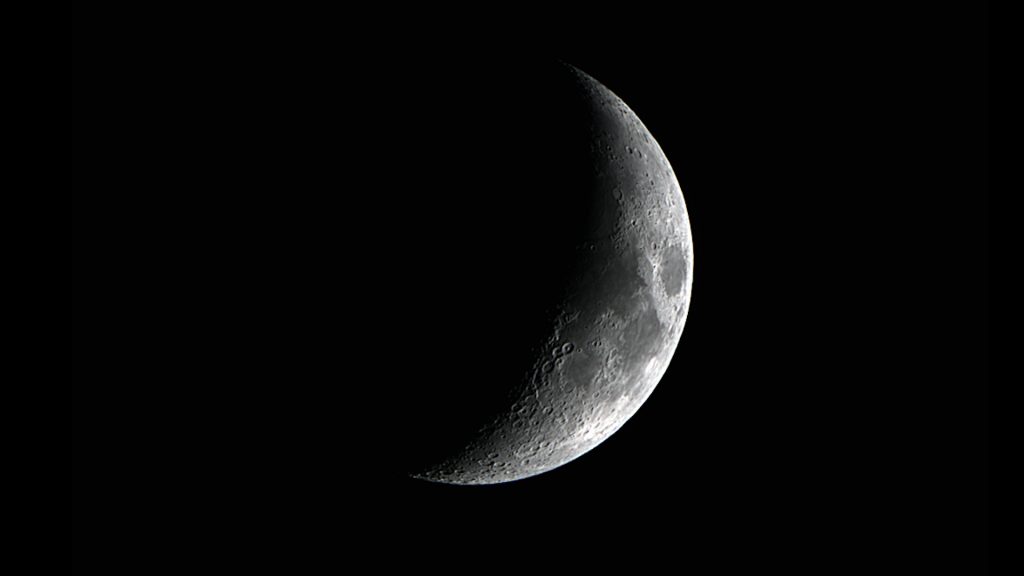
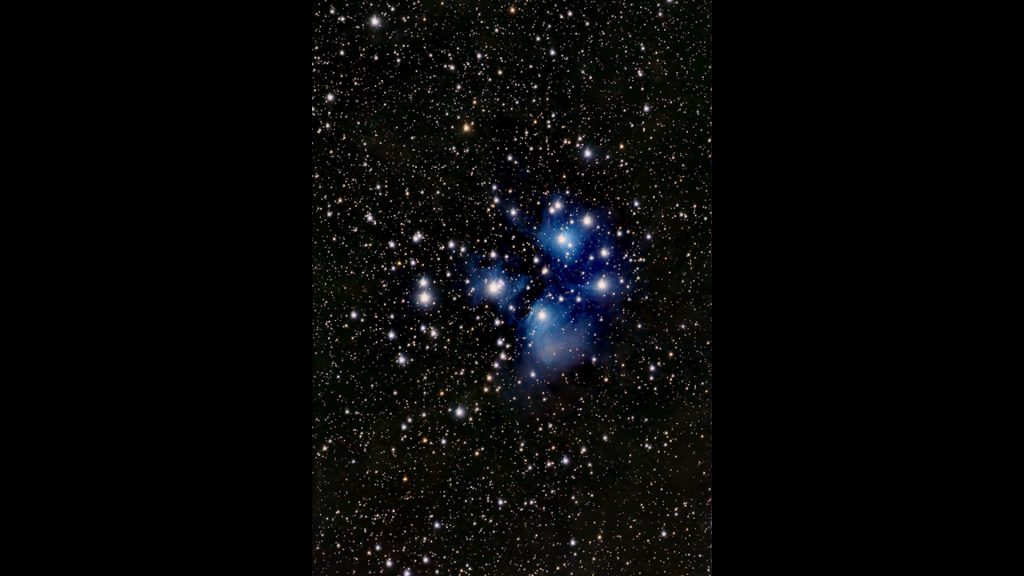
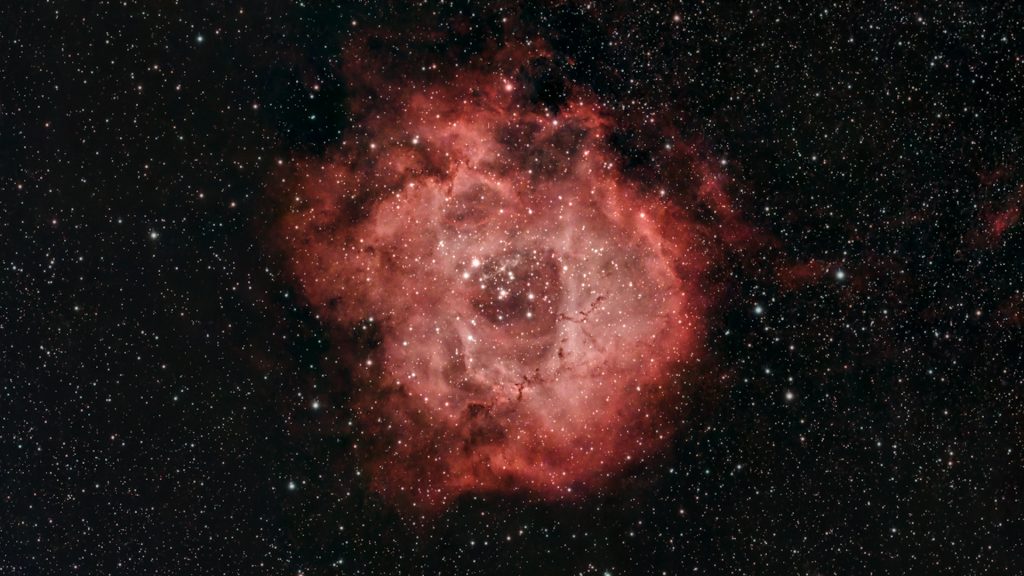
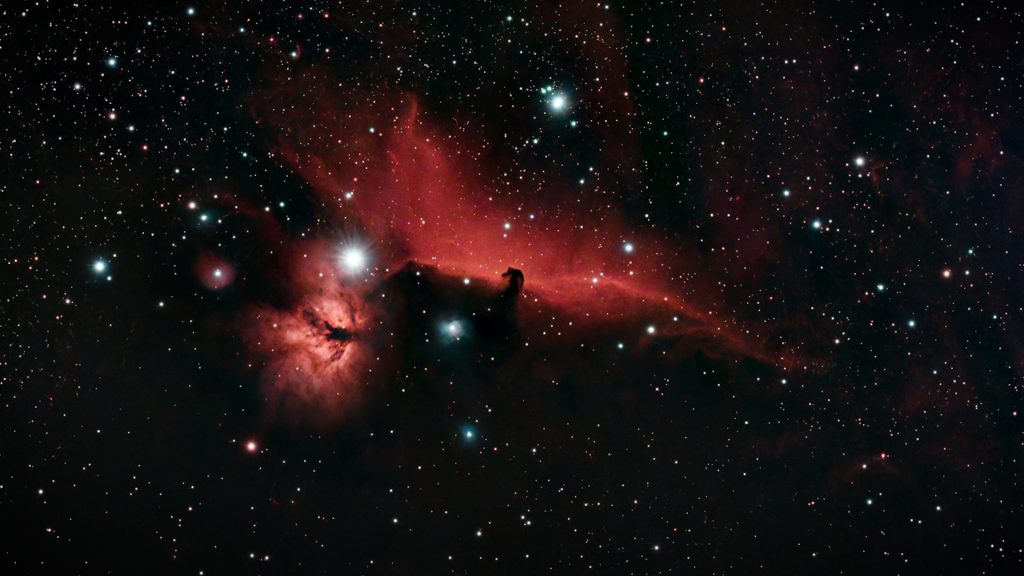
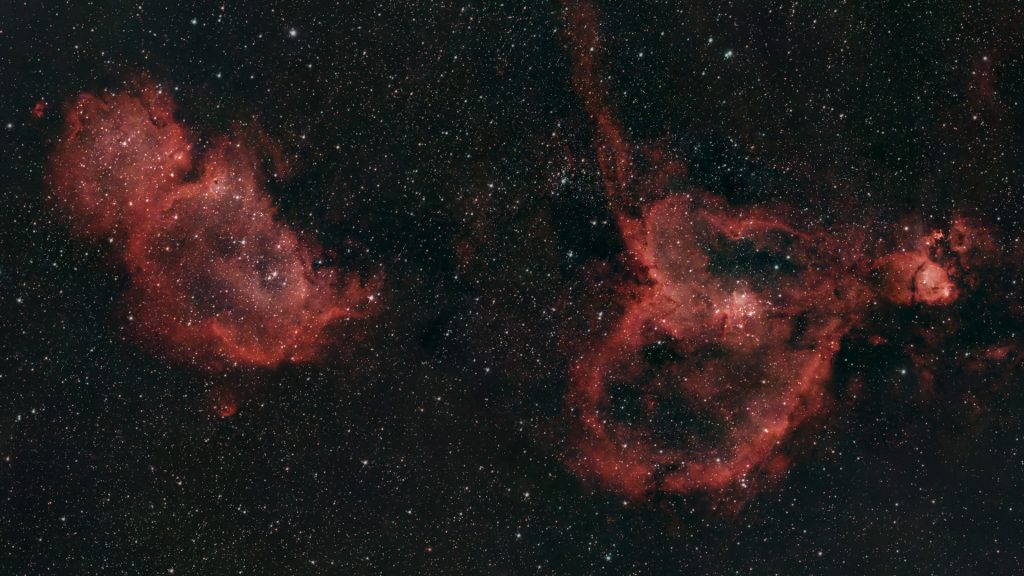
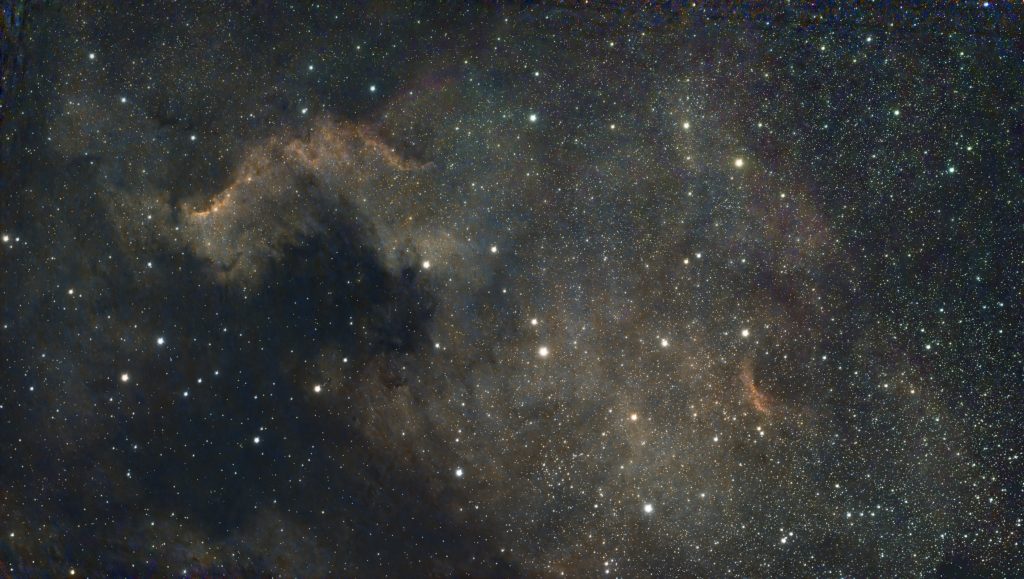
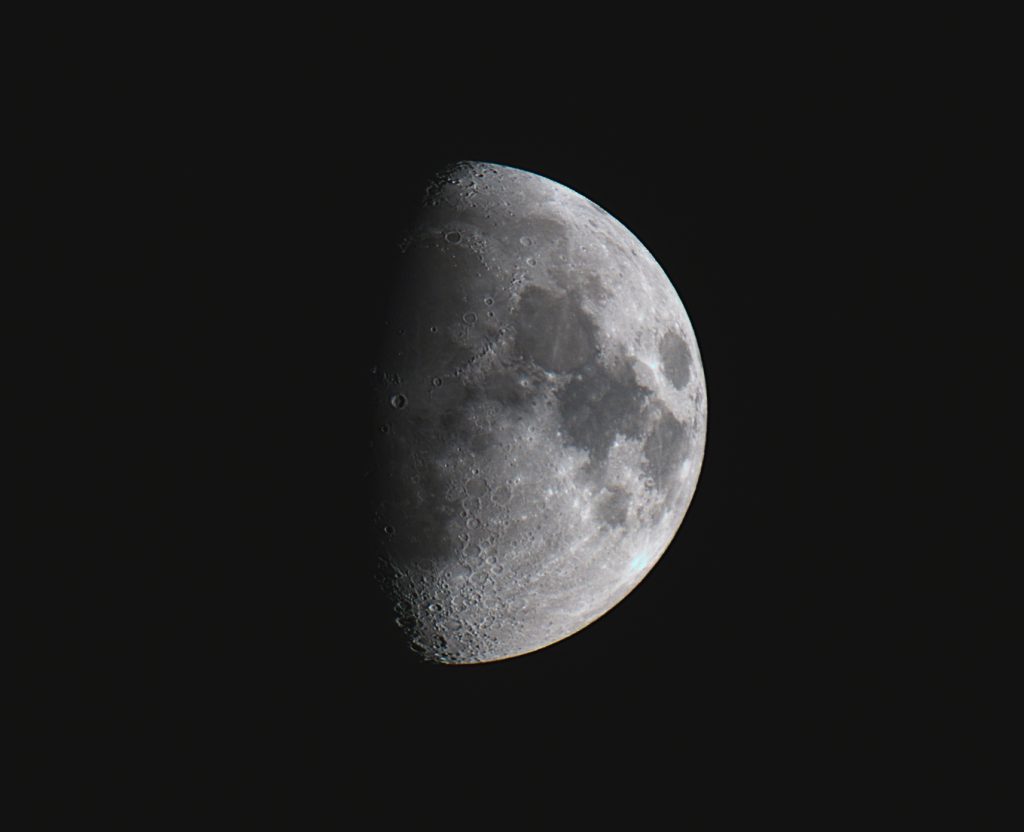
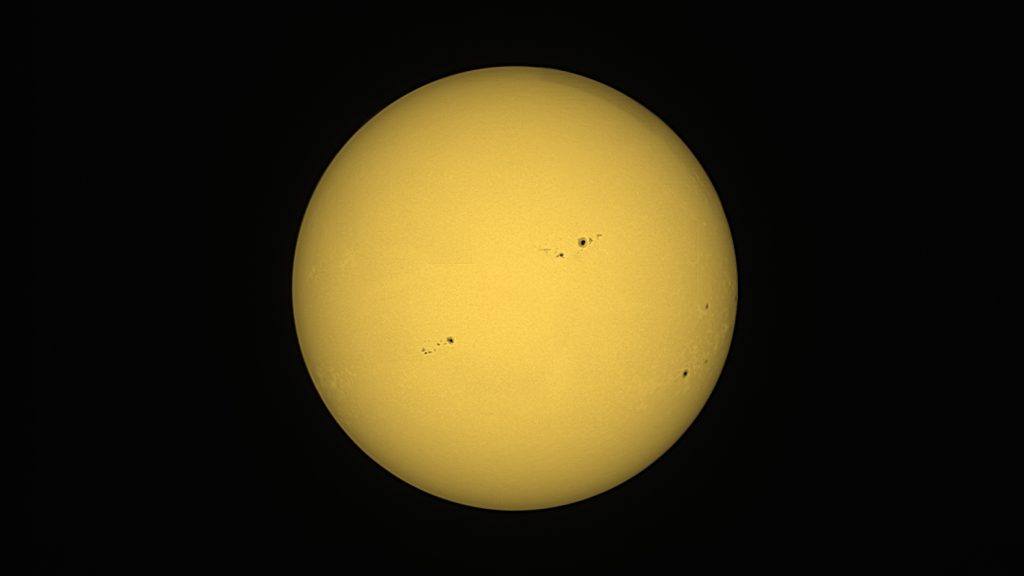
Real-world images best showcase performance. Here are some pictures I took with some of the Smart Telescopes in my light-polluted Bortle 7 urban sky. All images were stacked and processed by me, with exposure times ranging from 45 to 90 minutes.
ZWO Seestar S30
ZWO Seestar S30 Pro
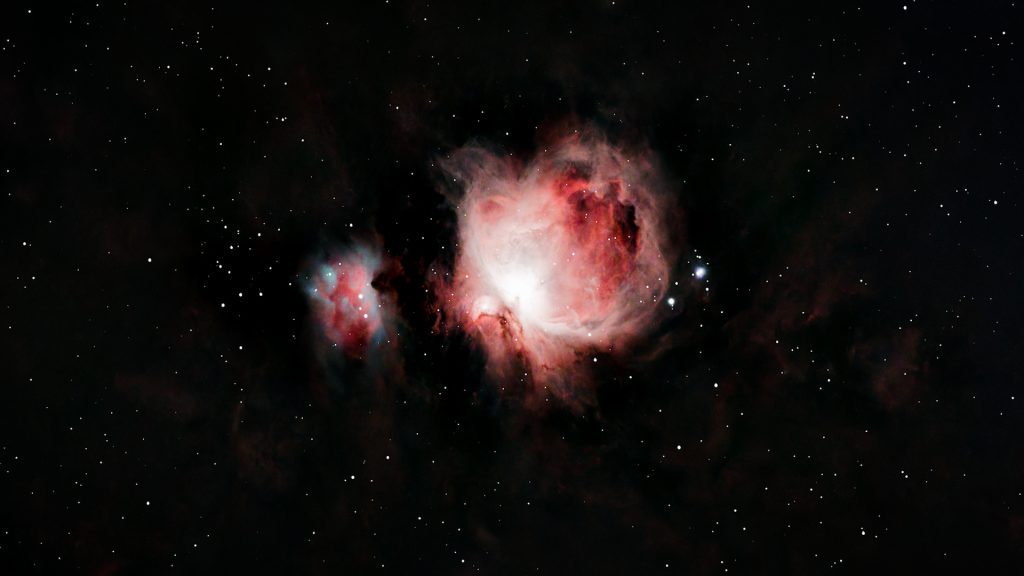
ZWO Seestar S50
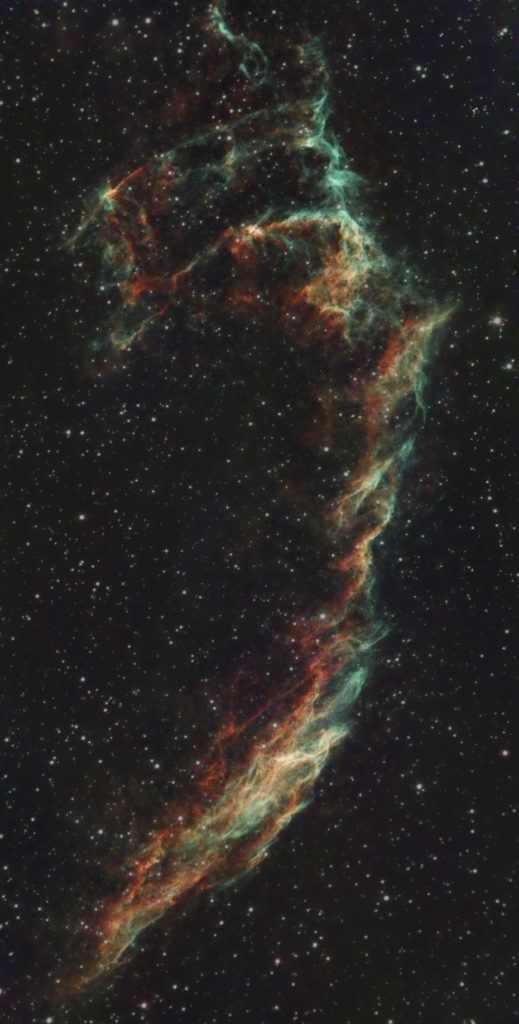
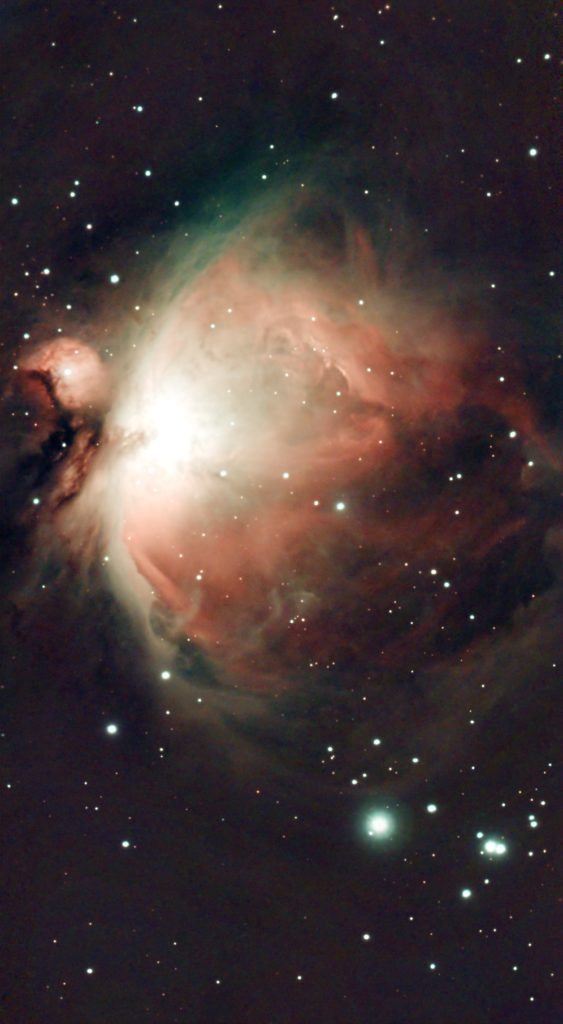
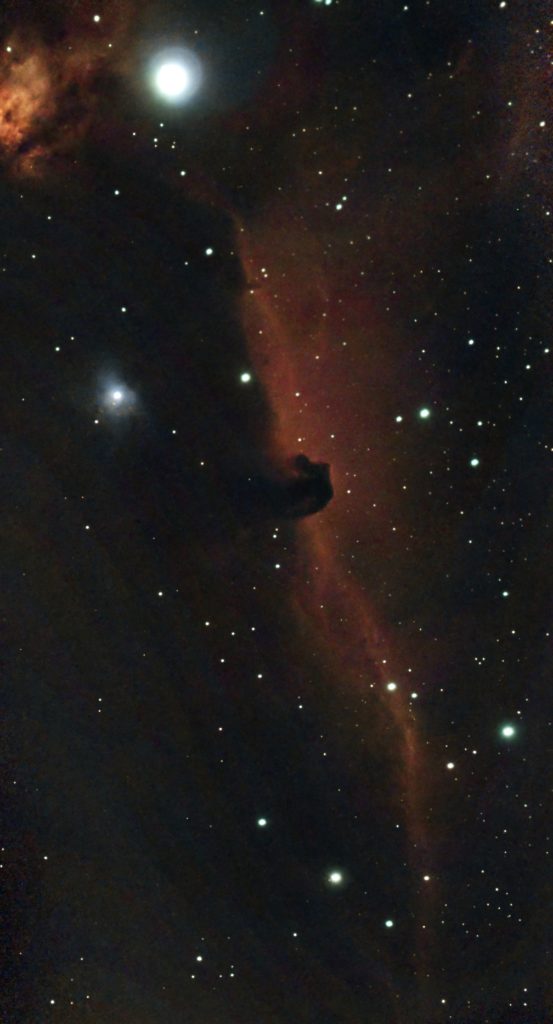
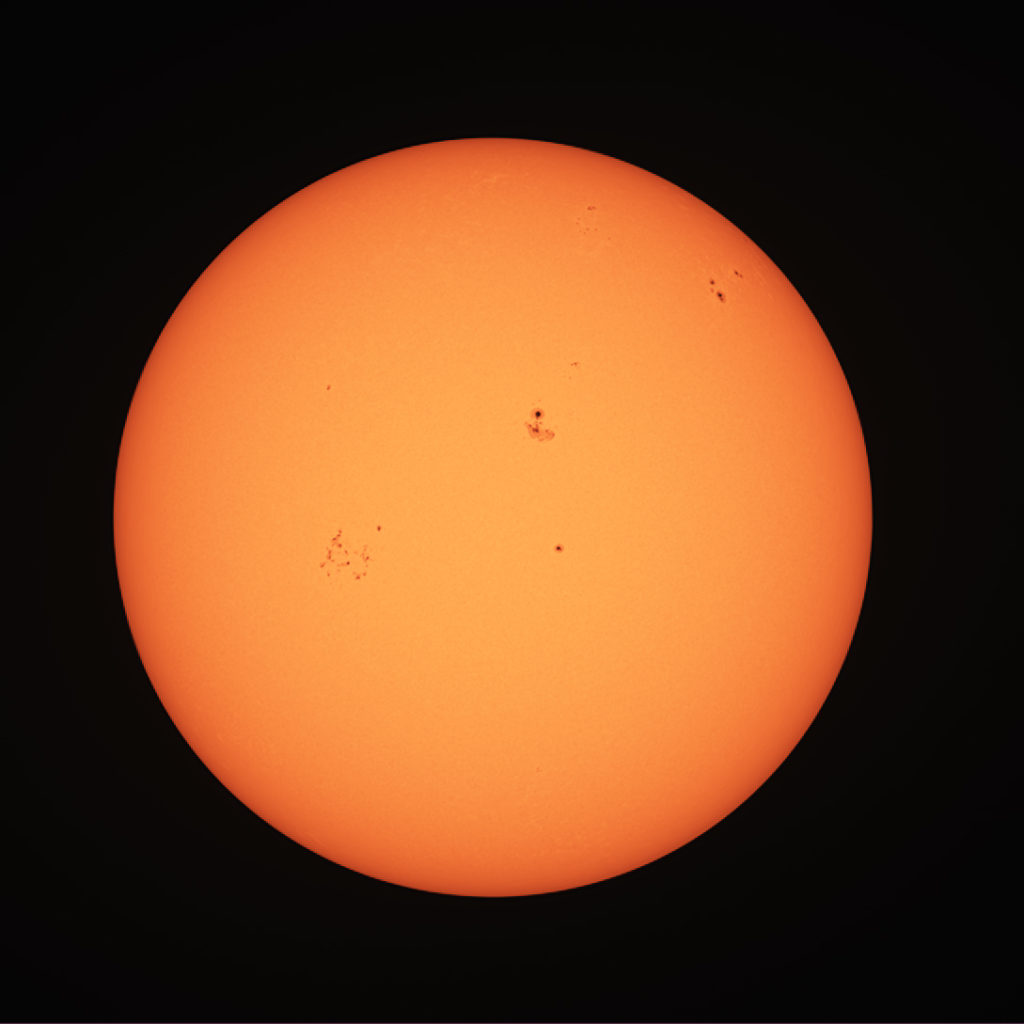
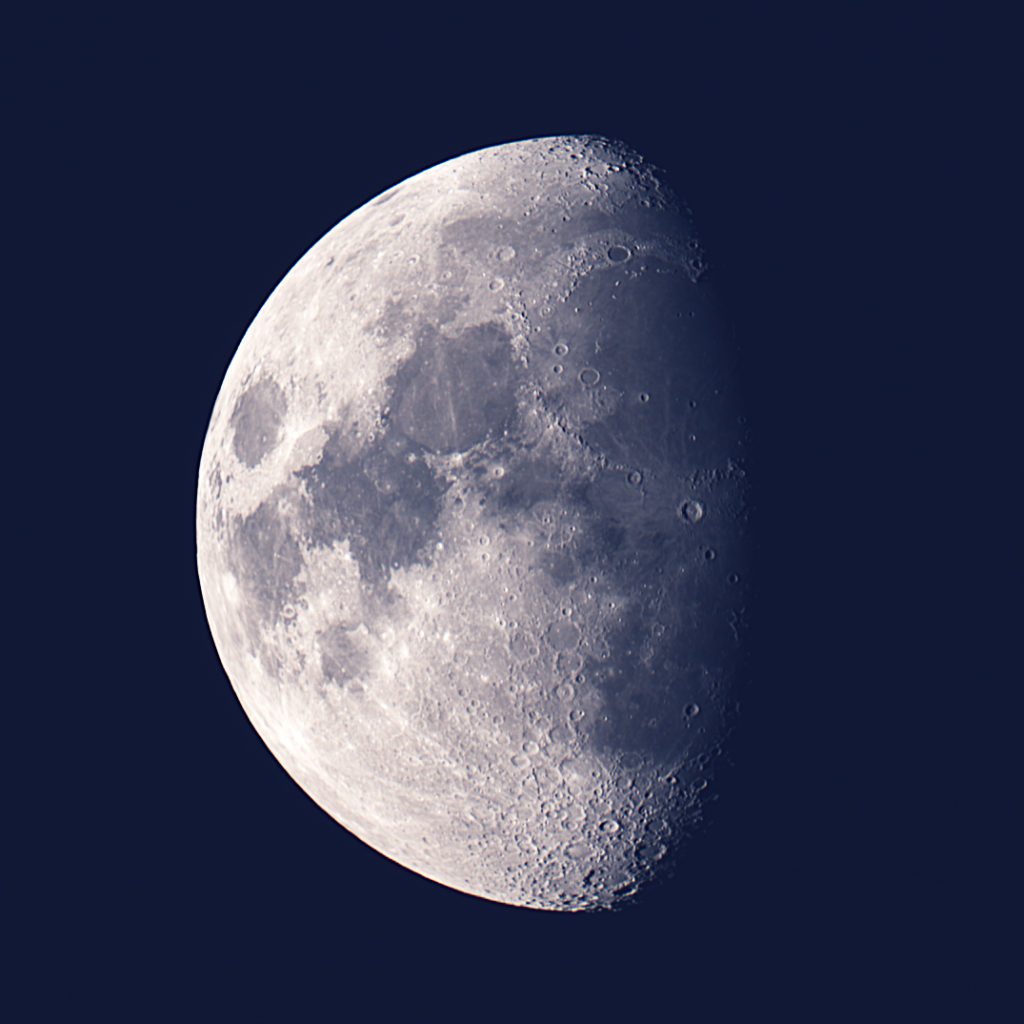
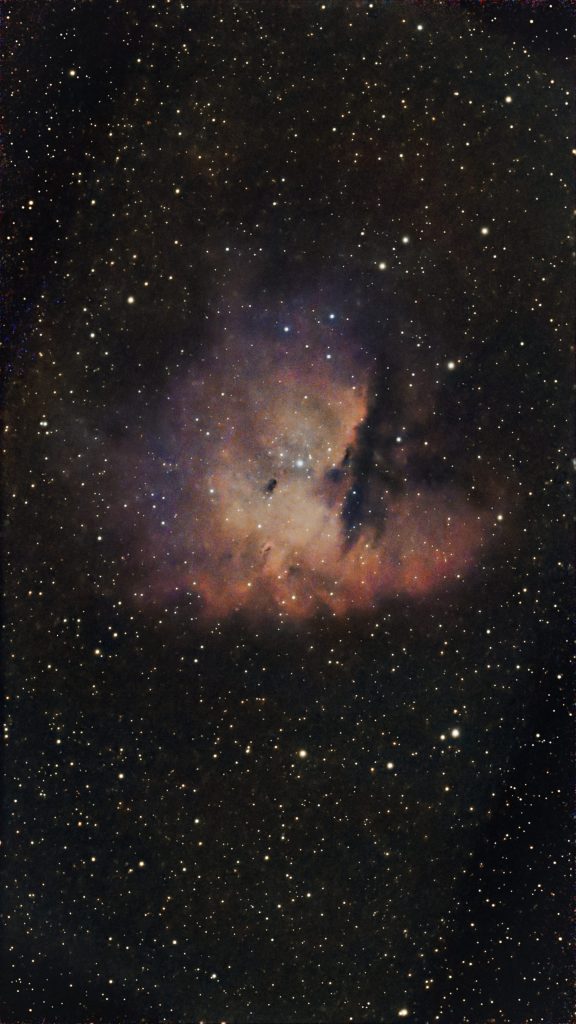
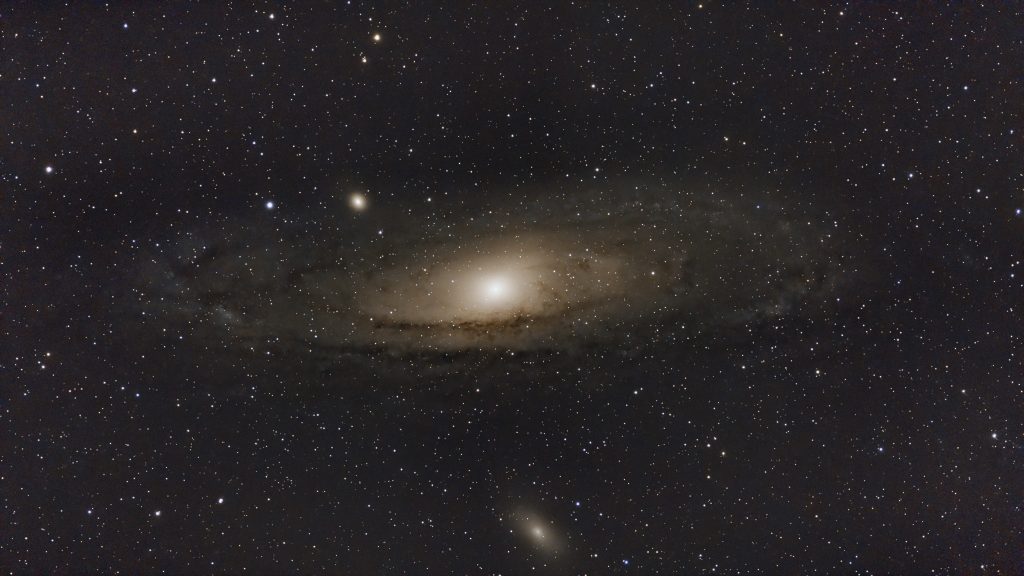
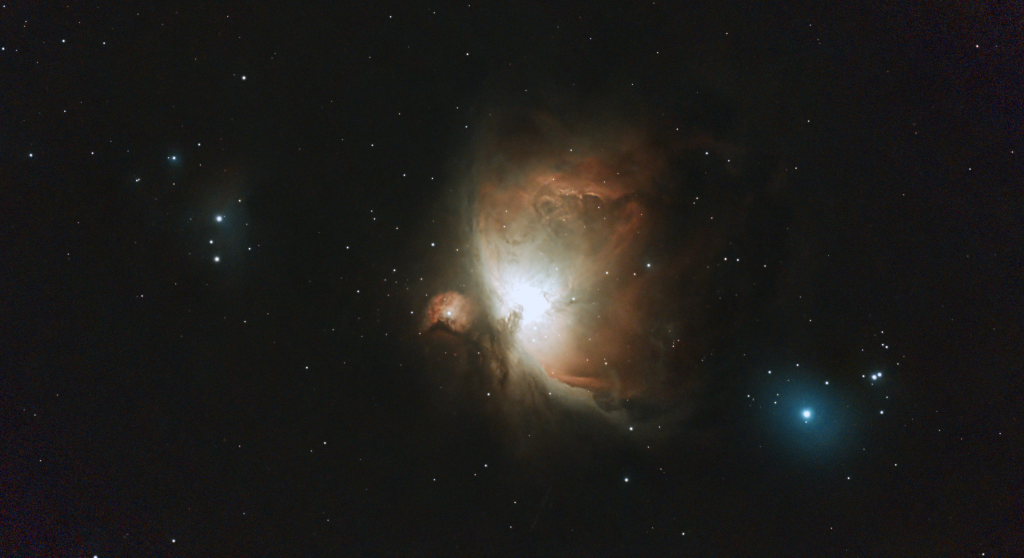
Vaonis Vespera II
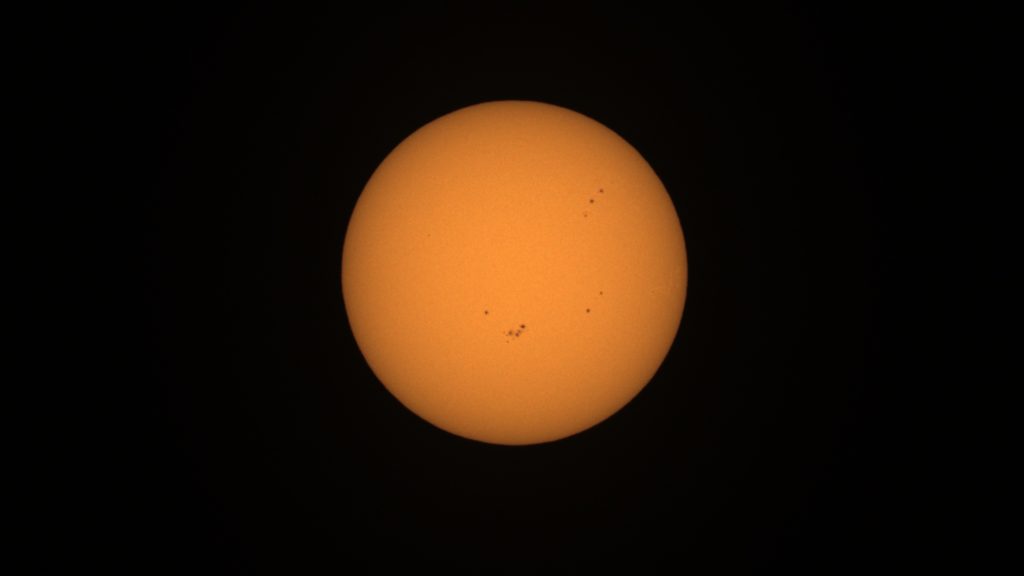
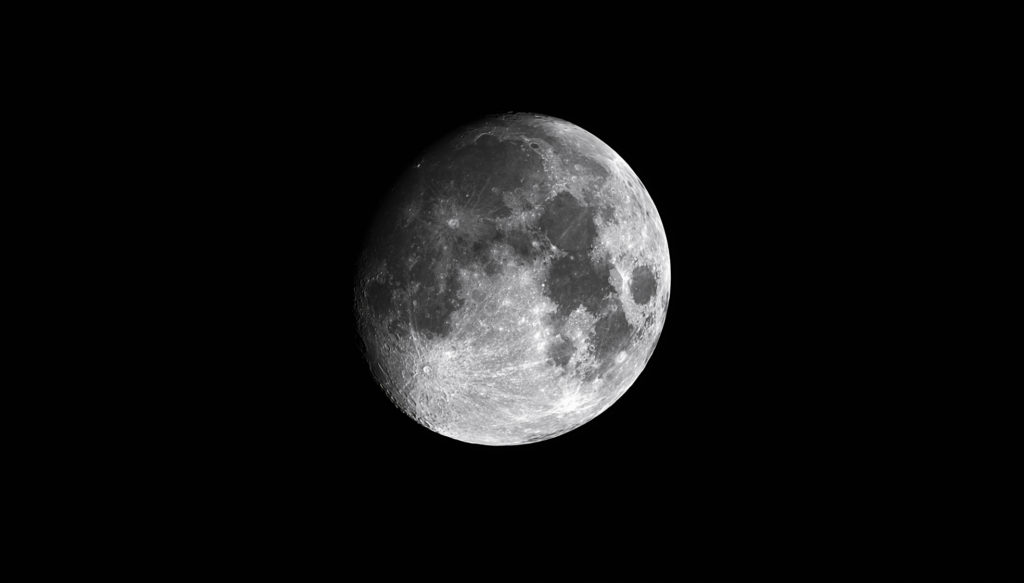
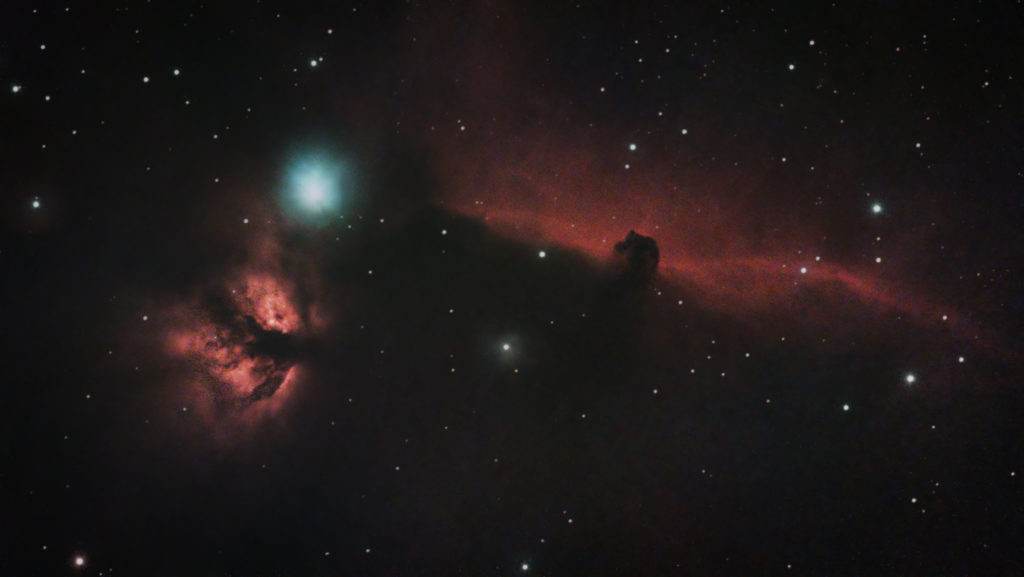
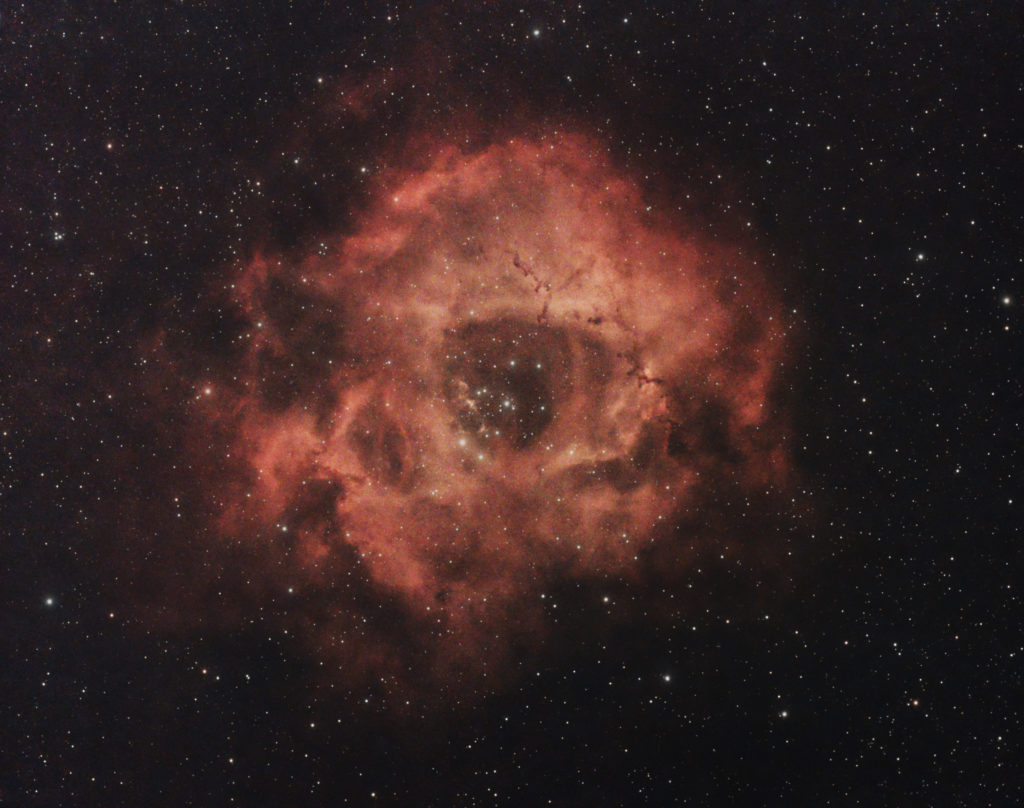

VAONIS Vespera Pro
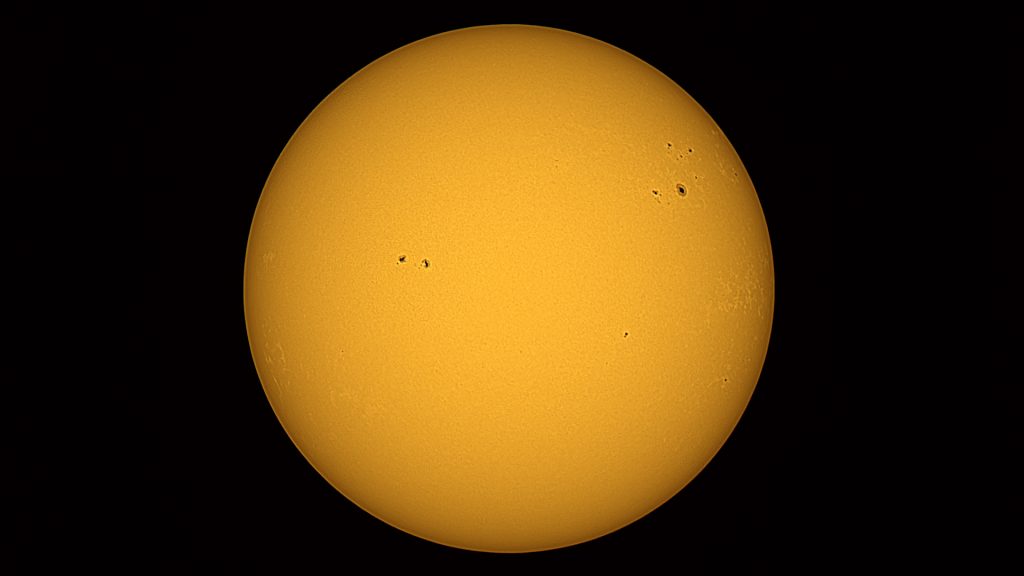

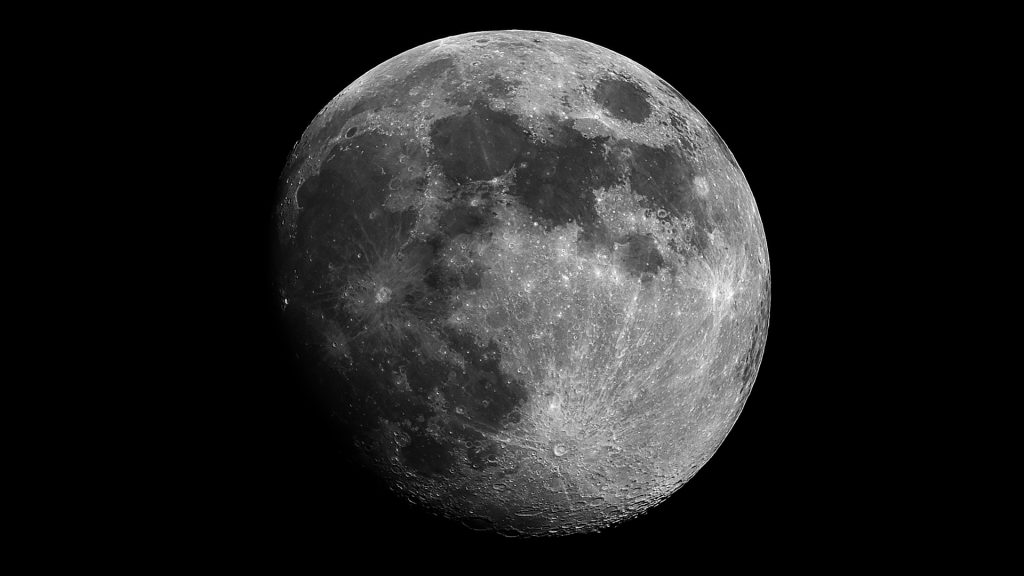
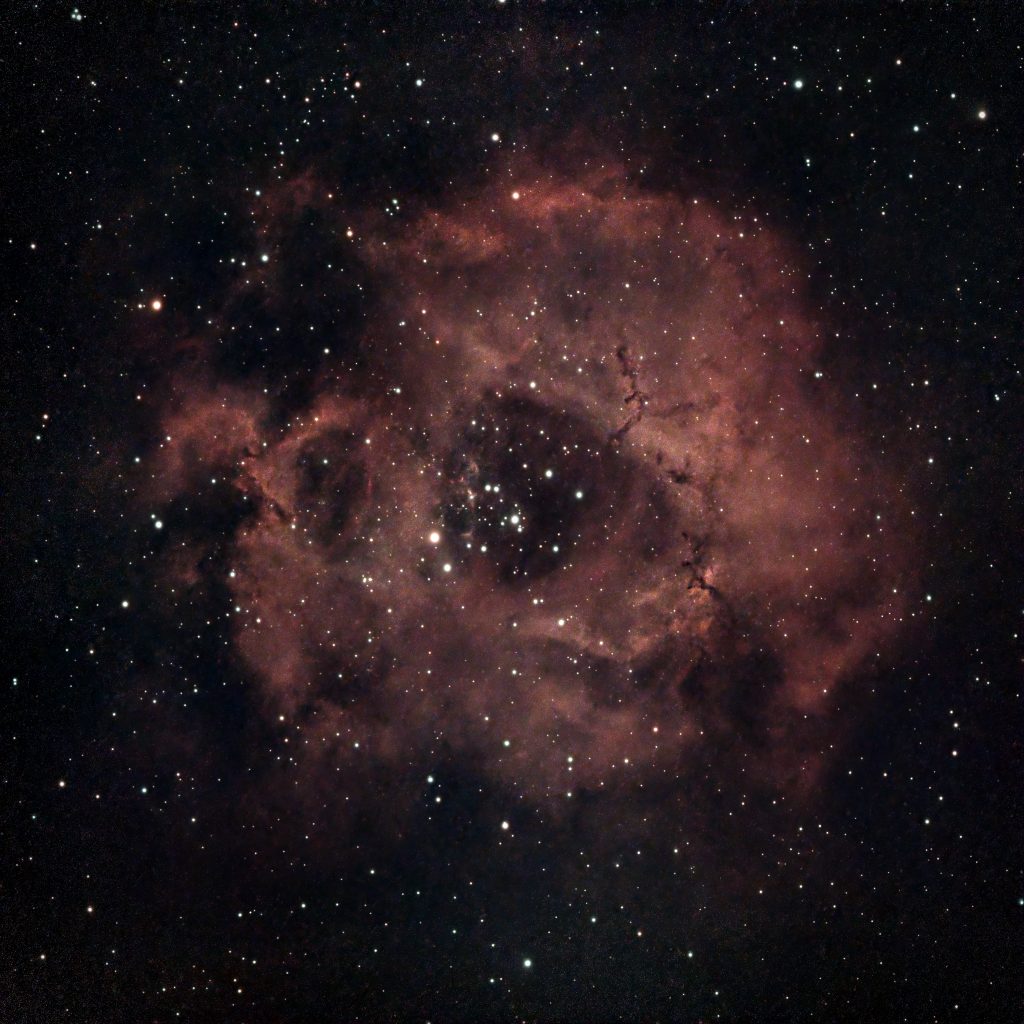
DWARF 3 Smart Telescope (with EQ mode)
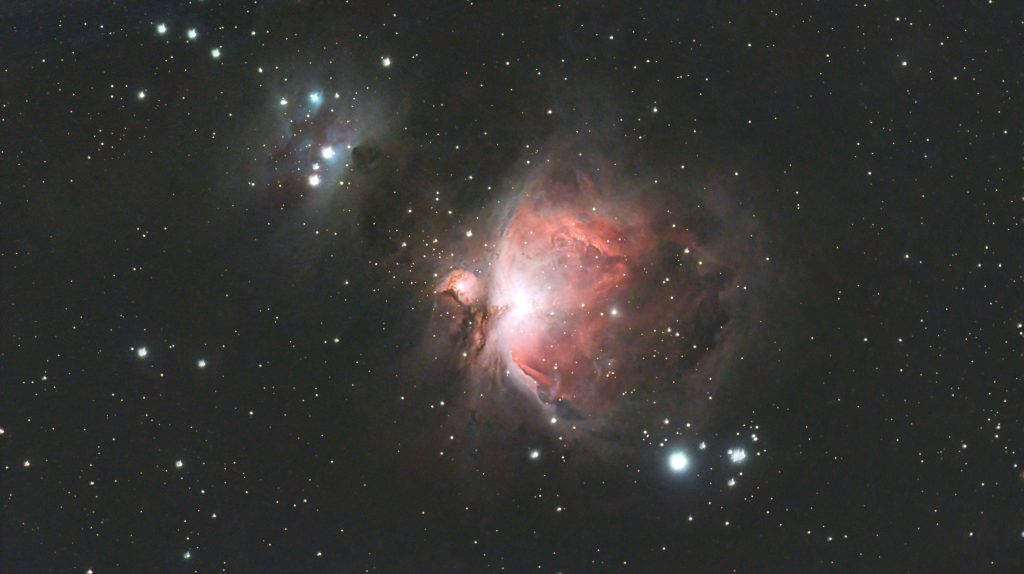
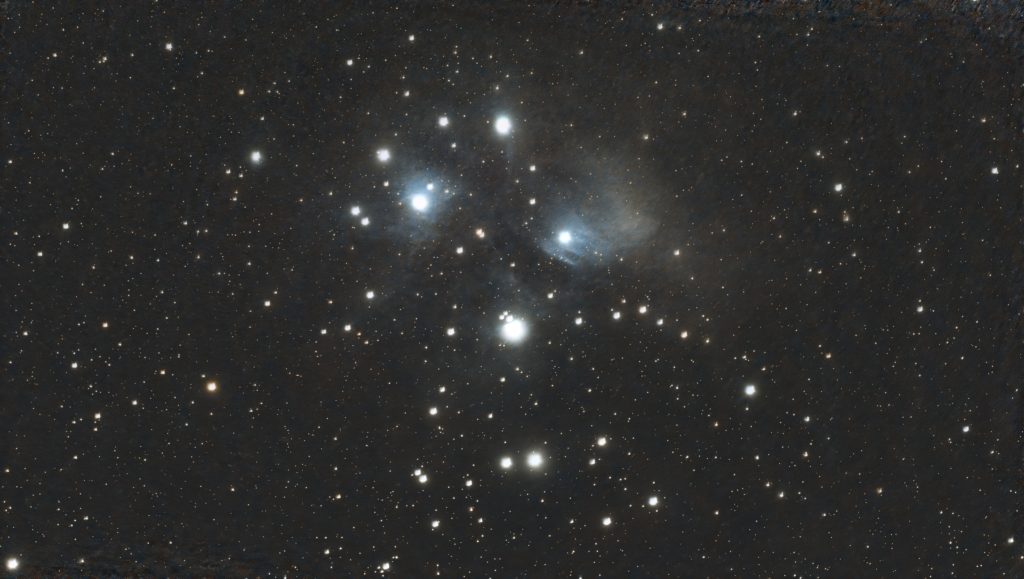
Dwarf Mini Smart Telescope (with EQ/Mosiac mode)
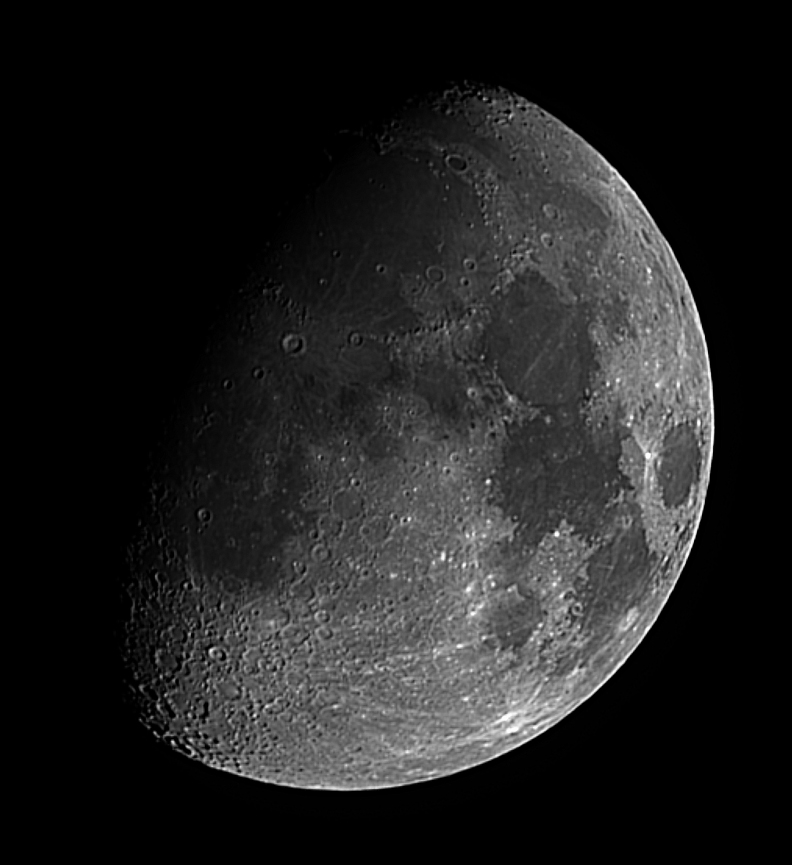
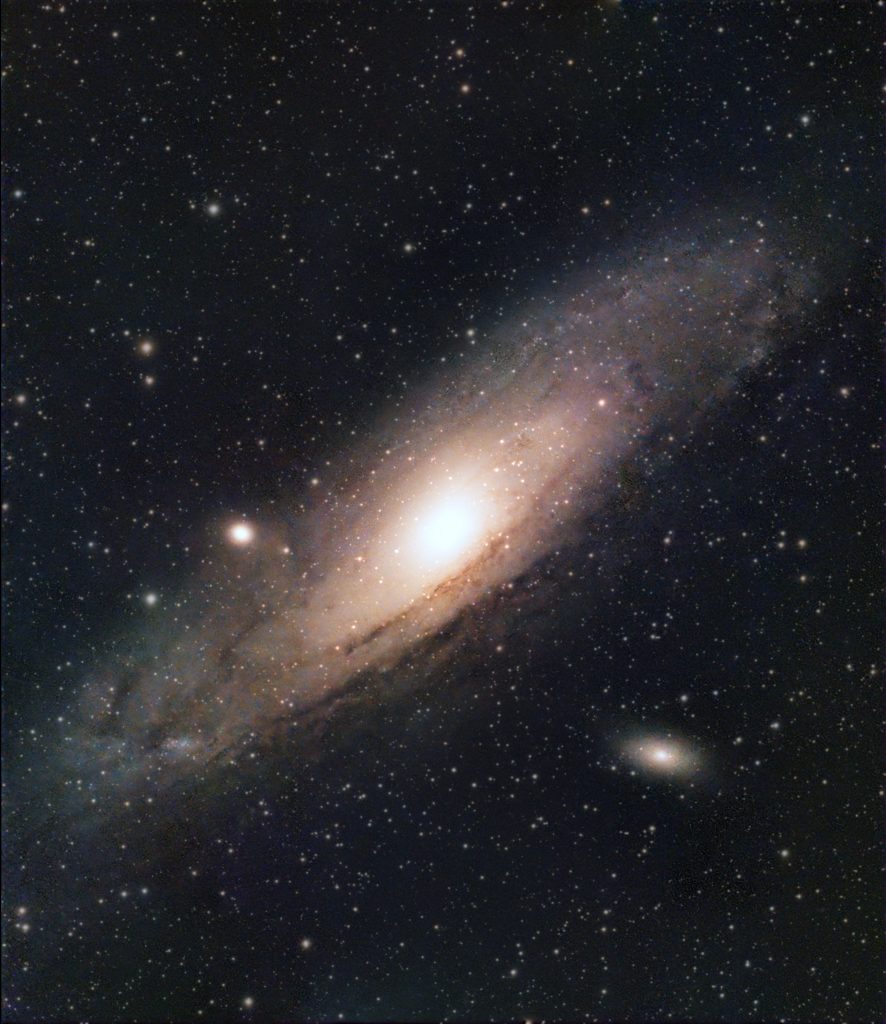
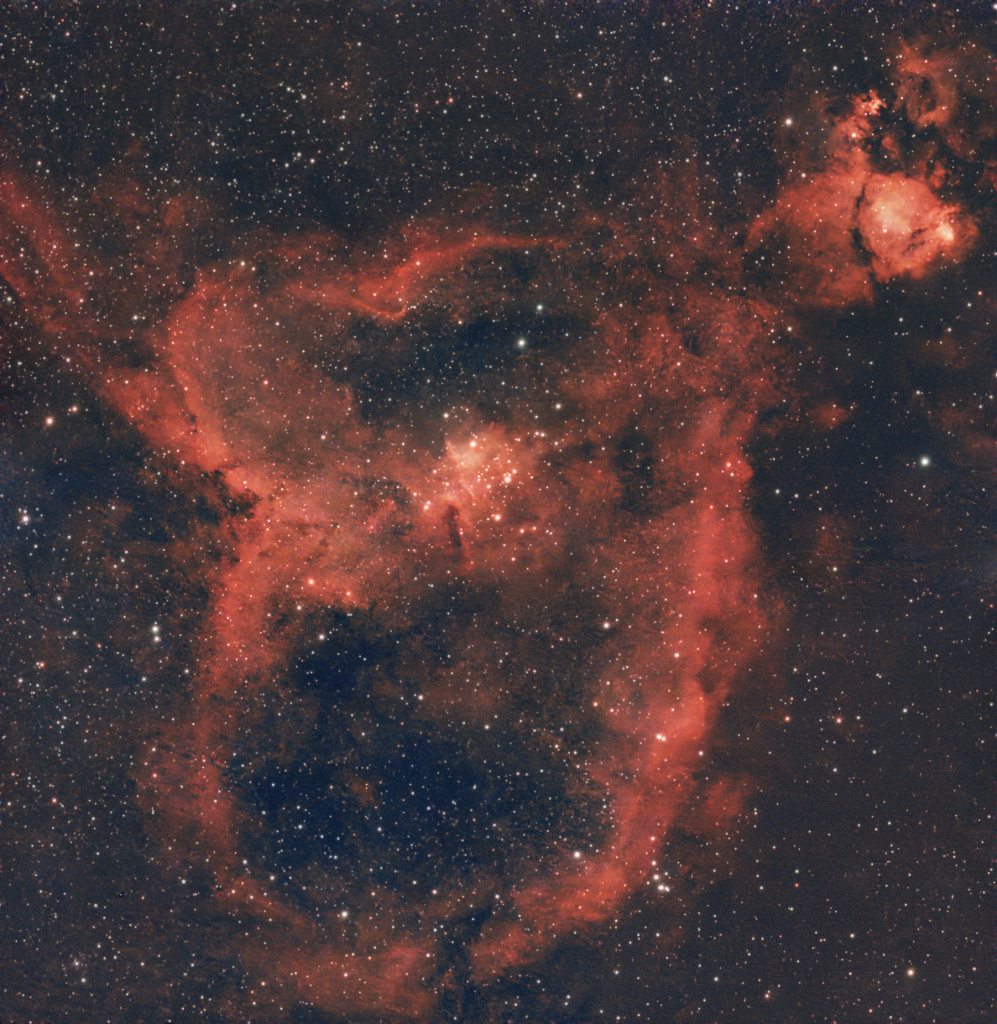

Other images
Astrobin is a reliable website to check out astrophotography photos taken with other smart telescopes that I’ve not yet tested and/or included in this overview.
↑ back to criteria
Storage capacity and Battery life
All smart telescopes have internal storage capacity to save your photos, which can be transferred to your computer, smartphone, or tablet after an imaging session. More storage capacity is useful as it relates to less time needed to transfer files to other devices and delete images to free up space for the next imaging session. In that respect, the Vaonis Vespera Pro stands out with a storage capacity of 225GB, followed by the Dwarf 3 Smart Telescope and S30 Pro at 128GB; the Seestar S50/S30, Unistellar Equinox 2, Odyssey and EVscope 2 all have a 64GB storage capacity. The Celestron Origin has about 45GB storage capacity, and the Vaonis Vespera II only has 25 GB of storage.
All smart telescopes have internal batteries that can be recharged after an imaging session. Longer battery life is useful so you don’t have to worry about forcefully stopping an imaging session because your smart telescope runs out of battery. In that respect, the Vespera Pro and Unistellar Equinox 2 boast 11 hours of battery life, followed by the Unistellar EVscope 2 rated at 10 hours. The Seestar S50/S30/S30 Pro, Dwarf 3, and the Celestron Origin all boast about 6 hours, the Unistellar Odyssey has about 5 hours of battery life. Finally, the Vaonis Vespera II and Dwarf Mini only runs for 4 hours before needing a recharge. Most smart telescopes can be recharged using a USB-C cable, also while in use.
↑ back to criteria
Weight and Size
The portability and size of these smart telescopes may also be important, especially if you’re planning to take them on to remote places for stargazing. The Celestron Origin is the heaviest smart telescope weighing 18,9 kg, followed by the Unistellar EVscope 2 at 9kg, and the Unistellar Equinox 2 at 7kg. Significantly more portable are the Vaonis Vespera models at 5kg. The Unistellar Odyssey weights 3 kg. The Seestar S50 is only 3kg, and by far the most portable devices are the Seestar S30 and S30 Pro at 1.65 kg, Dwarlab’s Dwarf 3 smart Telescope weighing only 1.3 kg, and Dwarflab’s Dwarf Mini weighing just 840 grams, respectively.
As for size, the Celestron Origin (61 x 66 x 121 cm) is the biggest telescope. The Unistellar Evscope 2 (77 x 33 x 26 cm) and Equinox 2 (65 x 23 x 12 cm) are also pretty bulky, although they do fit in a backpack. All models of the Vaonis Vespera are significantly smaller (48 x 20 x 9 cm), as well as the Unistellar Odyssey (43 x 20 x 13 cm), and easily fit in a backpack. Finally, the Seestar S50 (14 x 13 x 26 cm), S30 and S30 Pro (21 x 14 x 8 cm), Dwarf 3 (20 x 6 x 13 cm), and Dwarf Mini (10 x 18 x 6 cm) are the most portable smart telescopes in this overview.
↑ back to criteria
Astrophotography filters
Good quality astrophotography filters play a crucial role in mitigating the impact of light pollution in urban settings while enhancing the nebulous details in your astronomical images. Additionally, employing a solar filter is imperative for safeguarding your smart telescope by reducing solar energy, and enabling the observation of sunspots. Remember, never gaze directly at the sun, as it poses a risk of blindness.
The Seestar S50 is equipped with an internal light pollution filter to counter urban light pollution and enhance signal to noise ratio. The Seestar S30/S30 Pro are equipped with a Dark Field Filter (reduces noise), a UV/IR Cut Filter (blocks infrared light interference) and a Light Pollution Filter (Optimized for OIII and Ha wavelengths, great for nebulae). Both Seestar telescopes also include a solar filter without any extra charge. The Dwarf 3 has a magnetic solar glasses with ND filters that come with the telescope to place in front of the two lenses. The Dwarf 3 also comes with additional VIS filter for daytime use, an internal Astro filter to combat light pollution, and a Duo band filter (Ha, Oiii) for deep sky astrophotography. The Dwarf Mini features an ND solar filter, and built-in Astro, Duo-band, and Dark filters.
The Vaonis Vespera provides customization options with separately purchasable dual-band, light pollution, and solar filters, ranging from $199 for a solar filter to $399 for a dual-band filter. Not cheap, but the filters do their job well.
the Celestron Origin has a built-in filter drawer that accepts standard 1.25” and 2” format filters. This allows you to install optional filters, which can be especially useful in imaging nebulae in light-polluted environments like the typical suburban backyard. Celestron offers an optional ‘Nebula’ filter (Hydrogen-alpha, Hydrogen-beta, doubly ionized oxygen) for $199.
Unistellar only offers a smart solar filter for the Evscope 2 and Equinox 2 ($249) and Odyssey ($199). Unistellar asserts that its software is crafted to combat light pollution. While they may employ techniques like dynamic background extraction, background neutralization, and color balancing in their capturing software, like I do when I’m processing my astro-pictures, the specifics remain undisclosed…
↑ back to criteria
Final verdict
Best Smart Telescope for $399; Dwarf mini vs. Seestar S30
The Seestar S30 and the Dwarf Mini, both priced at around $399 at the time of writing, are among the most affordable smart telescopes for anyone wanting to enhance their stargazing and try astrophotography without breaking the bank.
The ZWO Seestar S30 is very much aimed at beginners. Its intuitive Seestar app (iOS and Android) lets you control the telescope wirelessly from your phone or tablet. You simply select a target, and the S30 handles slewing, tracking, and live stacking for you, delivering surprisingly good images for the price with almost no learning curve.
The Dwarf Mini is a very capable competitor. Dwarflab has put a lot of effort into making the Dwarflab app more user-friendly, and like the S30, the Mini can be controlled wirelessly from your smart device. It offers separate General, Solar System, and Deep Sky modes to automatically point the telescope at the Sun, Moon, planets, or deep-sky objects you want to see and photograph.
Under the hood, both telescopes use the same Sony 2 MP IMX662 camera sensor, but they differ in optics and form factor. The Dwarf Mini uses an ED telephoto lens design, while the Seestar S30 uses an APO refractor, which feels closer to a traditional small astro-refractor. The Mini is noticeably lighter at about 840 grams, and its sensor is oriented in landscape, whereas the S30’s sensor is portrait, which can matter for how certain targets frame up straight from the device.
On the software side, they are very similar. Both offer Station Mode, so you can connect the telescope to your home network and control it from anywhere in the house, instead of being limited to the 5–10 meter range of the built-in Wi-Fi. Both apps now include a scheduling module to plan and even fully automate an imaging night, and both provide in-app editing tools to process your astrophotos.
Like all small telescopes, the S30 and Dwarf Mini have their limitations. Neither is ideal for high-resolution planetary imaging—larger telescopes with apertures of 8″ (200 mm) or more, such as Dobsonians or SCTs, are much better suited for that. The recently introduced EQ mode for Seestar and the EQ mode on the Dwarf Mini do help with tracking and allow for longer exposures, but their modest apertures and focal lengths still limit fine detail compared to bigger gear.
The key takeaway is that there isn’t a single clear winner—both are excellent entry points into smart-telescope astrophotography.
- Choose the Seestar S30 if you prefer the APO refractor design and ZWO’s ecosystem and app.
- Choose the Dwarf Mini if you value low weight, a landscape sensor, and a very compact form factor.
| Seestar S30 ($399) | Dwarf Mini ($399) |
|---|---|
|
✔ Very affordable ✔ Intuitive app for wireless control ✔ Beginner-friendly automation (pick a target and go) ✔ APO refractor design, familiar to traditional astro users ✔ Great for casual astrophotography from light-polluted skies |
✔ Very affordable & ultra-light (~840 g) ✔ Super compact, easy to travel with ✔ Landscape sensor for natural camera type framing ✔ Simple app with General / Solar System / Deep Sky modes ✔ Great value for wide-field nebula & galaxy shots (with duo-band filter) |
|
✘ Small aperture, less detail than larger telescopes ✘ Short focal length, low magnification for planets ✘ Portrait sensor orientation not ideal for traditional landscape photos ✘ Limited planetary detail compared to 8″+ scopes |
✘ Small aperture/ED lens – limited fine detail ✘ Not suitable for high-resolution planetary work ✘ Relies heavily on app & automation |
The Seestar S30 is currently available at ZWO (WW), High Point Scientific (USA/WW), Agena Astro (USA/WW), and Astroshop (EU/WW).
The Dwarf Mini is currently available at Dwarflab (WW), and High Point Scientific (USA/WW).
Best Smart Telescope for $599; Seestar S50, Seestar S30 Pro & Dwarf 3
In the $400 – $600 range, Dwarlab’s Dwarf 3, the Seestar S30 Pro, and ZWO’s Seestar S50 cater to distinct preferences in astrophotography.
The Dwarf 3 is a great choice for anyone looking for a true all-in-one, multipurpose telescope suited for nature, wildlife, and astrophotography. The Seestar S30 Pro offers an even wider field of view, and its Seestar app includes a Scenery mode for capturing daytime photos and videos. That said, it’s important to note that the camera sensor is mounted in portrait orientation—similar to most smartphone sensors—which makes it ideal for vertical, short-form content, but less suitable for traditional landscape framing.
The Dwarf 3 features a 150mm focal length, 35mm aperture ED telephoto lens, and Sony IMX678 8 MP sensor, making it perfect for capturing large deep-sky objects like the Orion Nebula. With a 2.93° x 1.65° field of view (FoV), it enables wide-angle imaging, and its EQ mode allows up to 120-second long-exposure astrophotography, reducing distortion and field rotation. The Seestar S30 Pro provides an even wider field of view of 2.24 × 3.99 and features an EQ mode in the Seestar app with a maximum exposure time of 60 seconds. By eliminating field rotation, EQ mode enables longer exposures, allowing more light from faint deep-sky objects to be captured, resulting in brighter images with reduced noise.
The Seestar S50, on the other hand, is designed for ease of use and offers an advanced stargazing experience. It boasts a longer 250mm focal length, 50mm aperture, and Sony IMX462 2.1 MP sensor, which are well-suited for smaller deep-sky objects. Its standard 0.73° x 1.29° FoV can be expanded with a framing mode in the Seestar app to capture larger mosaics (up to 1.4° x 2.6°), although this process requires more time. Its image scale (2.39 arc seconds) is slightly better than the Dwarf 3’s (2.75 arc seconds), and the Seestar S30 Pro (3.74 arc seconds), and the recently introduced Seestar S50 EQ mode extends its exposures to 60 seconds and improves tracking, resulting in smooth images.
All three smart telescopes come with intuitive, easy-to-use apps. The Seestar app is primarily geared toward advanced stargazers and beginner astrophotographers, while the Dwarf 3 app extends beyond astrophotography to also support nature and wildlife imaging. If you’re looking for a truly versatile telescope for multiple use cases, the Dwarf 3 is likely the best choice. While the Seestar app does include a daytime scenery mode, it’s worth noting that Seestar telescopes use portrait-oriented camera sensors. If higher magnification and a more detailed stargazing experience on smaller deep-sky objects are your priority, the Seestar S50 may be the better fit.
| Dwarf 3 ($599) | Seestar S30 Pro ($599) | Seestar S50 ($599) |
|---|---|---|
|
✔ Ideal for large deep-sky objects ✔ Wide field of view ✔ Long exposures with EQ mode (up to 120s) ✔ Versatile for nature, wildlife, and astrophotography |
✔ Even wider field of view than Dwarf 3 ✔ EQ mode with 60s exposures ✔ Compact and beginner-friendly |
✔ Better suited for smaller deep-sky objects ✔ Higher magnification and finer image scale ✔ Mosaic framing for larger objects ✔ Polished and intuitive Seestar app |
|
✘ Less suited for small celestial objects ✘ Low aperture, limited resolution |
✘ Portrait-oriented sensor, no landscape framing ✘ Coarser image scale than S50 ✘ Shorter max exposure than Dwarf 3 |
✘ Narrow native field of view ✘ Slower light collection than Dwarf 3 ✘ Mosaic capture requires more time |
Check out my full reviews of the Seestar S50, the Seestar S30 Pro, and the Dwarf 3 for more details! And find my recent test of the Seestar EQ mode here.
The Dwarf 3 Smart Telescope is available at Dwarflab (WW), High Point Scientific (USA/WW), and Astroshop (EU/WW).
The ZWO Seestar S50 can be purchased directly at ZWO (WW), and at Agena Astro (USA/WW), High Point Scientific (USA/WW), and Astroshop (EU/WW).
The Seestar S30 Pro Smart Telescope is available at ZWO (vendor, worldwide), High Point Scientific (USA/WW), Agena Astro (USA/WW), and Astroshop (EU/WW)
If you’re looking for a side-by-side comparison of all smart telescopes, click the button below to launch my new interactive comparison tool.
Best Smart Telescope for $1000-$2000; Vaonis Vespera II and Vespera II-X
The Vaonis Vespera II offers an impressive upgrade in imaging performance and features, making it a top choice for astrophotography enthusiasts. It comes equipped with an advanced Sony IMX 585 8.3 MP sensor and 250mm focal length for high resolution and magnification, and 25 GB of internal storage. A modern USB-C charging port that can be used to recharge the telescope even when in use adds to its convenience and compatibility.
While its 4-hour battery life is shorter than some might hope for, this can be easily mitigated by using an external power bank via the USB-C port—an easy workaround for extended observation sessions.
The Vespera II also includes the powerful CovalENS mode, allowing users to create wide-field panoramas up to four times the native field of view. This is ideal for capturing large celestial objects like nebulae and galaxies, though it does require longer imaging times for best results. The experience is further enhanced by the intuitive Singularity app and a range of optional accessories such as filters and carrying cases.
Note that there is also a Vespera II X Edition on the market which is identical to the standard Vespera II in terms of optics, sensor, mount, and overall imaging performance, so image quality and functionality are exactly the same. The difference lies in the higher price (around €2,290 vs. roughly €1,600), for which you get premium extras like a transparent showcase housing, a carbon-fiber tripod, a hard transport case, and an integrated hygrometer—making the X Edition a deluxe package rather than a performance upgrade.
All in all, the Vespera II and the Vespera II-X edition deliver outstanding imaging capabilities, generous storage, and modern features, making it a great option in this price range.
| Vaonis Vespera II (about €1,590) | Vaonis Vespera II X Edition (about €2,290) |
|---|---|
|
✔ Advanced camera sensor (Sony IMX585) ✔ 250mm focal length for decent magnification ✔ USB-C charging port for convenience ✔ Excellent for panoramic imaging (CovalENS mode) |
✔ Identical optics, sensor, and imaging performance ✔ Transparent showcase housing ✔ Carbon-fiber tripod included ✔ Hard transport case and integrated hygrometer |
|
✘ Short battery life (~4 hours, extendable with power bank) ✘ No video capture for Solar System objects |
✘ Higher price with no imaging performance gain ✘ Extras focus on presentation rather than functionality |
Check out my original review of the Vaonis Vespera II and the Vaonis Vespera II-X for more details.
The Vaonis Vespera II is available at Vaonis, Agena Astro (USA/WW), High Point Scientific (USA/WW), and Astroshop (EU/WW).
The Vaonis Vespera II X-edition is available at: Vaonis (vendor, worldwide), Agena Astro (USA/WW), High Point Scientific (USA/WW), and Astroshop (EU/WW).
Best Smart Telescope for $2000-$3000; Vaonis Vespera Pro vs Unistellar Equinox 2 vs. Unistellar Odyssey
When shopping for a smart telescope in this price range, your decision ultimately depends on what you want to capture and how much effort you’re willing to put into maintenance and setup.
The Unistellar Equinox 2 and Odyssey stand out with their larger apertures (114mm and 85mm, respectively) and longer focal lengths (450mm and 320mm). These features make them excellent for capturing high-magnification views of smaller, more distant celestial objects like planetary details or compact star clusters. However, the Equinox 2, being a Newtonian reflector, requires manual focusing and collimation, which can be a dealbreaker for those seeking a maintenance-free experience.
On the other hand, the Vaonis Vespera Pro is designed for convenience and portability. With a 50mm aperture and 250mm focal length quadruplet refractor telescope, the Vespera Pro is perfect for wide-field imaging, making it the ideal choice for capturing expansive celestial wonders like the Andromeda Galaxy or the Orion Nebula. Its 225 GB of storage also far outpaces the Odyssey and Equinox 2, which offer 64 GB, giving you plenty of room to save and process your astrophotography sessions. Additionally, the Vespera Pro’s sleek design and maintenance-free operation make it an excellent choice for beginners or those who value simplicity.
- Choose the Vaonis Vespera Pro if you want a hassle-free, portable telescope that excels in wide-field imaging of large celestial objects and offers generous storage for extended imaging sessions.
- Opt for the Unistellar Equinox 2 or Odyssey if you’re focused on high-magnification views of smaller, more distant objects and don’t mind the extra effort involved in maintenance and collimation in case of the Equinox 2.
| Unistellar Odyssey ($2299) | Unistellar Equinox 2 ($2499) | Vaonis Vespera Pro ($2799) |
|---|---|---|
|
✔ Large aperture (85mm) ✔ Focal length (320mm), great for medium-sized objects |
✔ Large aperture (114mm) ✔ Focal length (450mm), higher resolution |
✔ Maintenance-free ✔ Wide-field imaging ✔ 225 GB storage |
|
✘ Limited storage (64 GB) ✘ Not ideal for wide-field |
✘ Manual collimation required ✘ Not ideal for wide-field |
✘ Small aperture (50mm) ✘ Not ideal for small objects |
The Vaonis Vespera Pro will be available from May 2024 onwards, and can be pre-ordered at Vaonis, High Point Scientific (USA/WW).
The Unistellar Equinox 2 is available at High Point Scientific (USA/WW), and Astroshop (EU/WW)
The Unistellar Odyssey is available at High Point Scientific (USA/WW) and Astroshop (EU/WW)
Best Smart Telescope for $3000 – $4500: Celestron Origin Home Intelligent Observatory versus Unistellar EVscope 2 and Unistellar Odyssey Pro
When it comes to high-end smart telescopes, the competition is between the Unistellar Odyssey Pro, EVscope 2, and Celestron Origin Intelligent Home Observatory. The Celestron Origin Intelligent Home Observatory stands out as a versatile and powerful option. With a 152mm aperture, f/2.2 optics, and a wide field of view (1.83° x 1.22°), it captures more light and provides a broader view than its competitors. This makes it ideal for imaging both expansive nebulae and smaller galaxies. At 18.9 kg, it’s the heaviest of this price range, but its sturdy build and impressive capabilities more than compensate for the added weight.
The EVscope 2, with a 114mm aperture, f/4 optics, and a narrower field of view (0.6° x 0.4°), excels at higher magnifications for smaller objects like globular clusters. It’s lighter at 9 kg and offers a more modern camera sensor, but its limited field of view restricts its versatility. The Odyssey Pro, featuring an 85mm aperture, f/4 optics, and a 0.93° x 0.69° field of view, is the most portable at just 4 kg, making it a great budget-friendly option—especially the standard model, which avoids the $1700 markup for the Pro’s Nikon eyepiece.
Smart telescopes shine for their ease of use, portability, and seamless app integration, making them perfect for beginners and casual astronomers. However, at this price point, a dedicated astrophotography setup offers superior flexibility and image quality for those willing to embrace a steeper learning curve. For versatility and value, the Celestron Origin is the top pick. For more guidance, feel free to contact me at astroforumlive@gmail.com or check out my information on this website on how to start astrophotography.
| Unistellar Odyssey Pro ($3999) | Celestron Origin Intelligent Home Observatory ($3999) | EVscope 2 ($4899) |
|---|---|---|
|
✔ Portable (4 kg) ✔ More affordable option without eyepiece |
✔ Large aperture (152mm) ✔ f/2.2 optics captures light faster ✔ Wide field of view (1.83° x 1.22°) |
✔ Higher magnification ✔ Great for smaller objects |
|
✘ Expensive Nikon eyepiece ✘ Not ideal for wide-field objects |
✘ Heaviest (18.9 kg) ✘ Camera sensor outdated |
✘ Narrow field of view (0.6° x 0.4°) ✘ Limited versatility |
The Celestron Origin is available at Agena Astro (USA/WW), High Point Scientific (USA/WW), and Astroshop (EU/WW).
The Unistellar EVscope2 is available at High Point Scientific (USA/WW), and Astroshop (EU/WW)
The Unistellar Odyssey Pro is available at High Point Scientific (USA/WW), and Astroshop (EU/WW)
Clear skies!
Wido.
@Wido’s Astroforum
Smart Telescope Comparison Table
| wdt_ID | Name | Price | B2C | USA1 | USA2 | EU | Telescope type | Glass / mirror type | Aperture | Focal Length | f/ratio | Sensor type | Resolution | Megapixels | Pixel size | Image scale | Field of View (Native) | Field of View (max) | Photo formats | Video formats | APP type | OS | connection | APP ease of use | Storage | Battery life | Data transfer | Size | Weight |
|---|---|---|---|---|---|---|---|---|---|---|---|---|---|---|---|---|---|---|---|---|---|---|---|---|---|---|---|---|---|
| 2 | Vaonis Vespera II | 1.590,00 | Link | Link | Link | Link | Quadruplet Refractor | S-FPL52 (ED) | 50 | 250 | 5,0 | Sony IMX 585 | 3840 x 2160 | 8,3 | 2,90 | 2,39 | 2.5°x1.4° | 4.33°x2.43° 3.25°x3.25° | jpg, fits, tiff | Singularity | Android, iOS | Wi-Fi | 5/5 | 25 | 4 | USB-C | 48 x 20 x 9 | 5,0 | |
| 3 | Vaonis Vespera Pro | 2.799,00 | Link | Link | Link | Quadruplet Refractor | S-FPL52 (ED) | 50 | 250 | 5,0 | Sony IMX 676 | 3536 x 3536 | 12,5 | 2,00 | 1,60 | 1.6°x1.6° | 3.4°x2° 2.56°x2.56° | jpg, fits, tiff | Singularity | Android, iOS | Wi-Fi | 5/5 | 225 | 11 | USB-C | 48 x 20 x 9 | 5,0 | ||
| 5 | Seestar S50 | 499,00 | Link | Link | Link | Link | APO triplet Refractor | APO (ED) | 50 | 250 | 5,0 | SONY IMX 462 | 1080 x 1920 | 2,0 | 2,90 | 2,39 | 0.7°x1.3° | 1.4°x2.6° | jpg, fits, tiff | MP4, AVI RAW | Seestar | Android, iOS | Wi-Fi | 5/5 | 64 | 6 | USB-C | 14 x 13 x 26 | 3,0 |
| 7 | Unistellar EVscope 2 | 4.899,00 | Link | Link | Newtonian Reflector | Mirror | 114 | 450 | 4,0 | Sony IMX 347 | 2088 x 1536 | 7,7 | 1,45 | 0,66 | 0.34°x 0.45° | 0.34°x 0.45° | jpg, fits, tiff, png | Unistellar | Android, iOS | Wi-Fi | 4/5 | 64 | 10 | USB-C | 77 x 33 x 26 | 9,0 | |||
| 8 | Unistellar Equinox 2 | 2.499,00 | Link | Link | Newtonian Reflector | Mirror | 114 | 450 | 4,0 | Sony IMX 347 | 2048 x 1536 | 6,2 | 1,45 | 0,66 | 0.34°x0.45° | 0.34°x 0.45° | jpg, fits, tiff, png | Unistellar | Android, iOS | Wi-Fi | 4/5 | 64 | 11 | USB-C | 65 x 23 x 12 | 7,0 | |||
| 9 | Dwarf 3 | 599,00 | Link | Link | Link | Telephoto lens | photolens (ED) | 35 | 150 | 4,3 | Sony IMX 678 | 3840 x 2160 | 8,0 | 2,00 | 2,75 | 2.9°x1.7° | 2.9°x1.7° | jpg, fits, tiff, png | MP4 | Dwarflab | Android, iOS | Wi-Fi | 5/5 | 128 | 8 | USB-C | 22 x 7 x 14 | 1,3 | |
| 10 | Seestar S30 | 399,00 | Link | Link | Link | Link | Triplet Refractor | APO (ED) | 30 | 150 | 5,0 | Sony IMX 662 | 1080 x 1920 | 2,0 | 2,90 | 3,99 | 1.2°x2.13° | 2.4°x2.25° | jpg, fits, tiff | MP4, AVI RAW | Seestar | Android, iOS | Wi-Fi | 5/5 | 64 | 6 | USB-C | 21 x 14 x 8 | 1,7 |
| 11 | Unistellar Odyssey | 2.299,00 | Link | Link | Newtonian Reflector | Mirror | 85 | 320 | 3,9 | Sony IMX 415 | 3840 x 2160 | 8,0 | 1,45 | 0,93 | 0.56°x0.75° | 0.56°x0.75° | jpg, fits, tiff, png | Unistellar | Android, iOS | Wi-Fi | 4/5 | 64 | 5 | USB-C | 43 x 20 x 13 | 4,0 | |||
| 12 | Unistellar Odyssey Pro | 3.999,00 | Link | Link | Newtonian Reflector | Mirror | 85 | 320 | 3,9 | Sony IMX 415 | 3840 x 2160 | 8,0 | 1,45 | 0,93 | 0.56°x0.75° | 0.56°x0.75° | jpg, fits, tiff, png | Unistellar | Android, iOS | Wi-Fi | 4/5 | 64 | 5 | USB-C | 43 x 20 x 13 | 4,0 | |||
| 13 | Celestron Origin | 3.999,00 | Link | Link | Link | RASA | Mirror | 152 | 335 | 2,2 | Sony IMX 178 | 3096 x 2080 | 6,4 | 2,40 | 1,48 | 1.27°x0.85° | jpg, fits, tiff | Origin App | Android, iOS | Wi-Fi | 4/5 | 45 | 6 | USB flash drive | 61 x 66 x 121 | 18,9 | |||
| 14 | Dwarf Mini | 399,00 | Link | Link | Telephoto lens | APO (ED) | 30 | 150 | 5,0 | Sony IMX 662 | 1080 x 1920 | 2,0 | 2,90 | 3,99 | 1.2°x2.14° | 2.4°x2.28° | jpg, fits, tiff, png | MP4 | Dwarflab | Android, iOS | Wi-Fi | 5/5 | 64 | 4 | USB-C | 1- x 18 x 6 | 0,8 | ||
| 15 | Seestar S30 Pro | 599,00 | Link | Link | Link | Link | Quadruplet Refractor | APO (ED) | 30 | 160 | 5,3 | Sony IMX 585 | 3840 x 2160 | 8,0 | 2,90 | 3,74 | 2.24°x3.99° | 4.4°x7.98° | jpg, fits, tiff, png | MP4, AVI RAW | Seestar | Android, iOS | Wi-Fi | 5/5 | 128 | 6 | USB-C | 21 x 14 x 8 | 1,7 |
Hello greetings, I wanted to ask if the Seestar will have a pro version? with more aperture and longer focal length, greetings from Chile
Let’s wait and see. ZWO usually announces new product updates at AP conferences like NEAF, next one is in April 2024.
I was wondering if any of these can work while plugged into a battery pack. That would extend the battery life but I don’t know if that would interfere with any of the functionality.
Hi Scott, I tested the Seestar S50 and the Vespera classic/II, and they both work fine when an extra battery pack is plugged in.
They re-charge while imaging, no problem.
Background: I own the Meade LX90 12″ ACF, Televue 102 Refractor, Orion 150mm Maksutov and Lunt LS152THa solar conventional telescopes. In 2020 I purchased a Vaonis Stellina to use in public outreach during Covid. Last year I ordered the Seestar S50 and then a month later the Vaonis Vespera Pro upon its release. I sold the Seestar when it arrived, unopened. I’m awaiting delivery of my Vespera Pro.
Nice review with an excellent comparison of features. However, you left out one critical parameter: sensitivity. I was happy with Stellina when I received it in June of 2020, however, it compares poorly with today’s offerings. Stellina is good to Mag 13, eVScopes can image to Mag 18 and Vespera Pro is claimed to be Mag 16. I have a friend that has imaged the Hershel 400 with his eVScope II. That would not be remotely possible with Stellina because of the wider field and 5 mag lower sensitivity. I have a friend with an original Vespera and his images of M51, Whirlpool Galaxy, are superior to Stellina’s despite its 1/3 pixel resolution and 50mm vs 80mm aperture optics. Vespera supposedly also has a sensitivity of mag 13 but it seems to do better than that. I suspect that its Sony IMX462 camera sensor has better sensitivity than Stellina’s Sony IMX178 chip which is now a 11+ year old design. And the precision apochromatic quadraplex lens optics may also help Vespera. It appears that Vaonis has stopped selling Stellina although I have not yet seen a formal announcement, it’s always “out of stock”… it’s just technically obsolete. I’m looking forward to seeing how the new Vespera Pro performs.
[ I’m surprised that Celestron’s new Origin Telescope uses an IMX178LQJ, Although it is a more advanced unit with better features, it still has the same 6.3 mega pixel resolution of the earlier IMX178 family sensors used in Stellina. Without Stellina’s mechanical field decorator, Origin will necessarily produce more misaligned pixels in the software rotation matrix transform, necessarily yielding a softer image.]
So, adding sensitivity to your review would be extremely useful.
It would be useful to know which scopes here can connect to an existing wifi network. If the scope can only use it’s own wifi network then range can be a problem if you want to go indoors, as well as it means your phone will no longer have internet access while connected to the scope (unless you can use the phones cellular connection). The Unistellar eVscope eQuinox 2 seems to have a particularly limited wifi range.
Seestar, Dwarflab an Celestron APPs have a station/STA/network mode that connects your smart telescope to your home WiFi network. Vaonis and Unistellar only have a direct WiFi connection and do not (yet) support a network mode. Beware that APPs are updated frequently (especially Seestar and Dwarflab seem to be very active) so this and other functionalities may change in the future.
Celestron Origin Intelligent Home Observatory camera which you say is a little outdated and can be removed do you think it can upgraded in the future
Thanks for the comprehensive comparison! I am new to astrophotography and will be considering the S30 or Dwarf Mini; I have read the Dwarf Mini allows for an exposure time up to 120 seconds, and also has low rejection rate in comparison to the Seestar. In addition it also has Stellar Studio support. They otherwise look pretty comparable in specs – would you recommend the Mini over the S30 because of these features?
Both are great budget-friendly options for getting started in astrophotography, and there isn’t a huge difference between them. You can use my comparison tool and the smart telescope guide on my website to explore the distinctions and make an informed choice. For example: https://astroforumspace.com/smart-telescope-comparison-tool/